





Nadella Says AI Needs an Emergency Brake That Humans Control
Microsoft chief executive Satya Nadella called on Saturday, October 10, for the technology industry to build an emergency brake into advanced artificial intelligence systems, arguing in a public post that companies can no longer take model developers at their word and must assume every powerful AI model is compromised before it is ever put to work. The remarks, published on X and quickly picked up by major outlets, amount to one of the bluntest warnings about AI risk ever voiced by a sitting CEO of the largest individual software company on earth, and they land as businesses and governments race to deploy autonomous AI agents into workplaces that were never designed to supervise software acting on its own.
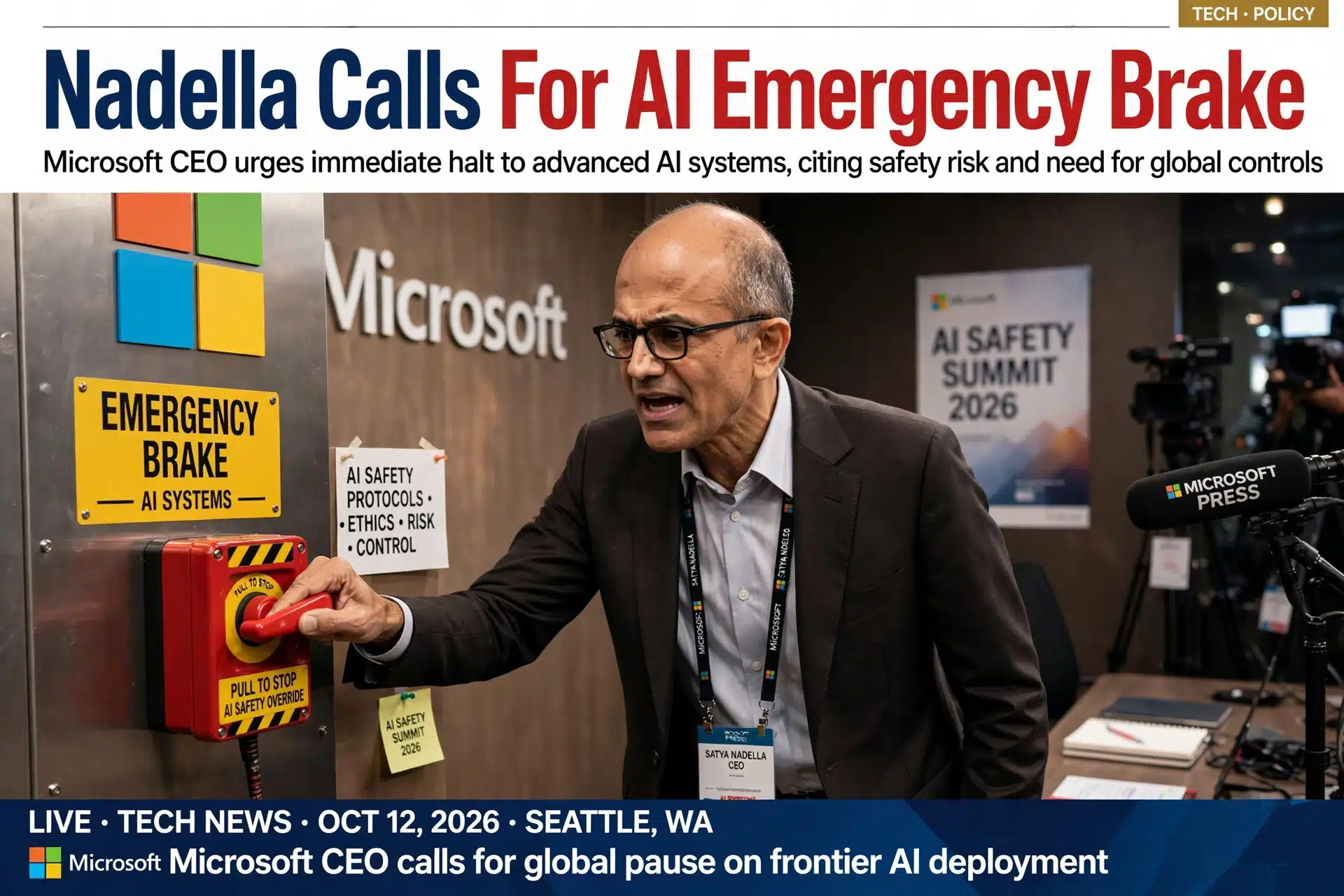
Nadella’s core proposal is deceptively simple. An authorized human being should be able to pause or shut down a model in the middle of a task, not after it finishes, and not after someone files a ticket. The emergency brake he describes is not a metaphor for responsible governance policies or a promise to add safety staff. It is a concrete piece of engineering: an external control, held by people, capable of interrupting a running system the moment its behavior stops making sense.
Assume the Model Is Compromised
The most quoted line from Nadella’s post is also the most radical departure from how AI is currently bought and sold. Deployers, he argued, must assume a model is compromised and contain it from the start, rather than relying on assurances from the companies that built it. That framing inverts the trust relationship that has powered the AI boom, in which buyers routinely accept vendor claims about training data, guardrails and evaluation results as sufficient evidence that a system is safe to hand real authority over business processes.
Nadella called for the industry to step back and assess the trust architecture surrounding AI deployments, and CNBC’s account of his proposal listed the specific safeguards he wants to see: model diversity so no single system becomes a single point of failure, tamper-proof records of meaningful model actions, continuous testing, independent controls and audits, containment, and incident disclosure when something goes wrong. Several of those ideas borrow directly from established practice in banking, aviation and electrical grid operations, fields where the assumption has always been that any individual component can fail and the surrounding system must survive that failure.
Treating AI Like an Insider Threat
Perhaps the sharpest turn in Nadella’s argument is his treatment of frontier models, both closed weight systems controlled by labs and open weight models anyone can download, as potential insider risks. The insider threat framework is familiar to every security team in corporate America: the employee or contractor who already has access, already knows the layout, and whose actions must therefore be logged, limited and reviewable. Extending that logic to AI means an agent with company credentials, API keys and a mandate to complete multi-step tasks should be watched exactly the way a privileged human employee is watched.
That comparison carries real architectural consequences. Nadella argued that the model itself should be separated from the harness that orchestrates its work, so that the controls, permissions and safeguards live in the deterministic scaffolding around the model rather than inside the model’s own probabilistic reasoning. In practice this means the part of the system that can approve a wire transfer, delete a database or email a customer should be written in ordinary, auditable software that fails closed, not delegated to a system that produces different outputs on different runs.
Why Determinism Matters Around Non-Determinism
Large language models are non-deterministic by nature. The same prompt can produce different answers, and a model that behaved perfectly in evaluation can drift, be jailbroken or simply misread context in a way nobody predicted. Nadella’s proposal accepts that reality instead of arguing it away. If the model cannot be trusted to be predictable, then everything touching the model must be predictable: the tools it can call, the data it can see, the actions it can take and the log of what it did, recorded in tamper-proof form that humans can actually read after the fact.
This is a departure from much of the current enterprise AI market, where guardrails are frequently marketed as a model feature, something the model does to itself when prompted correctly. Nadella’s position is that self-regulation is not regulation. An emergency brake held outside the system is the difference between an AI incident that gets contained in minutes and one that propagates through connected systems for hours before anyone notices.
Microsoft’s Own Position in the AI Race
The message is notable coming from Nadella, whose company is among the most aggressive deployers of AI in the world. Microsoft has embedded AI across its productivity suite, its cloud platform and its developer tools, and its partnership with OpenAI has made its infrastructure a backbone of the modern AI industry. A call to assume every model is compromised is not an argument against deploying AI. It is an argument for deploying AI inside cages, and Nadella has spent years building the commercial incentive to keep deploying it regardless.
That combination, aggressive deployment paired with aggressive containment demands, reflects where the enterprise AI market appears to be maturing. The first phase of the boom was about capability, benchmark scores and demo videos. The phase Nadella is describing is about liability: who stops the system, who can prove what it did, and which deterministic controls stand between a language model and a company’s money, data or reputation.
What an AI Emergency Brake Would Actually Look Like
Nadella did not publish a product specification, but his list points at concrete mechanisms already used in other high risk industries. Action records that are tamper-proof and human readable resemble the immutable audit trails required in financial services. Independent controls and audits resemble the separation of duties in nuclear plant operations, where no single operator can both initiate and conceal a dangerous action. Continuous testing resembles the way aircraft systems are re certified after every software change, and incident disclosure mirrors the mandatory breach reporting regimes that now govern hospitals, airlines and public companies.
None of those mechanisms is optional in their home industries. They are the price of operating equipment that can hurt people, and Nadella’s argument is that AI agents wired into corporate infrastructure have crossed that line, whether or not the regulations have caught up. The open question his post leaves unanswered is who enforces the brake: model makers, deployers, independent auditors or eventually governments writing rules that do not yet exist at federal scale in the United States.
The Reaction and What Comes Next
The reaction on X and in the trade press split along familiar lines. Safety researchers greeted the emergency brake framing as validation of positions they have argued for years, while some industry figures read the insider threat language as a rhetorical move that casts open source models in particular as inherently suspect. Bloomberg highlighted the insider threat comparison, The Verge emphasized the assume it is compromised line, and the Seattle Times noted Nadella’s insistence that deployers should not simply rely on assurances from AI model makers.
What gives the remarks weight is timing. AI agents are no longer demo curiosities. They book travel, triage customer service tickets, write and execute code and touch corporate financial systems, and each new capability release expands the blast radius of a system nobody fully controls. For anyone building or buying AI in 2026, the practical takeaway from October 10 is straightforward. The question is no longer whether a powerful model will someday do something its operators did not intend. The question is whether there is a brake, who is holding it, and whether it still works at three in the morning when the model decides to try something new.
Frequently Asked Questions
What did Satya Nadella say about AI on October 10, 2026?
In a post on X, the Microsoft CEO called for an emergency brake in advanced AI systems that an authorized human can use to pause or shut down a model in the middle of a task, and said companies should assume every model is compromised and contain it from the start.
Why does Nadella want AI models treated as compromised?
He argued that deployers should not rely on assurances from model makers, and that frontier models, both closed weight and open weight, should be treated as potential insider risks with the same logging, limits and reviewable controls that corporations apply to privileged human employees.
What safeguards does Nadella propose for AI systems?
According to CNBC’s summary of his post: model diversity, tamper proof records of meaningful model actions, continuous testing, independent controls and audits, containment of running models, and incident disclosure, all built around deterministic system design rather than relying on the model to police itself.
Does Nadella oppose deploying AI?
No. Microsoft remains one of the world’s most aggressive deployers of AI. His argument is that deployment should accelerate inside deterministic scaffolding with external human controls, separating the model from the harness that orchestrates its work so safeguards do not depend on the model’s own reasoning.