






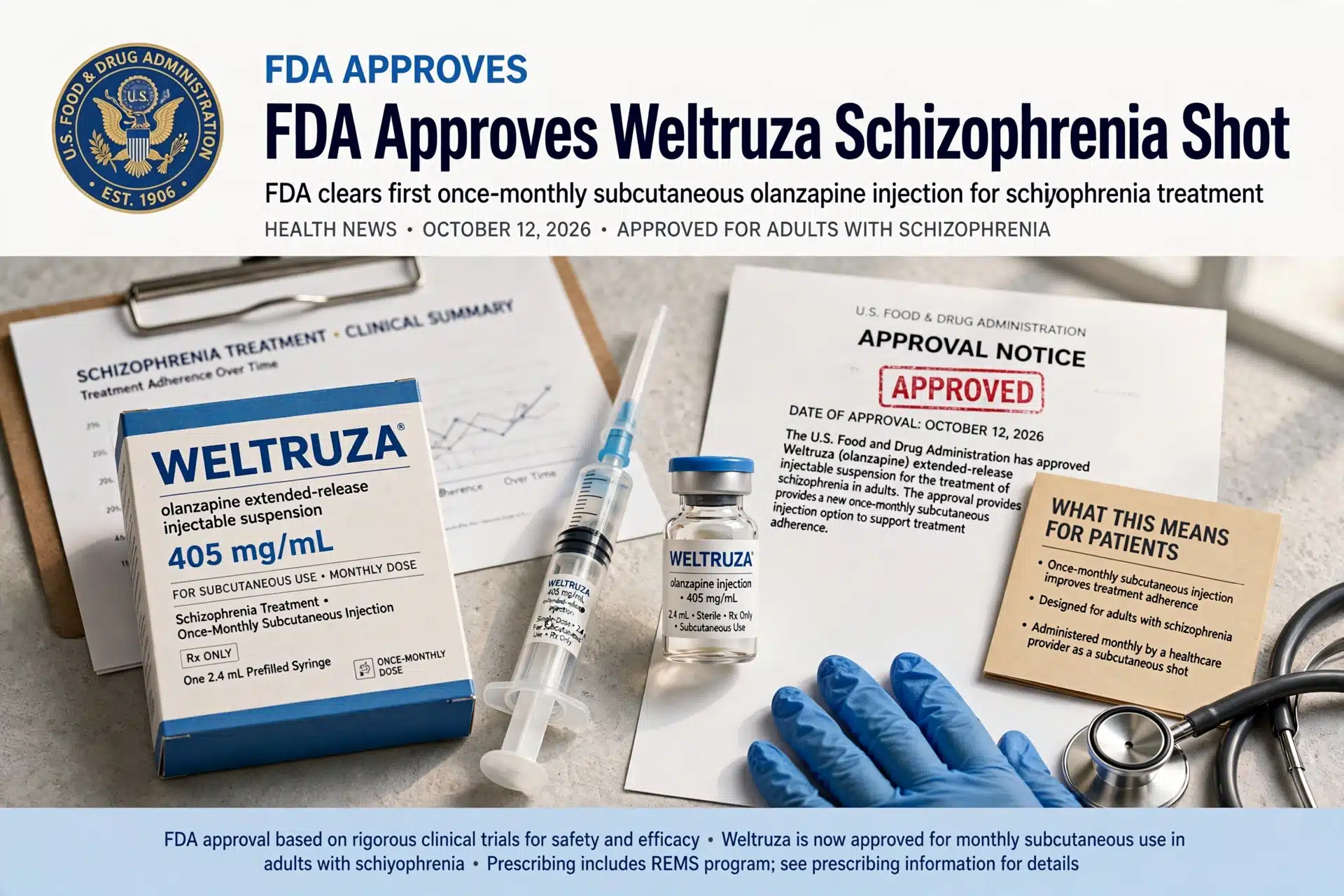
FDA Clears Weltruza, the First Once-Monthly Under-the-Skin Olanzapine Shot
The Food and Drug Administration approved Weltruza on October 9, a once-monthly subcutaneous injection of olanzapine for adults with schizophrenia, in a decision Teva Pharmaceuticals is calling the first and only approval of its kind. The new formulation compresses a daily antipsychotic pill into a monthly injection given just under the skin, and it arrives without the administrative baggage that has long made long-acting injectables inconvenient: no loading doses, no oral supplementation in the lead-up, and no post-injection monitoring requirement under the labeling described by the company.
Schizophrenia affects roughly one in 100 people worldwide, and one of the oldest and most stubborn problems in treating it is not which antipsychotic a doctor prescribes, but whether the patient keeps taking it. Daily oral regimens demand a level of routine that illness itself disrupts, and missed doses are a leading driver of relapse, hospitalization and recurrence of psychotic symptoms. Long-acting injectables were invented to solve exactly this problem, but earlier generations required burdensome initiation protocols that gave both patients and clinicians reasons to hesitate.
What the Approval Covers
Weltruza, known generically as olanzapine extended-release injectable suspension, is approved for adults with schizophrenia. Olanzapine itself is not new. It belongs to the atypical antipsychotic class and has been prescribed in oral form for more than two decades, giving psychiatrists extensive real-world experience with its efficacy and its risk profile, including metabolic side effects that require monitoring. What is new is the delivery system: a subcutaneous depot that releases the medicine steadily over a month, developed so that the injection can be given in a clinic or office setting rather than an infusion suite.
According to coverage of the approval, the injectable comes in three dose strengths, 318 mg, 425 mg and 531 mg, corresponding to daily oral olanzapine doses of 10 mg, 15 mg and 20 mg. That mapping matters clinically, because it means a psychiatrist can convert a patient stable on oral olanzapine to the monthly shot using familiar dose equivalents rather than starting the therapeutic relationship with a guess.
The Trial Behind the Approval
The FDA based its decision on the Phase 3 SOLARIS trial, reported to include 675 adults, which evaluated the injection’s ability to control schizophrenia symptoms. Reporting on the study results describes improvements across standard psychiatric measurement tools, including the Positive and Negative Syndrome Scale, or PANSS, which scores the hallmark symptoms of the illness, the Clinical Global Impression of Severity, which captures how ill a patient appears overall, and measures of personal and social functioning, which track whether a patient can hold a job, maintain relationships and live independently.
Improvement on functioning measures is the outcome that matters most to patients and families, because schizophrenia’s toll is measured less in clinic scorecards than in the ability to keep a life together between appointments. A monthly injection that keeps symptoms controlled for four weeks at a time changes the arithmetic of that daily struggle, replacing 30 chances to forget with one supervised event.
No Loading Dose, No Post-Injection Watch
Two details in the approval stand out to clinicians who work with long-acting antipsychotics. First, Teva says the dosing does not require loading doses, the intensive early schedule some injectables need before steady blood levels build up, nor oral supplementation during that lead-in period. Second, there is no post-injection monitoring requirement under the labeling described in the company’s announcement. Earlier injectable antipsychotics in some formulations required patients to be observed for hours after administration because of risks associated with the injection itself, a protocol that consumes clinic time and frightens patients.
Eliminating those steps is a deployment advantage as much as a medical one. Community mental health clinics, where a large share of patients with serious mental illness receive care, operate on thin staffing margins, and a dosing protocol that requires an observation period can quietly determine which therapies those clinics can afford to offer.
The Market Reacted Immediately
Markets moved on the news within hours. CNBC reported that Teva’s shares closed about 2 percent higher in Tel Aviv trading, while Medincell’s Paris-listed shares rose 16.9 percent. Teva has said a United States launch is expected in the coming weeks, meaning the medicine could reach prescriptions before the end of the year, subject to the usual questions about insurance coverage, formulary placement and prior authorization that accompany every new antipsychotic.
Pricing details were not outlined in the approval announcement itself, and that gap will likely determine as much about Weltruza’s real-world footprint as its clinical profile. Payers frequently require documentation that a patient struggles with oral adherence before approving an expensive injectable, a catch-22 that advocates for serious mental illness have criticized for years, since the nonadherence the policy demands proof of is often invisible until something goes wrong.
Why Monthly Under-the-Skin Matters
The distinction between subcutaneous and intramuscular delivery sounds like technical trivia, but it changes where and by whom treatment can be given. Intramuscular injections require trained staff and are typically administered in clinical settings. Subcutaneous injections use a smaller needle and shallower placement, expanding the range of settings and personnel who can administer them comfortably, a practical advantage for a medicine whose success depends on patients actually showing up for every dose.
Teva’s framing of Weltruza as first and only refers to the combination being a once-monthly subcutaneous olanzapine for schizophrenia. Other atypical antipsychotics already have long-acting injectable forms, so Weltruza’s competitive position rests on the specific pharmacology of olanzapine, a drug many patients already know works for them, delivered in the least intrusive format available.
What Doctors and Patients Should Watch Next
The approval settles the regulatory question but leaves the practical ones open. Psychiatrists will want to see the full SOLARIS data published and peer reviewed, including discontinuation rates and long-term metabolic monitoring outcomes in the injectable population. Patients and families will watch whether insurers treat the monthly shot as a premium product requiring jump-through-hoops prior authorization or as the adherence tool that hospitalization data suggests it is.
For now, the significance of October 9 is straightforward. A drug class that has existed for a generation just got easier to take, and for the substantial share of patients whose illness makes daily pills unreliable, ease of use is not a convenience. It is the treatment.
Frequently Asked Questions
What is Weltruza and what did the FDA approve?
Weltruza is the brand name for olanzapine extended-release injectable suspension, a once-monthly subcutaneous injection for adults with schizophrenia that the FDA approved on October 9, 2026, described by Teva as the first and only once-monthly under-the-skin olanzapine injection.
How is Weltruza different from oral olanzapine?
The medicine is the same atypical antipsychotic used in daily pills, but delivered as a monthly injection just under the skin. Teva says the dosing requires no loading doses, no oral supplementation beforehand and no post-injection monitoring, with dose strengths corresponding to 10 mg, 15 mg and 20 mg daily oral doses.
How effective was Weltruza in testing?
The approval was based on the Phase 3 SOLARIS trial, reported to include 675 adults, with results showing improvement versus placebo on standard measures including PANSS symptom scores, clinical severity ratings and personal and social functioning.
When will Weltruza be available in the United States?
Teva has said a U.S. launch is expected in the coming weeks following the October 9 approval, with insurance coverage and pricing details still to be determined.