





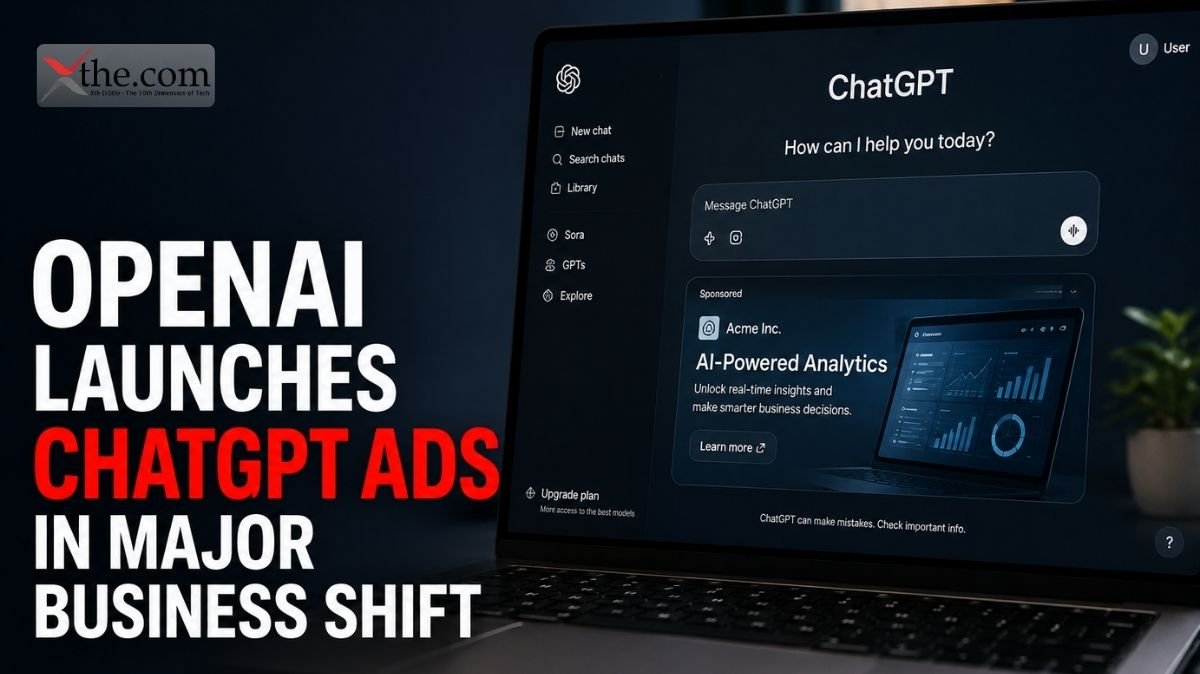
OpenAI has launched advertising within ChatGPT for the first time, marking a dramatic shift in the company’s business model and raising questions about the future of AI-powered search. The ad rollout, which began on August 22, 2026, places sponsored content alongside AI-generated answers in response to commercial queries like best laptops, cheapest flights, and best restaurants.
The move represents a fundamental change for OpenAI, which had long positioned ChatGPT as a premium subscription service free of advertising. CEO Sam Altman acknowledged the shift in a blog post, writing that advertising allows us to offer ChatGPT free to hundreds of millions of users who cannot afford the 0 monthly subscription while continuing to invest in cutting-edge research.
How the Ads Work
The advertising system works differently from traditional search engine ads. Instead of placing ads above organic results, ChatGPT integrates sponsored recommendations naturally into its conversational responses. When a user asks about products or services, ChatGPT may include a sponsored recommendation alongside its organic suggestions, clearly labeled with a small Sponsored tag.
For example, a user asking about the best budget smartphone might receive an AI-generated comparison of several devices, with one or two sponsored entries highlighted as Recommended by our partner. The ads are powered by a new AI system that matches commercial intent with relevant advertisers while maintaining the conversational quality users expect from ChatGPT.
Early advertisers include major brands across retail, travel, finance, and technology. Amazon, Booking.com, American Express, and Samsung are among the launch partners. Advertisers pay on a cost-per-click basis, with prices reportedly ranging from to 5 depending on the query’s commercial value.
Impact on Search Industry
The introduction of ads into ChatGPT has sent shockwaves through the search industry. Google, which derives approximately 57% of its revenue from search advertising, saw its stock drop 3.2% on the news. Analysts at Bank of America warned that ChatGPT’s conversational format could be more effective at driving commercial decisions than traditional search results, potentially siphoning ad revenue from Google over time.
However, other analysts argue the impact will be limited. Google processes approximately 8.5 billion searches per day, while ChatGPT handles roughly 200 million queries daily. Even with rapid growth, ChatGPT’s search volume remains a fraction of Google’s, making it unlikely to significantly impact Google’s advertising revenue in the near term.
The bigger threat may be to Google’s long-term search dominance. If ChatGPT continues to grow and its advertising proves effective, it could gradually capture an increasing share of commercial search queries, which are the most valuable for advertisers. Microsoft, which has invested 3 billion in OpenAI, could benefit from this shift through its integration of ChatGPT into Bing and Copilot.
User Reaction
User reaction has been mixed. Some users have expressed frustration at seeing ads in what they considered an ad-free experience. Social media posts frequently used terms like betrayal and enshittification to describe the change. The hashtag ChatGPTAds trended on X (formerly Twitter) for several hours after the announcement.
Others have been more accepting, noting that the free tier of ChatGPT has always been subsidized by paying subscribers and that advertising is a natural evolution. Some users have even reported finding the sponsored recommendations useful, particularly for product comparisons and shopping queries where commercial results are expected.
OpenAI has tried to address concerns by committing to several principles. Ads will never appear in responses to medical, legal, or financial questions. The Sponsored label will always be clearly visible. Users can disable personalized ads in their settings. And the free tier will remain available without a subscription.
Privacy Implications
The advertising launch has also raised privacy concerns. For targeted ads to work effectively, ChatGPT needs to analyze user conversations for commercial intent. While OpenAI says it does not use conversation data to train its advertising algorithms, the mere capability to do so has alarmed privacy advocates.
The Electronic Frontier Foundation (EFF) issued a statement warning that the introduction of advertising creates powerful incentives to collect and analyze user behavior in ways that may not be obvious to users. The EFF called for greater transparency about what data is used for ad targeting and how long it is retained.
European regulators are also watching closely. Under the EU’s Digital Services Act, OpenAI may be required to provide more detailed disclosures about how its advertising system works and give users more control over ad personalization. The company has indicated it will comply with all applicable regulations but has not specified what additional measures it may take for European users.
Financial Impact
The advertising launch is expected to significantly boost OpenAI’s revenue. The company generated approximately 2 billion in annualized revenue from subscriptions and API access in the first half of 2026. Analysts at UBS estimate that advertising could add -5 billion in annual revenue within the first year, with potential for much more as the user base grows.
The additional revenue will be critical as OpenAI faces rising costs from model training and inference. The company’s compute costs have reportedly exceeded billion annually, and the development of next-generation models like GPT-6 will require even more investment. Advertising revenue could help OpenAI maintain its aggressive research spending without further increasing subscription prices or diluting equity through additional fundraising rounds.
The move also signals a broader trend in the AI industry. As AI chatbots become primary interfaces for information and commerce, advertising is likely to become an increasingly important revenue stream for AI companies. Anthropic, Google, and Meta are all reportedly developing similar advertising capabilities for their AI assistants, suggesting that the era of ad-free AI may be shorter than many hoped. The advertising landscape in AI is evolving rapidly. Meta has announced that its AI assistant, powered by the Llama model, will begin testing sponsored content in late 2026. Google is reportedly developing ad capabilities for Gemini that would integrate product recommendations directly into AI-generated search summaries. Amazon’s Alexa Plus already includes product placement in its conversational responses.
For consumers, the key question is whether AI advertising will be more or less intrusive than traditional digital advertising. Proponents argue that well-targeted AI ads could actually be more helpful than the banner ads and pop-ups they replace, providing relevant recommendations at the exact moment of purchase intent. Critics worry that the intimacy of conversational AI makes advertising feel more manipulative, as users may not always distinguish between organic AI recommendations and paid placements.
The Federal Trade Commission (FTC) has signaled it will scrutinize AI advertising practices. Chair Lina Khan said the agency will ensure that AI companies do not deceive consumers about the nature of sponsored content in conversational interfaces. The FTC has already issued guidance requiring clear and conspicuous disclosure of sponsored content, and enforcement actions against AI companies that violate these standards are expected in the coming months.
Sources:
https://techcrunch.com/
https://www.reuters.com/technology/
https://www.theverge.com/