






The stunning declaration has sent diplomatic shockwaves around the world and raised serious questions about international law and American foreign policy.
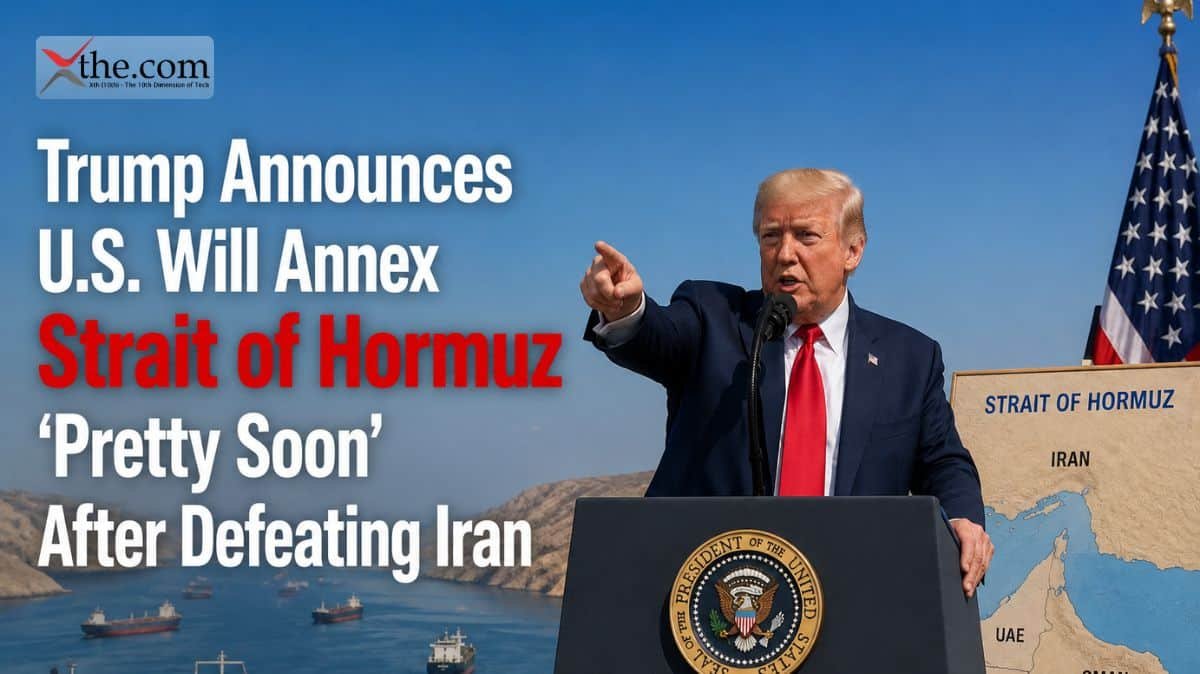
President Donald Trump has announced that the United States will annex the Strait of Hormuz ‘pretty soon’ after defeating the Iranian regime in the ongoing war. The declaration, made on August 14, 2026, is one of the most provocative statements of the conflict and has triggered immediate condemnation from allies, adversaries, and legal scholars alike.
The Strait of Hormuz is one of the most strategically vital waterways on Earth. Approximately one-fifth of global oil shipments pass through the narrow channel, making it a chokepoint for the world economy. For decades, it has been governed by international maritime law, with Oman and Iran controlling the respective coastlines.
“We Are Going to Take It”
Trump’s announcement came during a press availability at the White House, where he framed the annexation as both a strategic necessity and a reward for American military sacrifice.
“We are going to take it,” Trump said. “It is vital to American interests. We have spent billions and lost brave soldiers to keep that strait open. Pretty soon, it will be U.S. territory.”
The president did not elaborate on how the annexation would be carried out, what legal mechanism would be used, or how the United States would address the sovereignty claims of Oman and Iran. The statement appeared to be improvised rather than the product of policy deliberation — a pattern that has defined much of Trump’s wartime rhetoric.
International Condemnation
Reactions were swift and overwhelmingly negative. The United Nations issued a statement reminding the United States that the annexation of territory by force is prohibited under the UN Charter. NATO allies expressed alarm, with several European diplomats privately calling the statement ‘unhinged’ and ‘legally indefensible.’
Oman, which controls the southern coast of the strait and has historically maintained friendly relations with Washington, summoned the U.S. ambassador for an urgent meeting. Omani state media called the announcement ‘a grave violation of international norms and Omani sovereignty.’
“This is not how allies behave,” said Omani Foreign Minister Badr al-Busaidi. “The United States has bases in our country. We have hosted their ships for decades. And now they threaten to take our coastline? This is a betrayal.”
Legal and Strategic Problems
Constitutional scholars say a unilateral annexation by the president would face immediate legal challenges. Under the U.S. Constitution, the acquisition of new territory requires congressional approval — something Trump is unlikely to secure, particularly with Democrats controlling enough Senate seats to filibuster.
Strategically, the announcement undermines the very justification for the Iran war. The U.S. has repeatedly claimed its military action was aimed at restoring freedom of navigation and protecting global energy markets — not territorial expansion. By declaring his intention to annex the strait, Trump has handed Tehran a propaganda victory, allowing Iran to frame the conflict as American imperialism.
“He just proved every conspiracy theory Tehran has ever pushed,” said Dr. Vali Nasr, a Middle East expert at Johns Hopkins University. “The Iranians can now tell the world: we told you so. This was never about nuclear weapons or terrorism. It was about America stealing our land.”
What Happens Now
The Pentagon has not commented on the annexation statement, and the State Department has been conspicuously silent. Congressional Democrats have called for hearings, while some Republicans have quietly distanced themselves from the president’s remarks.
For now, the Strait of Hormuz remains international waters, patrolled by a U.S. naval blockade that has choked off Iranian shipping. But Trump’s words have changed the conversation. What began as a conflict over nuclear enrichment and regional influence has now become something far more dangerous — a war with territorial ambitions that echo the imperial conquests of centuries past.
And as the world watches in disbelief, one question hangs in the air: if the Strait of Hormuz can be annexed, what is next?








