






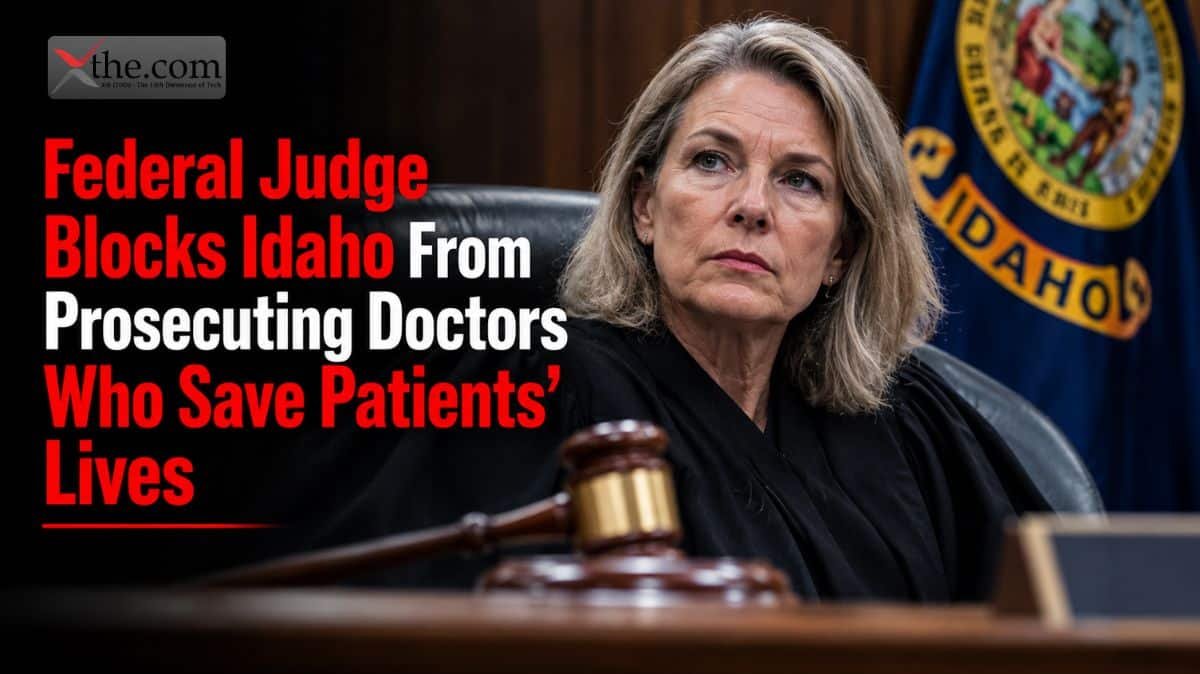
“A pregnant woman’s health is not a state resource to be allocated at the legislature’s whim,” the judge wrote in a blistering ruling.
A federal judge has ruled that Idaho must allow abortions when a pregnant person’s health and life are at risk, blocking state officials from prosecuting physicians who perform the procedure under those circumstances. U.S. District Judge B. Lynn Winmill declared Idaho’s near-total abortion ban unconstitutional, saying it violates the due process and equal protection clauses of the 14th Amendment. The ruling is a major victory for reproductive rights advocates and a sharp rebuke to one of the nation’s most restrictive abortion laws.
“It Is About Self-Preservation”
In his opinion, Judge Winmill did not mince words. He wrote that Idaho’s ban — which threatened physicians with up to five years in prison for performing abortions — placed an unconstitutional burden on pregnant patients and the doctors who treat them.
“It is about self-preservation and the limit of the state’s power to make a woman suffer for the sake of an unborn child,” Winmill wrote. “A pregnant woman’s health is not a state resource to be allocated at the legislature’s whim.”
The ruling centers on the so-called ‘health exception’ — a narrow window in Idaho’s law that technically allows abortions to save the mother’s life but makes no provision for serious health complications that fall short of immediate death. Doctors have testified that the distinction is medically absurd, forcing them to wait until patients are on the brink of death before intervening.
Doctors Were Living in Fear
Since Idaho enacted its trigger ban after the Supreme Court overturned Roe v. Wade in 2022, physicians in the state have described a climate of fear. Emergency room doctors faced impossible choices: provide standard care and risk felony prosecution, or delay treatment and watch patients suffer.
“I’ve had colleagues leave the state. I’ve had colleagues refuse to take call in the ER because they were terrified,” said Dr. Emily Corrigan, an obstetrician-gynecologist who practices in Boise. “This ruling doesn’t just protect doctors — it protects every woman in Idaho who might need emergency care.”
The case before Judge Winmill was brought by a coalition of Idaho physicians and the Planned Parenthood organization, who argued that the ban’s narrow health exception was unworkable and dangerous. The plaintiffs presented testimony from multiple doctors who described cases where they had to transfer patients out of state because Idaho’s law made it impossible to treat them safely.
State Officials Vow to Appeal
Idaho Attorney General Raúl Labrador announced within hours of the ruling that the state would appeal to the Ninth Circuit Court of Appeals. In a statement, Labrador called the decision ‘judicial overreach’ and insisted that Idaho’s law ‘protects both mothers and unborn children.’
But legal experts say Winmill’s ruling is grounded in well-established constitutional principles. The 14th Amendment’s due process clause has long been interpreted to protect individuals from state actions that deprive them of life or liberty without adequate justification. By forcing women to risk their health — and potentially their lives — to carry pregnancies to term, Idaho’s law crossed that line.
“This is not activism — this is basic constitutional law,” said Professor Mary Ziegler, a legal historian at UC Davis who has written extensively on abortion rights. “Judge Winmill applied the same standard the Supreme Court has used for decades. The only thing that changed is the political climate.”
A National Ripple Effect
The ruling could have implications far beyond Idaho. At least 13 states have enacted near-total abortion bans with similarly narrow health exceptions, and reproductive rights groups are already preparing lawsuits modeled on the Idaho case. If Winmill’s reasoning holds up on appeal, it could force multiple states to rewrite their laws.
For now, Idaho physicians can breathe easier. The threat of prison has been lifted — at least temporarily — and doctors say they can finally practice medicine without looking over their shoulders.
“Today, I can do my job,” Dr. Corrigan said. “Tomorrow, we’ll see what the appeal brings. But for now, this is a win for medicine, for women, and for basic human decency.”








