






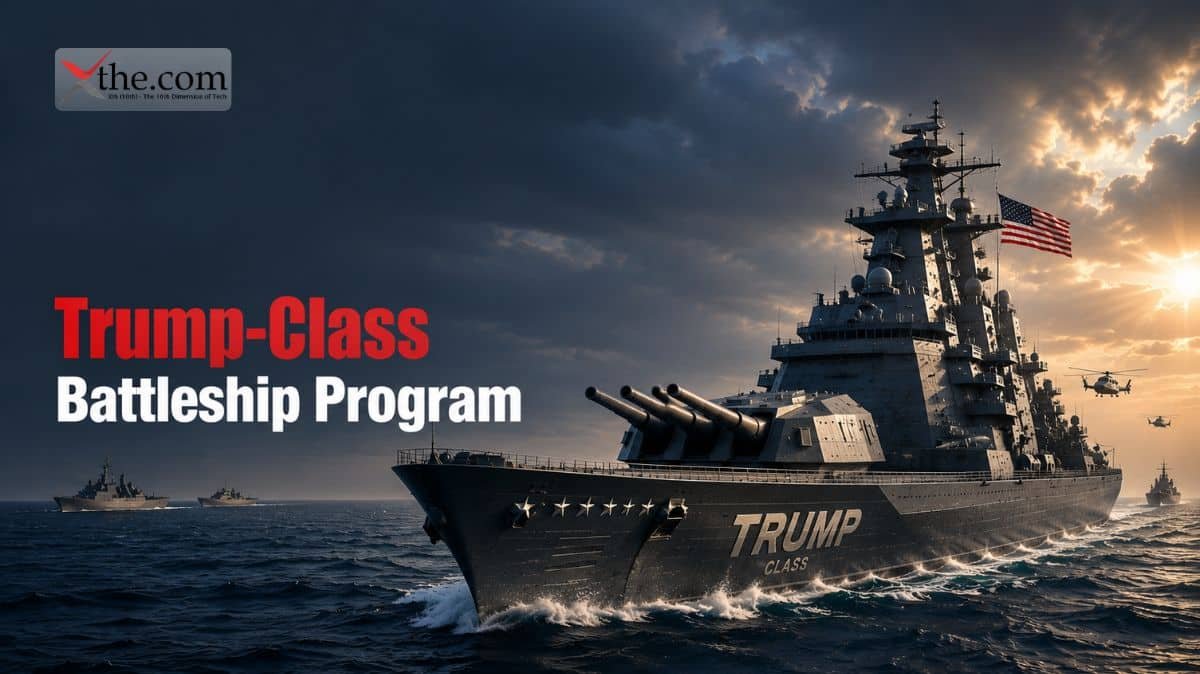
The $275 Billion Price Tag
The Congressional Budget Office (CBO) dropped a bombshell on August 5, 2026, publishing a report that estimates the U.S. Navy’s next-generation Trump-class battleship program will cost an eye-watering $275 billion over its lifetime. The first vessel alone — designated USS Defiant (BBG-1) — is projected to cost approximately $23.4 billion, making it the most expensive surface combatant ever constructed by the United States.
To put that figure into perspective, the USS Gerald R. Ford, currently the most expensive U.S. warship ever built, cost approximately $13.3 billion. The lead Trump-class battleship would cost nearly 76% more than an aircraft carrier. The subsequent 14 ships in the planned 15-vessel fleet would average $18 billion each, according to the CBO analysis.
The Navy’s own projections have been a moving target. Initial Navy estimates placed the lead ship at roughly $17.6 billion, but inflation in the shipbuilding sector, labor shortages, and the complexity of integrating nuclear propulsion with directed-energy weapons have driven costs upward by approximately $6 billion in just over a year.
Budget Breakdown Table:
Table
| Cost Component | Amount |
| Lead Ship (USS Defiant) | $23.4 billion |
| Subsequent Ships (avg) | $18 billion each |
| Total Program (15 ships) | $275 billion |
| FY2027 Advance Procurement | $1 billion |
| FY2028 Net Procurement | $16.47 billion |
| First 3 Ships (through FY2031) | $43.5 billion |
The CBO report notes that to keep pace with the Navy’s ambitious shipbuilding plan, American shipyards would need to produce a battleship approximately every other year from 2028 to 2056, while simultaneously continuing to build two Arleigh Burke-class destroyers per year.
What Makes the Trump-Class Battleship Different
The Trump-class battleship, designated BBG(X), represents the most radical departure in U.S. naval design philosophy since World War II. President Trump personally unveiled the concept on December 22, 2025, describing it as “100 times more powerful than previous battleships” and the cornerstone of his “Golden Fleet” vision.
Unlike traditional aircraft carriers that rely on air wings for power projection, the Trump-class is designed as a multi-domain command-and-control platform capable of independent operations. At 35,000 to 41,000 tons displacement, it would be more than three and a half times the size of an Arleigh Burke-class destroyer and more than twice the size of the Zumwalt-class.
The ship’s nuclear propulsion — using the A1B reactor currently deployed on Ford-class carriers — eliminates the need for refueling, dramatically extending operational range and reducing long-term logistics costs. However, this also means the vessel will be subject to the same complex maintenance cycles that have plagued carrier availability rates.
Specifications and Capabilities
The Trump-class battleship is designed to carry an unprecedented array of weapons systems:
Missile Systems:
- 128-200 cells Mk 41 Vertical Launching System (VLS)
- 12 cells for Conventional Prompt Strike (CPS) hypersonic missiles
- Surface Launch Cruise Missile Nuclear (SLCM-N) capability
- 2 × RIM-116 Rolling Airframe Missile close-in weapon systems
Directed-Energy and Kinetic Weapons:
- 1 × 32 MJ electromagnetic railgun (potentially)
- 2 × Mk45 5″/62-caliber naval guns
- 4 × Mk38 30 mm autocannons
- High-output laser systems for missile defense
Aviation and Command:
- Flight deck capable of fielding V-22 Ospreys and Future Vertical Lift helicopters
- Two hangars for rotary-wing aircraft
- Fleet command staff facilities for enhanced survivability
- AN/SPY-6 air-search radar
The CBO report emphasizes that if built to these specifications, the Trump-class would be “the largest surface combatant in the world and larger than any surface combatant built for the Navy since World War II.”
Shipbuilding Timeline and Challenges
The Navy projects construction of the first Trump-class battleship to begin in August 2028, with delivery to the fleet scheduled for August 2036 — an eight-year construction timeline. The second and third vessels would follow in 2038 and 2039 respectively.
However, defense analysts and the Government Accountability Office (GAO) have raised serious concerns about whether U.S. shipyards can meet this timeline. A March 2026 GAO report documented nearly two decades of lackluster progress in American shipbuilding, finding that newly constructed ships are frequently delivered up to three years late and often fail to function as expected.
Shelby S. Oakley, a GAO director, testified before the Senate Armed Services Committee that unrealistic cost and timing expectations have forced Navy programs and shipbuilders to operate in a “perpetual state of triage.”
The labor shortage presents another critical bottleneck. Building a 35,000-ton nuclear battleship requires thousands of experienced shipyard workers at a time when the industry is already struggling to staff existing programs. Shipyards are bidding against each other for skilled welders, nuclear engineers, and systems integrators, driving labor costs higher.
Congressional Reaction and Political Risks
The Trump-class program faces significant political headwinds. On June 4, 2026, the House Armed Services Committee voted to require the Secretary of the Navy to submit a detailed acquisition report by March 2027, including mitigation plans for impacts on Ford-class carrier construction. Minority members unsuccessfully attempted to cut $1 billion from advance procurement funding.
Defense experts at the Center for Strategic and International Studies (CSIS) have argued that the battleship program is so closely tied to President Trump personally that it represents a major political risk. “A future administration will cancel the program before the first ship hits the water,” predicted CSIS analyst Mark Cancian, noting that the ship’s extraordinary characteristics make it a prime target for budget cuts if political winds shift.
The program is also vulnerable to the November 2026 midterm elections. If Republicans lose control of the House, the Trump-class battleship — as one of the most expensive and controversial defense initiatives — would likely face aggressive scrutiny from Democratic oversight committees.
Strategic Implications for US Naval Dominance
Naval strategists suggest the Trump-class program is a direct response to China’s rapidly expanding blue-water navy, which now operates more than 370 vessels compared to the U.S. Navy’s roughly 290. The battleships are intended to serve as the centerpiece of future carrier strike groups, providing layered missile defense and long-range strike capabilities that current Arleigh Burke-class destroyers cannot match.
The shift toward larger, more heavily armed surface combatants also reflects a doctrinal evolution. Rather than distributing firepower across numerous smaller vessels — the philosophy behind the Littoral Combat Ship program — the Navy is now betting on concentrated, high-endurance platforms capable of surviving in contested waters against advanced anti-ship missile systems.
However, critics argue that concentrating so much capability in a single platform creates a “too big to lose” vulnerability. A $23 billion battleship represents an irresistible target for adversaries, and its loss would be both a strategic catastrophe and a political disaster.
Comparison with Existing Warships
Table
| Specification | Trump-Class | USS Gerald R. Ford | Arleigh Burke Flight III | Zumwalt-Class |
| Displacement | 35,000-41,000 tons | ~100,000 tons | ~9,700 tons | ~15,000 tons |
| Cost (Lead Ship) | $23.4 billion | $13.3 billion | ~$2.8 billion | ~$7.5 billion |
| Propulsion | Nuclear (A1B) | Nuclear (A1B) | Gas Turbine | Gas Turbine |
| Crew | 650-800 | ~4,500 | ~300 | ~140 |
| VLS Cells | 128-200 | N/A | 96 | 80 |
| Railgun | Potentially | No | No | Cancelled |
| Hypersonic Missiles | Yes (CPS) | No | Limited | No |
Frequently Asked Questions
1Q: When will the first Trump-class battleship be operational?
A: The Navy projects initial operational capability for the lead ship, USS Defiant, in 2036, assuming construction begins on schedule in 2028.
2Q: How does the $23.4 billion cost compare to other warships?
A: It is 76% more expensive than the USS Gerald R. Ford aircraft carrier ($13.3 billion) and approximately 8 times the cost of an Arleigh Burke-class destroyer.
3Q: What is the “Golden Fleet” concept?
A: The Golden Fleet is President Trump’s vision for a modernized U.S. Navy centered around large, heavily armed surface combatants, including the Trump-class battleship and an expanded carrier force.
4Q: Could the program be cancelled?
A: Yes. Defense analysts consider the program highly vulnerable to cancellation if a different administration takes office in 2028 or if Congressional funding priorities shift after the 2026 midterms.
External Sources:
- Congressional Budget Office: The Navy’s New Battleship Program: Costs and Implications for the Shipbuilding Industrial Base
- CSIS Analysis: The Golden Fleet’s Battleship Will Never Sail
- USNI News: Navy Removes Head of Drone Programs After 8 Months, PAE Maritime Head Miller Now Leading PAE RAS
- Wikipedia: Trump-class battleship








