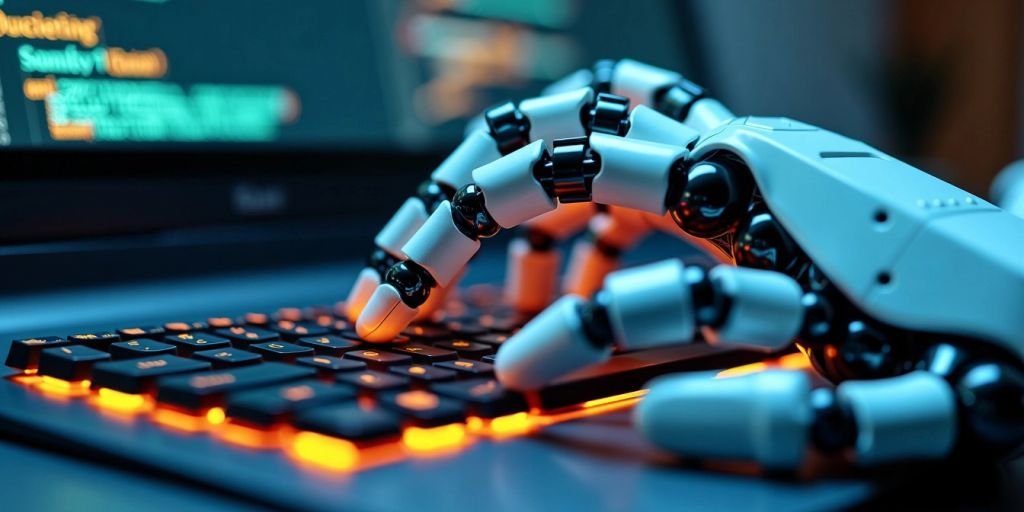
Austin, Texas: There is an ongoing revolution in the realm of automation, one that will redefine how robots perceive their environment. Robot learning AI is becoming increasingly popular as a replacement for conventional programming, marking a departure from hard-coded instructions towards adaptive learning behaviors. In the past, industrial machines followed fixed procedures programmed into them. However, as the operating environment becomes more dynamic, such methods become increasingly impractical. This is where AI-driven robot learning is stepping in, enabling machines to learn in ways similar to humans.
What’s New About Robotics?
The conventional approach to building robots involved extensive programming. The engineers would design every possible outcome, often resulting in inefficient robots when confronted with an unfamiliar setting. However, as robots become more intelligent, their programming methods will evolve as well. Instead of relying on predefined rules and procedures, AI robotic training will involve learning through trial and error.
Some of the most important factors facilitating this paradigm shift include:
- Learning skills by watching human behavior
- Reducing reliance on explicit programming protocols
- Adjusting to unforeseen circumstances
Such advances have been fueled by companies such as Figure AI.
Why Coding Doesn’t Work on a Larger Scale
The inadequacies of conventional coding quickly become apparent in practical situations. Warehouses, manufacturing facilities, and logistics centers feature an array of variables, including constantly changing layouts, unforeseen obstructions, and human interactions.
Manual coding for all of these cases is not only impractical but also outright unfeasible. Enter AI in industrial robotics. With learning systems, there is no need to code solutions for every case, as they can generalize across different conditions.
No more coding solutions through millions of lines of code. But rather, training the robot using datasets and practical experience.
Vision-Language-Action Model’s Role
At the heart of this evolution lies VLA models, also known as Vision-Language-Action. They unite perception, inference, and actuation into a single solution.
Robots are capable of:
- Perceiving the surroundings
- Interpreting human commands in natural language
- Converting that information into an action
Put simply, a robot stops following orders and starts comprehending context.
Why does this make AI robotics training unique? The robot no longer needs to be programmed to perform tasks; it can be trained through demonstration or command.
Deployment Trends Shaping the Future
The shift from programming to training is not a vision for the future but something happening now.
Main deployment trends are:
- Manufacturing sector – adaptive manufacturing assembly line solutions
- Logistics sector – automated warehouses management systems
- Retail sector – automated fulfillment centers
Each of these industries is gaining flexible, scalable, and cost-effective automation solutions. With the upcoming spike in 2026, it is clear that the shift has become a reality.
Why It Matters for the US
The effects on American business are both immediate and profound.
1. Speedier Automation Implementation
Artificial intelligence decreases training periods, enabling businesses to implement robotic technology faster than ever before.
2. Reduced Engineering Expenses
By minimizing the need for manual coding, companies save money on engineering staff and research and development.
In tandem, these benefits are opening the door to automation not only for big business but also for medium-sized enterprises.
What to do in the next seven days
In the context of business and engineering, this evolution requires urgent consideration.
Practical steps:
- Assess the potential of AI-based platforms for robot learning.
- Implement pilot trials for AI robotics training.
- Examine scalability in practical settings.
Early experimentation is essential for staying ahead of the game.
Conclusion
Robot learning AI represents a major milestone in the history of automation. In an era where programming becomes outdated, training models are becoming more efficient, intelligent, and scalable. Thanks to innovations spearheaded by startups like Figure AI, the future is clear: robotics is evolving from code-based programming to machine learning.
Source- Figure