






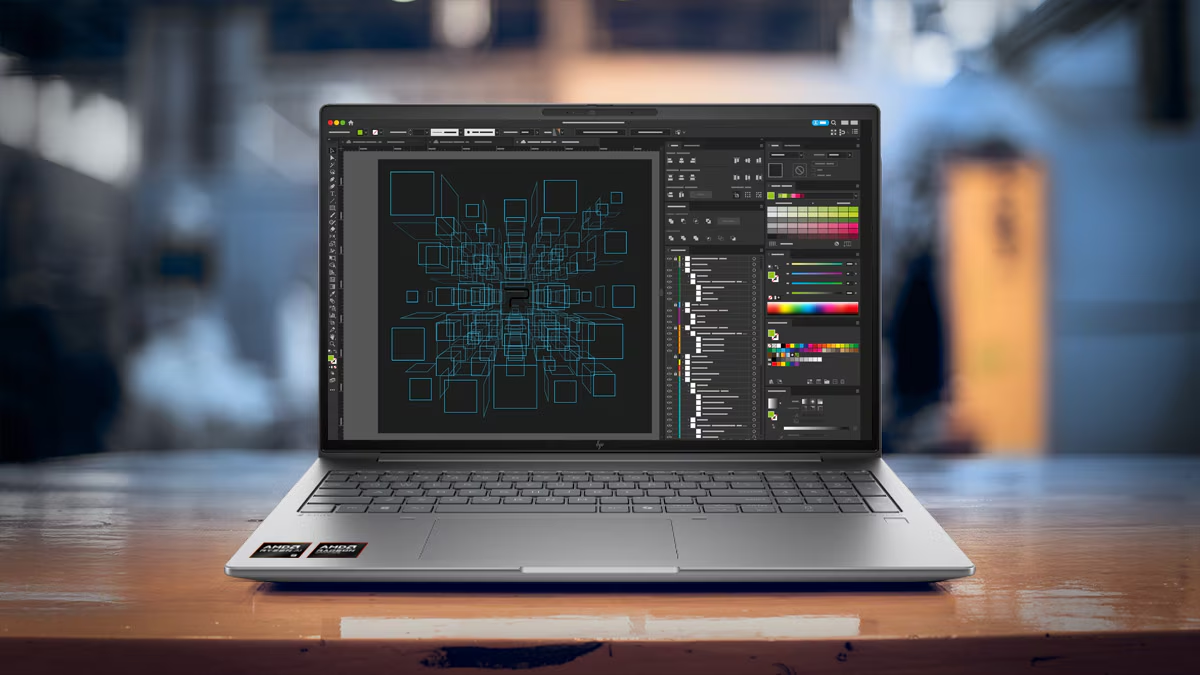
Santa Clara, Calif.: A 3D rendering project can quickly use more than 64 GB of geometry and textures, which demands a lot of computing power and special hardware. In the past, artists and engineers had to rely on large, power-hungry desktop computers and complicated server setups. With Ryzen AI Max+ | unified memory, this has changed. Professionals no longer need large desktop towers to process large simulation datasets or run complex local AI models. Now, they can manage heavy workloads while traveling or working remotely without losing data quality or speed.
When moving away from traditional desktops, the performance difference between AMD Ryzen AI Max+ and dedicated mobile GPUs is small for many professional tasks. The system combines the memory controller with built-in graphics, enabling it to use a large amount of system RAM as fast VRAM. This lets users load deep learning models with hundreds of billions of parameters directly into the graphics system, avoiding delays caused by external processing or network issues.
Redefining The Compute Paradigm
Enterprise technology buyers are always looking to reduce power consumption without sacrificing performance or efficiency. The newest AMD Strix Halo hardware meets this need by combining many processing cores with a cutting-edge neural engine. The NPU 60 TOPS architecture provides sufficient computing power for local AI tasks and background analytics without placing additional load on the CPU or graphics cores.
Moving to a true mobile workstation requires bringing everything together in a single design. Instead of using separate graphics cards that consume a lot of power and require large cooling systems, a single, efficient system-on-chip now handles graphics, computing, and AI tasks in a compact 55-watt power unit. For corporate buyers, this efficiency remains a key reason to update their hardware.
Enterprise Adoption and Hardware Allocation
Changing hardware needs are changing the way corporate IT departments buy equipment. Engineers are now testing whether a single device can replace several specialized machines. Early tests show that the new design handles complex CAD rendering and video editing very well, exceeding what most expect from thin-and-light devices.
The OEM strategy shows how market demand is changing. Major laptop makers are now offering thinner, lighter devices with up to 128 GB of memory. With these high-memory options, companies can run large language models or split data across devices without exceeding memory limits.
The Technical Reality Of Integrated Graphics
Although the processor can now handle many desktop tasks, graphics-intensive rendering still requires careful attention to memory bandwidth and raw processing power. The built-in Radeon 890M graphics offers strong performance for modern-day ray tracing and fast viewport work. It supports high-definition displays and multiple monitors with minimal latency. The Radeon 890M also keeps complex visualization software running smoothly during live editing and real-time model modeling.
Even with these advances, dedicated graphics cards remain better for some engineering tasks that require a lot of local cache and high rasterization performance. However, the Ryzen AI Max Plus | Unified Memory platform reduces this difference by maintaining fast data access. Since the CPU and GPU use the same memory, the system avoids PCI Express bandwidth limits.
Equalizing Power And Capability
Today, choosing hardware for corporate use is centered on balancing power efficiency and performance. A mobile workstation with this platform uses less than one-fifth the power of a regular desktop for the same tasks. This means less need for cooling and less heat in the office.
The NPU 60 TOPS processor handles low-level security and background tasks. This leaves the main cores free for heavy work, so engineers can run simulations in the background while joining video calls or compiling code.
Future Horizons for Professional Computing
The development of these processing platforms constitutes a lasting change in how companies set up their IT systems. New versions of AMD Strix Halo will likely offer more, even more memory capacity and processing power, making traditional desktop towers less necessary. Companies that focus on integrated efficiency will quickly see lower costs and more flexible deployment.
The third version of the Ryzen AI Max Plus | unified memory framework indicates that processing density is now more important than the size of individual COAs. Software improves. Demand for separate add-on cards will decrease, and large desktop setups will become a thing of the past.
Source: AMD Newsroom








