






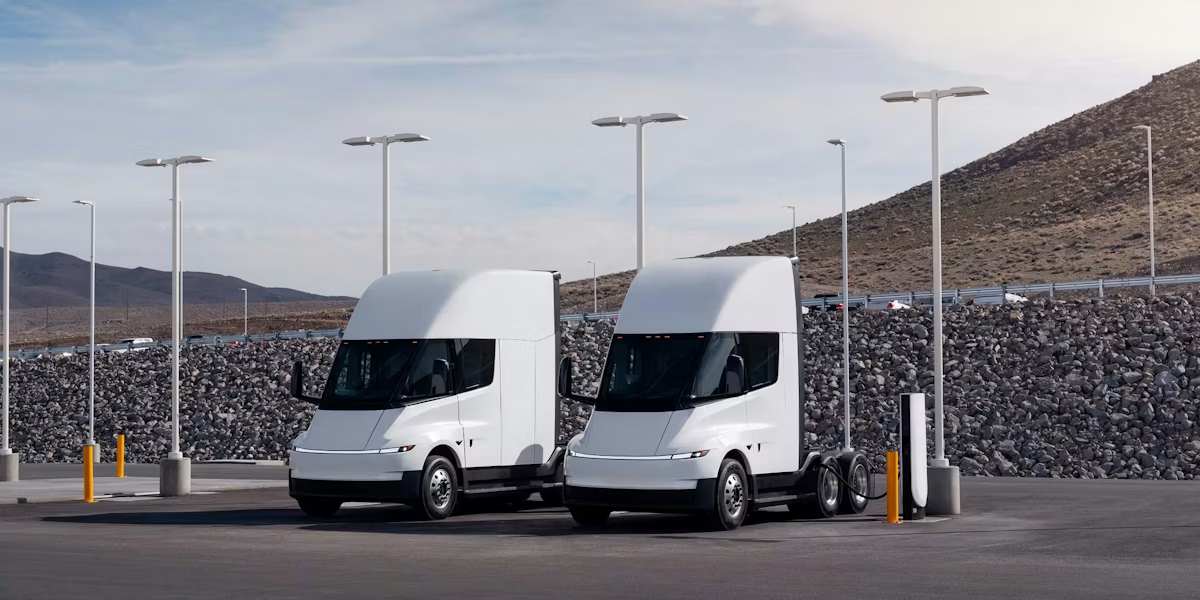
Austin, Texas: Margins in freight can disappear quickly. For example, a fleet operator with 200 Class 8 trucks might see fuel price swings change annual costs by millions. This is why many are looking at Tesla’s basecharger infrastructure, which is closely tied to semi manufacturing as a financial plan rather than just a sustainability move.
The main question is no longer if electrification works. Now it’s about whether the financial numbers finally make sense.
The Economics Behind the Tesla Basecharger Model
The primary challenge in heavy-duty electric truck fabrication has always been infrastructure costs, depending on how much the system is used. Traditional high-output systems like the Mega Charger work great for quick charging, but they require major grid upgrades and high upfront costs. This meant that any fleet electrification only made sense for routes with heavy use.
The Tesla basecharger takes a different approach. Most fleets do not run at full capacity all day, every day. Instead of focusing on fast charging, Tesla seems to be aiming for the lowest cost per kilowatt-hour delivered.
This shift matters in a typical depot charging scenario. Trucks return to base overnight. Charging windows stretch across 6 to 10 hours. The need for ultra-fast charging diminishes, whereas infrastructure optimization becomes the dominant variable in logistics CapEx.
Here’s a simple example. Imagine a region fleet with 50 electric trucks using Megachargers. Each truck requires a robust grid connection and cooling, which increases upfront costs. With the Tesla basecharger, slower but steady charging, lower installation complexity, and dynamic charging, the cost structure changes.
Reframing ROI Through Infrastructure Design
The real disruption lies in how ROI is calculated. Historically, commercial EV adoption hinged on fuel savings offsetting vehicle premiums. Infrastructure was treated as a sunk cost. That assumption no longer holds. New land with Tesla-based charging infrastructure becomes a strategic asset rather than a limitation. Lower installation costs and modular design let operators invest gradually as their fleets grow. This lowers financial risks and improves returns.
A comparative cost analysis of Tesla base chargers versus megachargers for fleet operations clearly highlights this shift. While mega charger systems deliver higher throughput, their cost per installed megawatt often exceeds what mid-sized fleets can justify. Tesla base chargers, in contrast, lower the entry barrier, enabling greater participation in fleet electrification without excessively committing capital.
High-speed charging still has its place. Long-haul routes will continue to need mega-charger networks, but for depot-based operations, a slower, more spread-out charging model now makes better financial sense.
The Role of Semi-Manufacturing in Cost Alignment
Infrastructure by itself does not change ROI. Vehicle production must match it. Tesla’s approach to semi manufacturing focuses on vertical integration to lower both vehicle costs and operational obstacles.
Standardizing battery packs, simplifying power electronics, and making charging compatible all help reduce system complexity. This is important because fleet operators look at the whole ecosystem, vehicles, chargers, maintenance, and software, not just the trucks alone.
When semi manufacturing works smoothly with depot charging via a Tesla base charger, the system behaves more like a single platform than a collection of separate assets. This reduces downtime, makes energy management more predictable, and simplifies financing.
For CFOs, this means clearer depreciation schedules and more reliable cost forecasts. These two factors often decide if a project gets approved.
Infrastructure Strategy Becomes a Competitive Edge
Early adopters of commercial EV fleets learned that a charging strategy is key to profitability. If you build too much infrastructure, you tie up money in assets you don’t use. If you build too little, you encounter operational slowdowns.
The Tesla base charger model brings a new path. It allows fleets to scale charging capacity incrementally, matching route density and vehicle deployment. Such flexibility reduces the risk associated with large upfront logistics CapEx commitments.
At the same time, this changes how fleets compete. Those who use cost-efficient depot charging gain a real advantage. Their operating costs become more stable. They are no longer affected by diesel price swings and can bid on contracts with greater confidence.
The comparative cost analysis of Tesla base chargers vs. megachargers for fleet operations underscores this advantage. It shows that while high-speed charging performs well in time-sensitive logistics, cost-optimized depot systems deliver stronger long-term margins for predictable routes.
What This Means for Fleet Decision Makers
Executives evaluating fleet electrification are no longer questioning whether the technology works. Now they want to know whether the financial model holds up under real-world challenges.
The arrival of the Tesla base charger changes the equation. It shifts the focus from top performance to cost control. It matches infrastructure to real usage patterns rather than theoretical peaks, and it works closely with semi-manufacturing to reduce system inefficiencies.
For many fleets, this will be the turning point. Electrification is not suddenly cheaper overall, but it is now more predictable, and predictability is what capital markets value most.
A Structural Shift, Not A Tactical Adjustment
Switching to a Tesla base charger is more than merely a new product. It denotes a greater change in how heavy-duty electrification is funded and implemented. Infrastructure is now central to ROI, not simply an afterthought.
As more commercial EVs are adopted, the winners will not be those with the fastest chargers or the biggest fleets. Success will go to operators who bring together depot charging, logistics scheduling, and vehicle deployment into one clear system.
This kind of alignment enables companies to rebuild their margins and shape the future of freight economics.
Source: Tesla Blog








