



Supreme Court Opens New Term Monday: Climate Suits, AR-15 Bans and Deportations
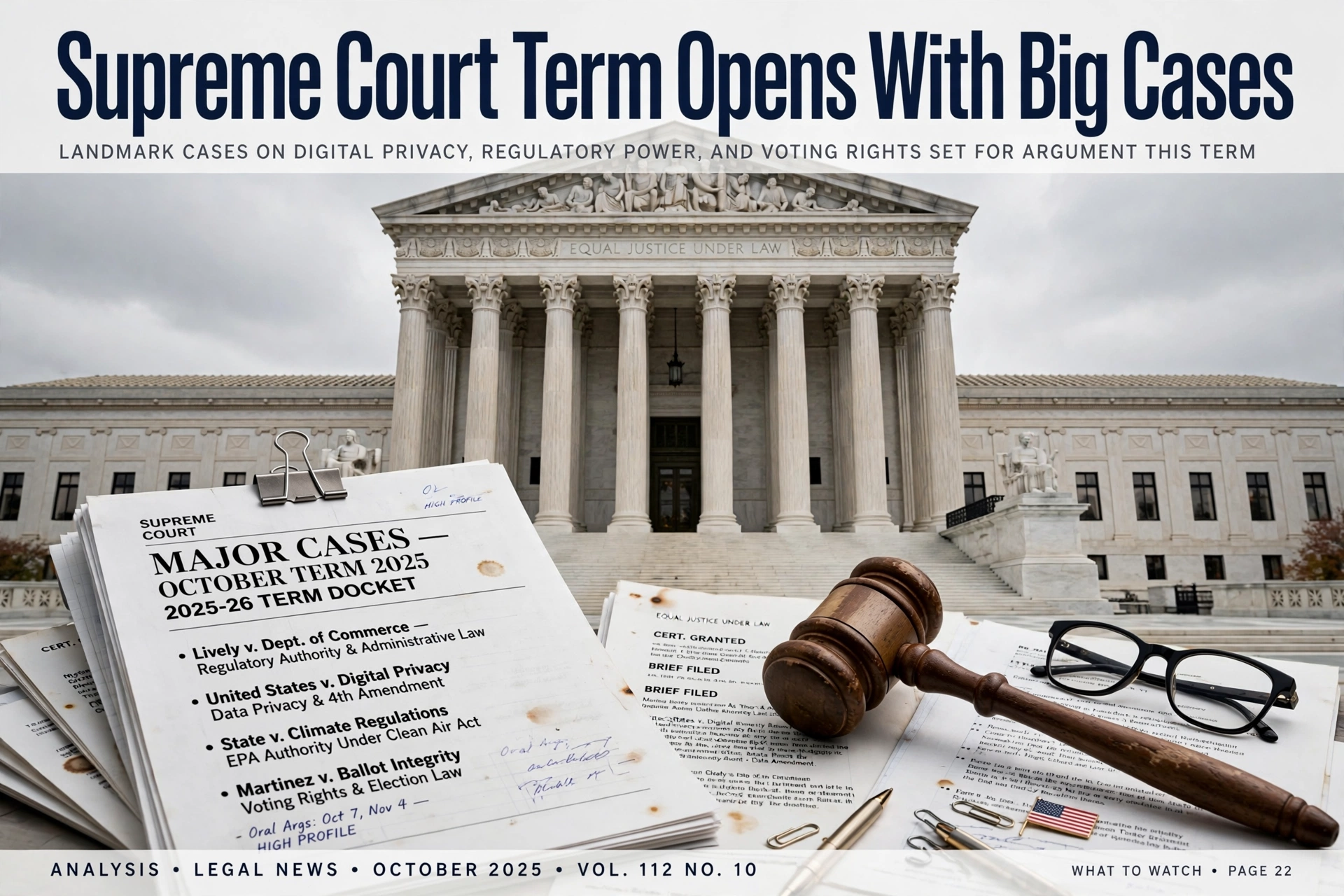
The U.S. Supreme Court returns Monday, October 5, to open its 2026-2027 term, and the docket already looks like a referendum on the country’s biggest fights: climate liability, assault weapon bans, third-country deportations, detention without bond hearings and public funding for religious schools. The justices have agreed to hear 30 cases so far, with the first arguments scheduled for opening day, and legal analysts expect more additions as the term progresses.
The session begins against the backdrop of a summer that was anything but quiet. A surge of petitions to the emergency docket, the so-called shadow docket, kept the court working through unsigned rulings with lasting consequences, including September’s decision temporarily blocking the administration’s effort to restrict mail-in voting. As SCOTUSblog co-founder Amy Howe put it, the justices hear relatively few merits cases compared with the past, and much of their real influence now flows through the emergency docket.
The Case That Opens the Term
First up on Monday is Suncor Energy v. County Commissioners of Boulder County, which asks whether corporations can be held liable in state court for their role in climate change. Boulder and its neighboring governments sued Suncor and Exxon Mobil in 2018, alleging the companies knew they were contributing to climate change and caused local harm, and the city is seeking monetary compensation. The companies counter that federal law and the Constitution bar the suits.
Lower courts have split the difference, ruling the cases belong in state rather than federal courts, according to the Congressional Research Service. The Supreme Court will decide whether that stands. The stakes extend far beyond Colorado: dozens of state and local governments are pursuing similar suits seeking billions in damages, and the outcome will determine whether that litigation pipeline continues. Justice Samuel Alito recused himself from the case on September 28.
The AR-15 Ban Question
In December, the court will hear Viramontes v. Cook County, testing the legality of a local Illinois law banning the possession, sale and transfer of assault weapons, including AR-15s. County residents and gun rights organizations sued in 2021, arguing the ban violates their constitutional rights. The question presented is whether the Second and Fourteenth Amendments protect the right to possess semiautomatic weapons.
The case matters because the Supreme Court has remained largely silent on the scope of the Second Amendment for more than two centuries, and its modern jurisprudence is still, in Howe’s words, in its relative infancy. Lawyer and columnist David French has noted that most U.S. jurisdictions do not ban AR-15s anyway, so the democratic process has partially worked in the gun control debate. What the court decides will shape which bans survive in the states that have them.
Two Immigration Cases on the Calendar
Immigration occupies more of the docket than any other subject. In Department of Homeland Security v. D.V.D., the court will weigh the policy of deporting immigrants to third countries, nations other than their own. The case arrived through the emergency docket, where on September 29 the justices allowed the administration to continue third-country deportations while the legal challenge proceeds. The merits ruling will decide whether the policy is lawful and whether immigrants have the right to object before removal.
The court also granted review this week of Rhoney v. Barbosa da Cunha, which challenges mandatory immigration detention without bond hearings. The administration contends a 1996 statute requires it to detain every immigrant arrested inside the United States without a bond hearing, an interpretation other administrations rejected. The named respondent, Brazilian national Ricardo Aparecido Barbosa da Cunha, has lived in the U.S. since 2016 and has no criminal convictions; his attorney notes that every court to consider the policy has rejected it.
Religion and Public Funding
Rounding out the marquee list is St. Mary’s Catholic Parish v. Roy, arising from Colorado’s universal preschool program. The state funds public and private preschools that sign a nondiscrimination agreement requiring them to accept students regardless of religion, sexual orientation or gender identity. A Catholic preschool says Colorado is discriminating against its religious freedom because its policies on enrolling children of same-sex couples disqualified it from the funds.
The case fits a term that NPR’s reporting frames around religion, guns, immigration and climate change. It will test how forcefully the court applies its earlier precedent requiring states to include religious institutions in generally available public benefit programs, and how far antidiscrimination conditions can go before they become exclusion. Similar disputes over funding and religious exemptions are pending at lower courts nationwide.
What Else Could Land on the Docket
Analysts expect the court to add cases as it has in prior years. Howe identified two possibilities: litigation over the military’s ban on transgender service members, and President Trump’s appeal in the defamation case brought by writer E. Jean Carroll. Ballotpedia’s tracker shows 29 cases agreed as of October 2, with 21 scheduled for argument and one dismissed, meaning the docket will roughly double before the term ends in June.
The emergency docket remains the wild card. The September order on mail-in voting showed how quickly the court can intervene in time-sensitive election disputes, and with midterms approaching, more such applications are likely. Each shadow-docket ruling arrives unsigned and thinly explained, which is precisely why the growing volume concerns legal scholars across the ideological spectrum.
Why This Term Matters
Supreme Court terms compound. A single ruling on climate suits can redirect a decade of municipal litigation; a Second Amendment decision rewrites how states legislate; an immigration case determines how the government treats thousands of people each year. With the court’s composition settled and its emergency powers expanding, the 2026-2027 term will show whether the institution is recalibrating after a stretch of extraordinary intervention or entrenching it.
Watch Monday’s first arguments in the Boulder case for tone, December’s AR-15 arguments for the Second Amendment’s direction, and the immigration rulings for the practical limits of executive power. The full calendar, argument schedules and orders lists are published on the Supreme Court’s website, and the opinions will land in weekly batches starting in the winter, with the term’s biggest decisions typically arriving in June.
Frequently Asked Questions
When does the Supreme Court’s new term start?
The 2026-2027 term begins Monday, October 5, 2026, with the first oral arguments, including the climate liability case Suncor Energy v. Boulder County.
How many cases will the Supreme Court hear?
The justices have agreed to hear 30 cases so far, with 21 scheduled for argument, and analysts expect additional grants as the term progresses toward June.
What is the third-country deportation case?
Department of Homeland Security v. D.V.D. challenges the policy of deporting immigrants to countries other than their own; the court allowed the policy to continue on September 29 while the case proceeds.
Why is the AR-15 case important?
Viramontes v. Cook County will decide whether the Second Amendment protects semiautomatic weapons, clarifying an area of constitutional law the Supreme Court has barely touched in two centuries.