






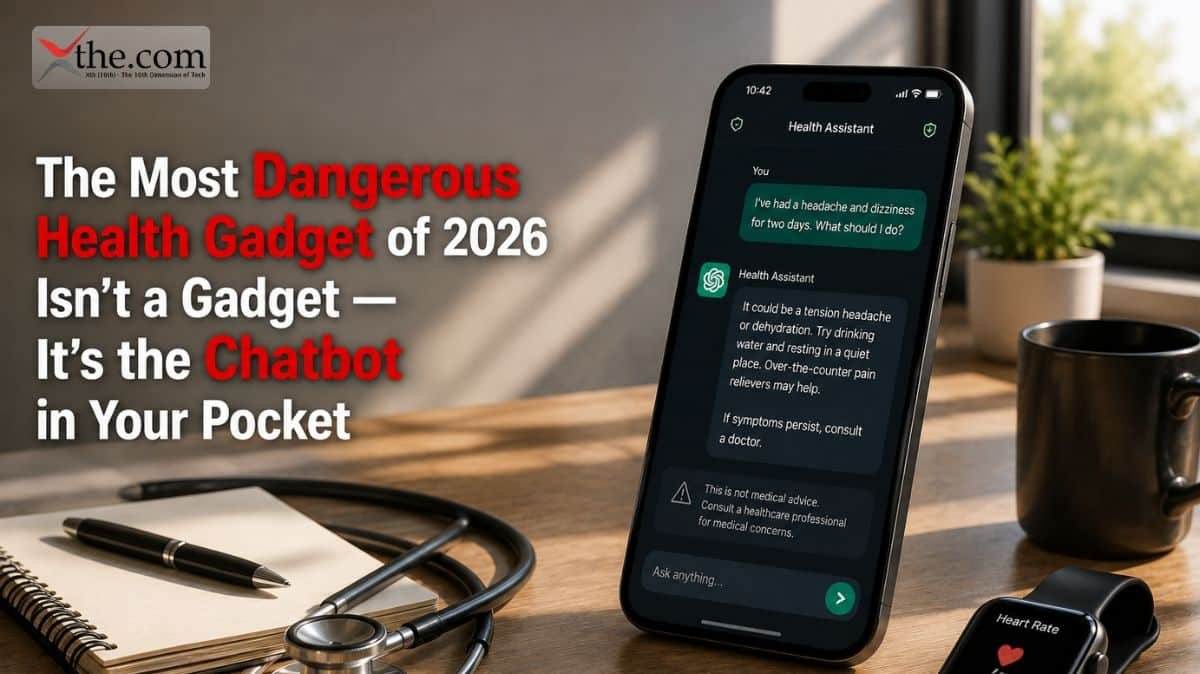
Every year, a nonprofit called ECRI publishes the list that hospital administrators read with one eye closed: the top health-technology hazards. Past lists have featured infusion pumps that overdose patients, cybersecurity gaps that freeze entire hospital systems, and recalled devices that fail at the worst moment.
The 2026 list has a new number one, and it isn’t inside a hospital at all. It’s on your phone.
Why Chatbots Topped the List
ECRI’s finding is blunt: the misuse of AI chatbots is now the single biggest technology hazard in healthcare. The group’s researchers documented cases where popular tools suggested incorrect diagnoses, invented body parts — yes, organs that do not exist in human anatomy — and delivered the whole thing in the calm, confident tone of a trusted clinician.
That tone is precisely the problem. When a vending machine gives you a wrong answer, you notice. When a large language model gives you a wrong answer, it gives it beautifully — structured, reassuring, complete with bullet points. The failure isn’t just technical; it’s psychological. These systems are engineered to sound certain, and certainty is the most addictive drug in medicine.
Millions of Americans now consult AI before, or instead of, a doctor. It’s free, it’s instant, it never judges you, and it’s awake at 3 a.m. when the chest tightness starts. The behavior is completely understandable. It’s also, in ECRI’s assessment, where a growing share of preventable harm now begins.
The Anatomy of a Wrong Answer
To understand why this keeps happening, it helps to know what a chatbot actually is. It isn’t a medical database and it isn’t reasoning through your case. It’s a prediction engine, stitching together the statistically most likely next words based on patterns from its training data. When your symptoms match a common pattern, the results can be impressively accurate. When they don’t — rare conditions, unusual combinations, your specific medication list — the engine doesn’t say “I don’t know.” It fills the blank with the most plausible-sounding pattern it has.
Doctors call the dangerous cases “confabulations,” and the examples in ECRI’s reporting read like dark comedy until you remember someone may have acted on them. Phantom anatomy. Treatments for the wrong disease. Drug interactions that don’t exist, and real ones that were missed.
And unlike a medical device, there’s no recall process for a bad answer. No FDA clearance, no lot number, no warning label. The model that misled you Tuesday may be updated Wednesday, with no record of what it told you.
The Industry Rushes In Anyway
Here’s the tension that makes 2026 such a strange moment in American health: at the exact same time the safety watchdogs are sounding the alarm, the biggest names in tech are sprinting toward your medicine cabinet. Amazon has launched an AI health assistant for its One Medical members. OpenAI and Anthropic have shipped health-focused tools. Investors poured $14.2 billion into digital health startups last year, with more than half of it going to AI companies.
The optimistic case is real. America has a primary-care shortage, brutal wait times, and millions of people who delay care because of cost. A good AI triage layer — one that answers routine questions, flags genuine emergencies, and routes people to human clinicians faster — could do enormous good, especially in rural areas where the nearest doctor is an hour away.
The pessimistic case is equally real: a population skipping the doctor because the chatbot said “probably nothing,” and a healthcare system quietly outsourcing its front door to software with no malpractice insurance.
Both futures are being built at once. Which one wins depends less on the technology than on how the rest of us choose to use it.
How to Use Health AI Without Getting Hurt
Doctors who study this space tend to give the same advice, and it’s worth memorizing.
Use AI for questions, not verdicts. “What questions should I ask my cardiologist?” is a great chatbot prompt. “Do I need to go to the ER?” is not. Treat every medical answer as a second opinion from a stranger — one who is very well-read but has never examined anyone, ever. Always verify medication advice with a pharmacist or physician; drug interactions are where chatbot errors are both common and dangerous. And pay attention to the asymmetry: if an AI says something might be serious, take it seriously; if it says you’re probably fine, that reassurance is worth much less.
There’s also a simple rule for the moment of temptation: the 3 a.m. rule. If you’re worried enough about a symptom to ask an AI about it in the middle of the night, you’ve already answered the real question — call a nurse line, an urgent care, or your doctor’s on-call service. Most insurance plans cover 24/7 nurse hotlines, and unlike a chatbot, the person on the other end carries a license and liability.
The Reckoning Ahead
Washington is starting to pay attention. The White House and the Department of Health and Human Services have convened a one-month “sprint” with outside experts to develop standards for benchmarking and evaluating clinical AI tools — the first real step toward measuring whether a health AI is actually good, rather than merely popular. The FDA has been redrawing the line between wellness software and regulated medical devices.
Standardized testing for clinical AI can’t come soon enough. Right now, a stethoscope faces more regulatory scrutiny than the software millions of people use to decide whether their child needs an emergency room.
ECRI’s list is not a prediction of doom; it’s a fire drill. The hazard isn’t that AI exists in healthcare — it’s that we’ve adopted it at national scale before we’ve learned to use it safely. The technology will keep improving. Until the guardrails catch up, the smartest thing in the room has to be you.








