



Austin, Texas
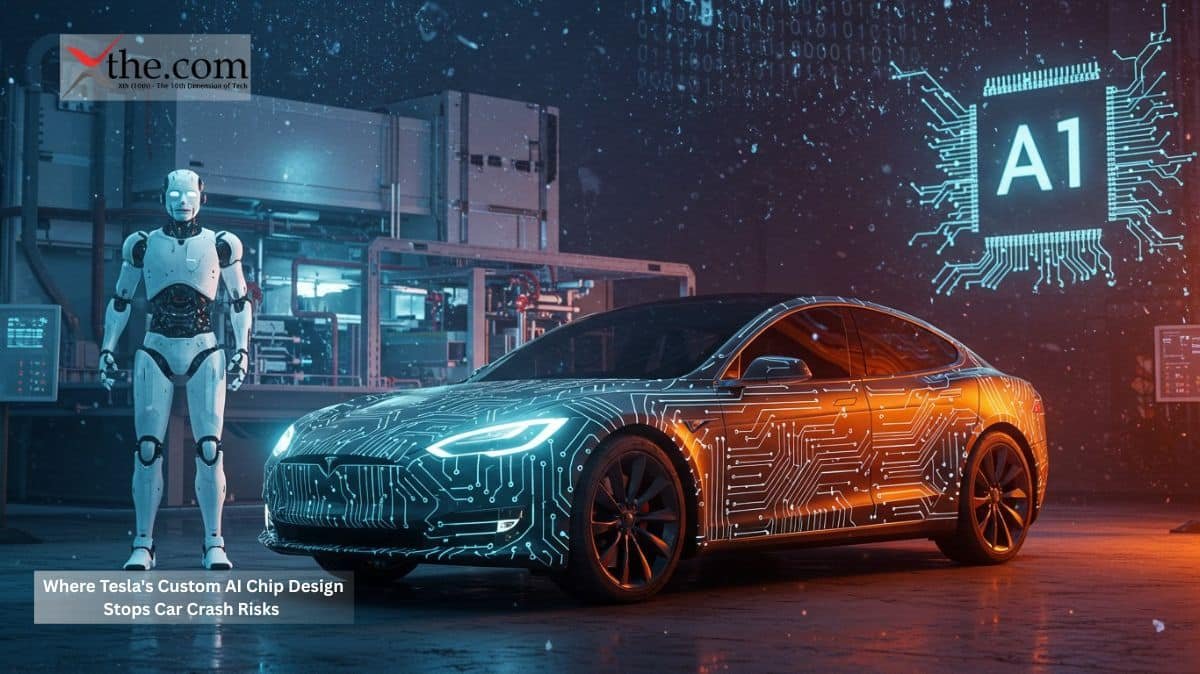
A distracted driver traveling at 70 mph can cross a football field in under 4 seconds. At that brief moment, a family’s safety can change in an instant. Safety today does not begin with airbags or steel frames, but with a quiet computer under the dashboard. Here, the Tesla custom AI chip analyzes millions of data points before the driver even hits the brakes.
Tesla’s new hardware approach shows just how intense the competition has become. Industry sources say Tesla is securing advanced semiconductor manufacturing for its next autopilot processors, including sub-2nm factory wafer orders for future full self-driving systems. This matters because real autonomous safety depends on fast computing, not just marketing claims.
Why The Tesla Custom AI Chip Matters More Than Horsepower
For years, carmakers focused on engine power. Electric vehicles changed that. Now, a car’s intelligence decides how well it handles traffic, sudden lane changes, construction, and people crossing at night.
Today’s full self-driving computer hardware can already handle trillions of operations every second. Cameras around the car send video to processors trained to spot lane lines, brake lights, cyclists, animals, and unpredictable drivers. It’s similar to how a pilot checks instruments during rough weather.
The next Tesla custom AI chip is designed to further reduce processing delays. Engineers measure these gains in nanometers. Using sub-two-nm silicon means more transistors fit on each chip, greatly increasing efficiency and computing power.
The engineering progress has a direct impact on preventing accidents.
When a child suddenly runs into the street, the vehicle’s computer must identify the object, predict motion, calculate braking distance, evaluate surrounding traffic, and initiate action almost instantly. Tesla’s future advanced vehicle neural network processing systems could reportedly execute these calculations up to 4 times faster than previous generations of hardware.
At highway speeds, every millisecond counts.
How Sub-2 nm Silicon Changes Highway Safety
Smaller transistors use less energy and can handle more tasks at once. In electric cars, this is especially important because processing power and battery life are closely linked.
A sub-2 NM chip design lets cars use more advanced real-time driving models without straining the electrical system. Engineers can run bigger neural networks that spot subtle dangers older systems might miss.
Imagine heavy rain on Interstate 95 at night. Water reflections distort lane markings. A pickup truck suddenly hydroplanes into the lane over. Older systems may hesitate while inspecting the scene. New edge-silicon autonomous safety upgrades reduce recognition latency, enabling the onboard computer to model vehicle trajectories faster and issue corrective steering inputs earlier.
This faster response could help prevent chain reaction crashes involving many cars.
The Tesla custom AI chip also enables higher-resolution sensor fusion. Rather than looking at each camera to feed separately, future systems will combine all visual data into a single model, similar to how our brains process what we see. Tesla engineers use these methods more and more because they help predict what will happen in heavy traffic.
What does the Tesla FSD Computer Use Today?
Many people wonder: what chip does the Tesla FSD computer use?
Today’s Tesla vehicles with full self-driving mainly use Tesla’s own Hardware #3 and the newer Hardware #4 platforms. These chips replaced older third-party systems, giving Tesla more control over software, neural network training, and safety timing.
This approach explains why Tesla keeps investing heavily in its own chip design instead of outsourcing. The company sees AI processing as a core part of its vehicles, not just another component.
The next generation of full self-driving computer hardware, reportedly under development, will likely push that philosophy further by integrating denser transistor layouts, more memory bandwidth, and more AI acceleration cores built for self-driving tasks.
The Semiconductor Is Behind Autonomous Driving
Tesla is not the only company seeking advanced chip manufacturing. All major automakers now realize that self-driving systems need top-notch semiconductors. Still, Tesla’s push for sub-2 nm wafer orders shows it expects future cars to need much more computing power.
Training advanced neural networks is like running a digital nervous system that keeps learning. Cars gather unusual driving situations from millions of miles on the road. Engineers keep improving the models and send updates back to the fleet.
This process only works if the cars’ processors are fast enough to keep up.
The industry now sees advanced neural network processing as the key to safer transportation. Faster chips mean quicker object recognition, leading to shorter reflection times and fewer crashes.
Most people notice self-driving cars because of flashy demos. Engineers, though, care more about cutting down hesitation by fractions of a second, which can save lives.
That is where the future of highway safety will likely be decided, not in the showroom, not in the battery pack, inside microscopic transistor structures powering the next wave of edge silicon autonomous safety upgrades that increasingly act as co-pilots for millions of drivers worldwide.
Source: Tesla Blog