






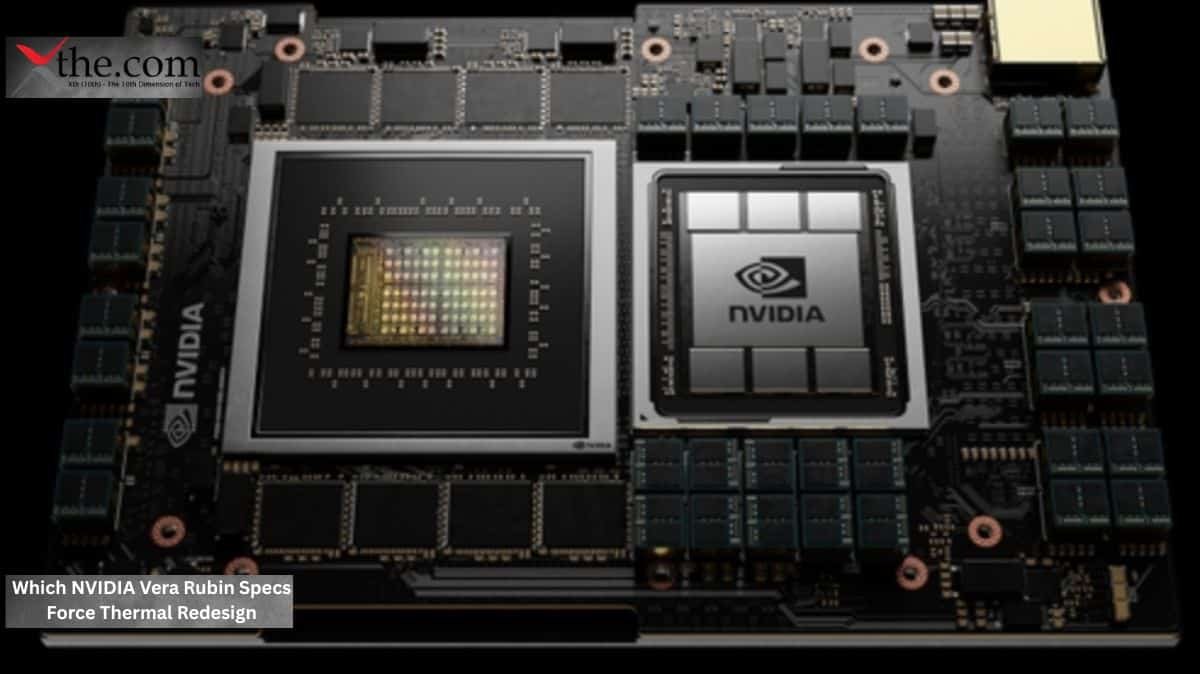
Santa Clara, Calif., the official unveiling of the NVIDIA NVDA Vera Rubin platform has established a new baseline for GPU power envelopes, necessitating liquid-to-chip cooling for all next-gen AI factories. The shift from Blackwell to Rubin requires rear door heat exchanger (RDHx) systems to manage the unprecedented heat density of the Vera CPU and Rubin GPU racks.
One AI rack could use as much electricity as a small commercial building. This challenge is central to the changes coming with the NVIDIA Rubin architecture. Over the past three years, data center operators have focused on optimizing for accelerated computing. Now, they have to ask a tougher question: Can their facilities handle the heat?
The solution is moving toward aggressive liquid cooling and major structural changes. Steps that many operators put off in earlier GPU cycles. The main concern is no longer just performance. Now, it’s about managing heat, distributing coolant, addressing electrical constraints, and the rising cost of upgrading cold facilities for new AI clusters.
Why the NVIDIA Rubin Architecture Changes the Cooling Equation
Moving from Hopper to Blackwell already pushed thermal limits in large AI setups. NVIDIA’s Rubin architecture goes even further by simultaneously boosting interconnect density, memory bandwidth, and compute power. This mix means each rack now has to handle much more heat from the GPU thermal envelope.
According to Nvidia’s roadmap, Rubin-based systems will support bigger GPU groups and higher power delivery per rack. Industry analysts now think future AI racks could require over 600 kW for ongoing inference and training. Standard air cooling was never meant to handle such concentrated heat.
At this point, liquid cooling is no longer just a nice-to-have. It’s a must.
Air-cooling systems perform well when workloads fluctuate or when rack densities remain moderate. AI training clusters do neither. They run continuously, often at near-maximum utilization, for weeks. That persistent demand intensifies AI power scaling, especially in multi-tenant AI factories, where every watt counts.
A typical enterprise facility built for 15-30 kW racks just can’t handle the heat output from Rubin-era systems without major changes.
The Rear Door Heat Exchanger Returns To The Spotlight
Many data center operators used to see the rear-door heat exchanger as a useful tool for high-performance computing. Robin is changing that view fast.
A rear-door heat exchanger pulls heat directly from the rack’s exhaust before it spreads into the data hall. This reduces server heat buildup and eases the load on the main cooling systems. Most importantly, it lets operators keep using their current facilities longer without having to rebuild all their cooling systems right away.
Take a regional co-location provider with a facility built in 2019 in northern Virginia or Phoenix. The building might still have good electrical systems, but its airflow setup probably can’t handle Robin-level deployment. Adding liquid-assisted cooling at the row or rack level is now cheaper than building a brand-new AI campus.
This is where the economics of infrastructure retrofitting become critical.
Many enterprise operators now face a difficult financial decision. They can either absorb rising thermal CapEx through phased modernization or risk losing AI customers to newer facilities optimized for direct-to-chip cooling.
GPU Thermal Envelope Expansion Drives Capital Spending
The Biggest Issue With Rubin Systems Isn’t The Cost Of Computing. It’s How To Manage The Heat.
The expanding GPU thermal envelope forces operators to redesign airflow pathways, coolant loops, rack spacing, and power delivery systems simultaneously. Small inefficiencies compound rapidly at high densities. A minor airflow imbalance inside a traditional server row can create localized thermal spikes severe enough to throttle AI workloads.
This problem worsens with advanced AI power scaling, where workloads consume more power during training spikes. Facilities that depended on steady CPU-era heat patterns now face changing rack heat profiles that regular HVAC systems can’t keep up with.
Because of this, spending on liquid cooling now goes beyond just the cooling hardware. Operators are also investing in extra water loops, leak detection, raising floor exchanges, stronger piping, and smart thermal monitoring systems.
These upgrades significantly expand thermal CapEx budgets.
Industry consultants estimate that advanced AI-ready retrofits can cost between $8 million and $20 million per megawatt, depending on local utility limits and the age of the facility. These costs are changing how the whole data center market thinks about investments.
Infrastructure Retrofit Becomes a Competitive Weapon
The term infrastructure retrofit used to mean fixing things after they broke. With NVIDIA Rubin, it now means staying competitive.
Large cloud providers can afford to build new AI campuses from scratch. Most other businesses can’t.
Regional providers, healthcare networks, banks, and government AI operators must upgrade their facilities to meet Rubin-era needs. How quickly they adapt could decide who wins the enterprise AI business in the next five years.
Think of a global bank rolling out AI models for fraud detection and risk analysis. Its main facilities may have enough backup power, but not enough cooling for Rubin-class GPU arrays. Waiting to upgrade could lead to more sluggish training, more downtime, and falling behind AI-focused financial firms.
That’s why infrastructure retrofit projects are now a top topic among colocation executives and engineering firms.
The larger issue extends beyond single facilities. The entire industry faces surmounting consequences from AI factors powered by the NVIDIA Rubin platform infrastructure as operators attempt to balance compute expansion with escalating energy demands.
NVIDIA Rubin Platform Infrastructure Consequences for AI Factories
The phrase ‘NVIDIA Rubin platform infrastructure consequences for AI factories‘ sums up a major shift happening across the AI industry.
Older data centers aimed to fit as many servers as possible in each square foot. Instead, Rubin-era facilities focus on solving heat and managing power. This shift changes how companies buy equipment, design buildings, and manage their finances.
For example, developers now look for good water access and electricity when choosing sites for AI campuses. City utility talks now include cooling capacity, a topic that used to come up only in industrial projects.
The impact spreads to investors as well, raising thermal CapEx requirements and compressing margins for operators who are unable to scale efficiently. Facilities constructed around legacy airflow assumptions may lose value as tenants migrate to high-density liquid-cooled campus campuses.
Meanwhile, companies that offer liquid cooling, heat reuse, and smart thermal management are likely to benefit significantly from the Rubin rollout.
The pressure from AI power scaling also brings geopolitical challenges. Areas with weaker grids or insufficient water may struggle to attract advanced AI projects. This could change where global AI infrastructure grows in the next decade.
The Next Phase of AI Infrastructure Is Physical, Not Just Computational
For years, AI computation was about models, chips, and software. The Rubin cycle changes that. Now, physical infrastructure decides if organizations can run advanced AI systems at scale and at a reasonable cost.
NVIDIA Rubin architecture is more than just another GPU upgrade. It forces the industry to face the real engineering limits of today’s data centers. The fastest adapters may not have the best algorithms, but they’ll have the facilities that can handle next-generation computing without overheating.
That shift places liquid cooling, the adoption of rare door heat exchangers, and strategic infrastructure retrofit planning at the center of the AI economy’s next expansion phase.
- Checklist / Cheat Sheet
✔ NVIDIA Vera Rubin increases GPU thermal density beyond air-cooling limits
✔ Liquid-to-chip cooling becomes mandatory for next-generation AI factories
✔ Rear door heat exchangers help extend existing data center lifespan
✔ Infrastructure retrofit costs are reshaping thermal CapEx strategies
✔ AI power scaling is changing global data center design and expansion
Source: NVIDIA Names Suzanne Nora Johnson to Board of Directors








