




Austin, Texas.
Picture a warehouse worker in Nevada lifting a heavy box, turning to dodge a forklift, and setting the box on a conveyor. In a data center, a machine studies each part of that movement. Later, a humanoid robot copies the task. No one had to program its motions by hand.
This change is more important than most new product launches.
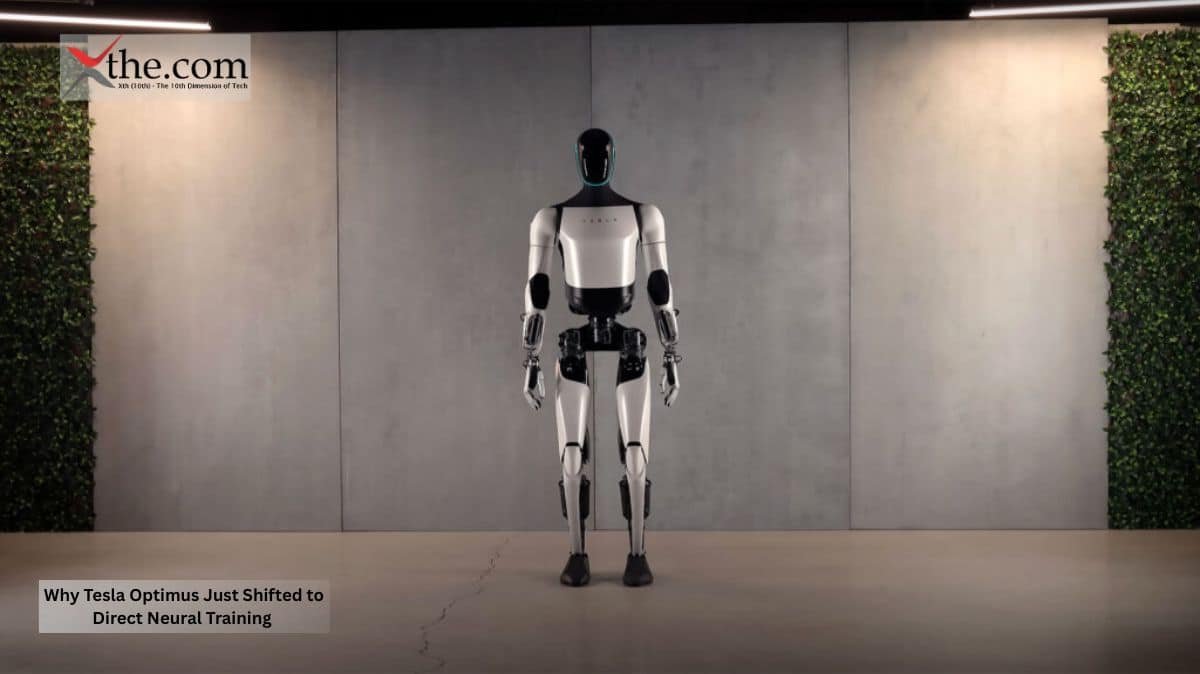
Recent talks about Tesla Optimus show the company is moving away from traditional scripted robotics and choosing direct neural training. Now, instead of programmers setting every arm angle and grip strength, the robot learns by watching videos of people and using neural networks to understand how to move. For investors and robotics engineers, this is a major step toward more flexible, adaptable robots.
Why Tesla Optimus Is Moving Beyond Traditional Robotics
Industrial robots usually work within strict limits. Engineers set their movement paths, object locations, and safety rules in advance. Everything works well until something changes. Even a moved pallet or a damaged box can halt the whole line.
This limitation has shaped factory robotics for a decade.
Tesla Optimus is taking a new approach. The company now focuses on physical neural networks, which learn from watching people. Instead of following handwritten instructions, the robot observes humans doing repetitive tasks and creates general movement patterns from those videos.
The difference might seem small, but it is actually significant.
A scripted warehouse robot can lift a specific package from a specific shelf. In contrast, a neurally trained humanoid robot understands how to lift different awkward objects even as conditions change. This flexibility is important in logistics centers where inventory changes constantly.
Tesla’s strength is its scale. The company already runs one of the world’s biggest real-world AI data systems with its cars. Bringing this approach to robotics creates a huge training system. Cameras record movements, neural networks study posture, balance, and grip, and the robot improves by trying and correcting its actions.
This process is more like how people learn than traditional programming.
The Rise of Physical Neural Networks
Right now, the key term in robotics might be physical neural networks.
Large language models guess what words come next. Physical neural systems, on the other hand, predict movement. They figure out force, timing, how objects interact, and body position all at once. This changes how machines handle messy, unpredictable environments.
Warehouses show this challenge clearly. A cardboard box might bend when lifted, tape could come loose, or the weight could move in a way no one expects. Traditional robots struggle with these surprises because programmers cannot anticipate every possible change.
A neurally trained humanoid robot can adjust in real time.
Tesla is working on more than just copying movements. The robot is being trained to understand space and recover if something goes wrong. For example, if an object slips, the robot tries to fix the issue rather than stopping. This ability could make robots much more useful and cost-effective in shipping centers.
The consequences for automated limbs are important. Older robotic arms excel in isolated stations surrounded by cages and barriers. Instead, Tesla pursues both mobility and adaptation. The robot walks, balances, rotates, and manipulates objects in human-designed environments.
This is why warehouses are the first place where this technology will be tested.
What This Means for Factory Workers
People often talk about robotics in extremes, either with wild hopes or big fears. In reality, change usually happens more quietly.
Most shipping warehouses already have trouble finding enough workers, especially during busy seasons. It is hard to fill overnight shifts that require heavy lifting and moving. Companies also pay a lot for injuries caused by repetitive work and back problems.
This is why mechanical safety is so important.
Tesla’s engineers seem to be making the robot more flexible than stiff. Traditional machines can hurt people if something goes wrong. A neurally trained robot that uses gentle force and can adjust its balance is safer to work around.
Even so, the economic pressure is clear.
If Tesla Optimus succeeds, many repetitive logistics tasks currently handled by factory workers could shift toward robotic assistance within the next decade. Loading, transferring containers, sorting parcels, moving pallets, and replenishing shelves all fit the profile of trainable visual labor.
This does not mean people will lose their jobs right away. Instead, the types of jobs in warehouses will change. There may be fewer entry-level workers and more roles for robotics supervisors, maintenance staff, and AI specialists.
This change will not happen everywhere at once. Smaller warehouses might wait because of the cost, but big distribution centers, which need to be very efficient, could see big benefits even from small improvements.
The Bigger Bet On Autonomous Humanoid Bipedal Robots For Factory Logistics
The idea of autonomous humanoid bipedal robots for factory logistics once sounded like speculative science fiction. It now reads more like an investment category.
The reason is a simple design.
Factories, warehouses, stairs, shelves, and loading areas are all built for people. Making robots that can navigate these spaces without altering the buildings saves a lot of money. In theory, two-legged robots could start working in these places right away.
This is why Tesla is moving quickly.
Tesla is not just making another robot. The company wants to build a scalable workforce powered by neural learning. If this works, the impact could go far beyond shipping centers, reaching retail stock rooms, factories, ports, and construction sites.
The real question is not whether robots will take on physical work, but whether society can adapt quickly enough to handle the economic and cultural changes that come with machines learning by watching us.
Source: Tesla Blog