






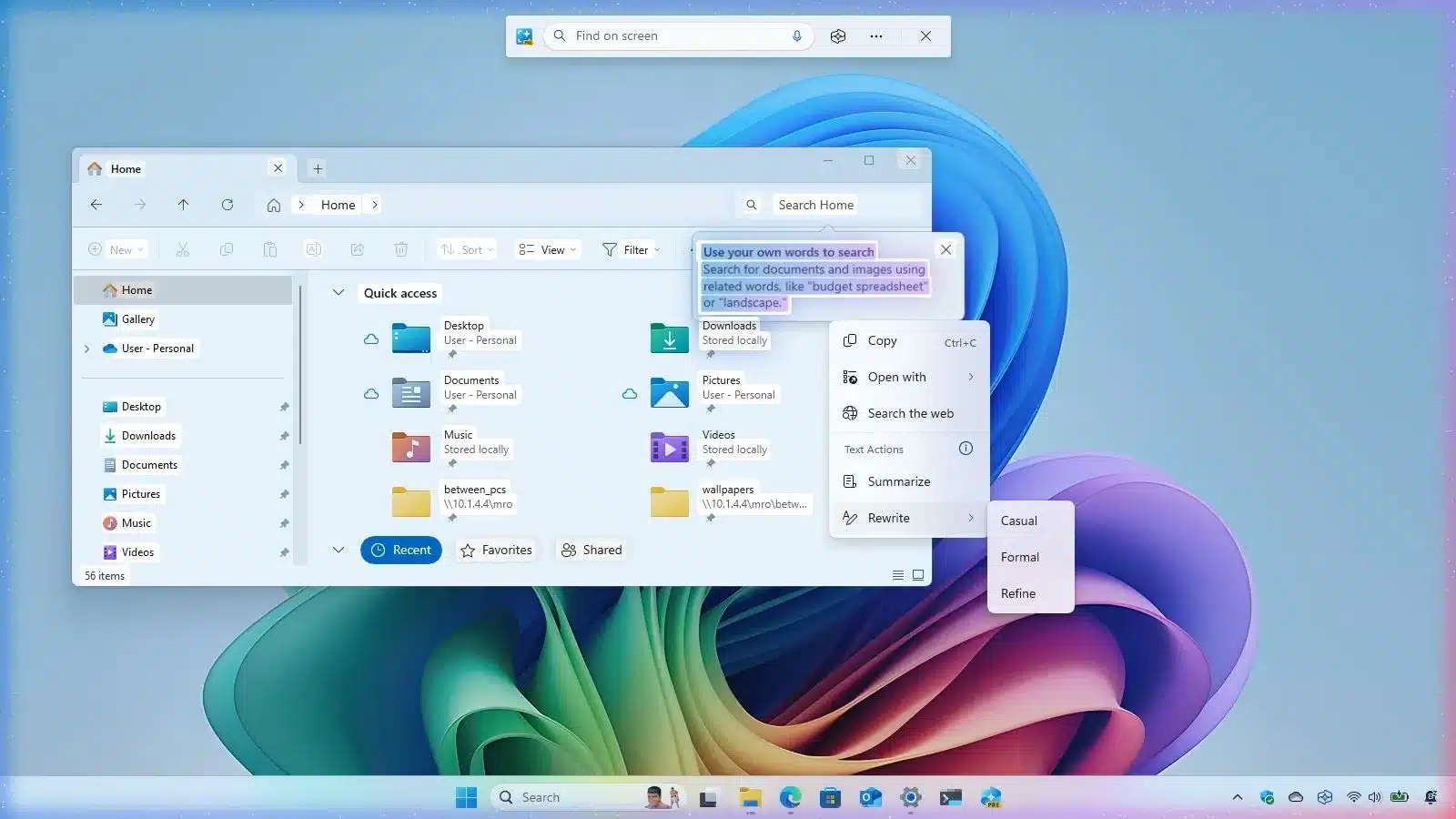
A hidden feature in a recent Windows developer build has quietly turned on system-wide AI navigation controls. Early testers say they can now trigger workflows across apps without switching contexts. This marks a turning point for Windows AI Assistant OS automation AI, where the operating system itself becomes an active participant in user tasks rather than a passive interface.
What the AI Navigator Actually Does
The AI navigator works on top of regular applications. It listens to what users want to do and turns those requests into system actions. Instead of opening apps one by one, users can simply describe what they want to achieve.
For example, if a user requests a report summary, the system collects the necessary files, opens the appropriate apps, and automatically compiles the insights. This shows a deeper level of integration than earlier assistant models.
Unlike separate tools, the navigator works directly with the main parts of the operating system. It can access memory, files, and app states in real time. This creates a single control layer for the whole desktop.
How System-Level Automation Changes Interaction
Workflow Control In Windows AI Assistant OS Automation AI
The main innovation is how the system manages workflows. It does more than just follow commands. It organizes actions across different apps and tools. This means users don’t have to switch between tools as much.
Take a developer debugging code as an example. Instead of moving between the terminal, browser, and editor, the system handles these steps automatically. It shows logs, suggests fixes, and runs commands in order.
This kind of control creates a new way to interact with the computer. Users set their goals, and the operating system handles the details.
Integration With Existing Tools
The navigator integrates directly with Microsoft AI navigation layers already present in Windows. This ensures compatibility with existing productivity tools. Applications do not need to be redesigned to support this feature.
At the same time, the system extends Copilot’s capabilities. Instead of operating in a sidebar, Copilot’s functions are embedded across the OS. This removes friction between suggestion and execution.
This leads to a smoother experience. AI suggestions and user actions are now part of the same workflow.
Implications For Productivity And Efficiency
Early tests show that tasks get done faster. Actions that used to require several steps can now be done with a single instruction. This is especially helpful in data-heavy settings.
In businesses, analysts can automate repetitive reporting. The system collects data, formats the results, and automatically sends them. This saves time and reduces mistakes.
With Microsoft AI navigation built in, the system can learn user habits and adjust workflows to suit. Over time, it gets better at handling tasks.
The Risk to Traditional Search and Navigation.
Decline of Manual Search Behavior
One of the first changes is how people search for things. Users don’t need to type in as many manual searches because the system can guess what they need. This means less use of traditional search tools.
Instead of looking for files or information, users just ask for results. The system finds and processes the data on its own, so there’s less need for outside search engines.
The embedded nature of the Copilot system accelerates this shift. It embeds intelligence directly into the opening environment, eliminating the need for separate discovery tools.
Impact On Software Ecosystems
This shift changes how software is built and sold. Apps that rely on users navigating through them may get less use as the operating system becomes the main way people interact with their tools.
Developers might have to redesign user interfaces. Instead of focusing on navigation, they’ll need to make sure their apps work well with AI-driven workflows. This calls for new design ideas.
Platform owners also get more control by bringing all interactions into one place. This lets them shape how users access and use software, which could affect competition and innovation in the long run.
Technical Challenges And Limitations
Accuracy And Context Understanding
System-wide automation needs to accurately understand users’ needs. If it gets things wrong, it can take the wrong actions, which is especially risky in sensitive tasks.
For example, if a financial task is done incorrectly, it could have serious consequences. To avoid this, the system’s ability to understand intent needs constant improvement.
The system also has to deal with unclear instructions. Users often don’t provide all the details, so the AI needs to infer context without making mistakes.
Privacy and Data Access Concerns
The navigator needs access to a lot of data, like files, messages, and app states. Managing this access brings up privacy concerns.
Users need to know how their data is used and be able to control permissions. Without this, people may be hesitant to use the system.
It’s important to balance useful features with privacy. The system has to be helpful without losing users’ trust.
Enterprise Adoption and Strategic Outlook
Organizations looking at this technology need to weigh the benefits and risks. Automation can make things more efficient, but it also means relying more on AI. This calls for new ways to manage and oversee these systems.
Businesses might begin by automating only certain workflows and keeping people involved to oversee the process. This helps them adopt the technology gradually.
Over time, the operating system will take on a bigger role in coordinating all digital activities. This will change how IT systems are managed.
Rethinking Control And Interaction In Modern OS
The rise of system-wide AI navigation marks a big change in computing. Instead of controlling each tool, users set their goals, and the operating system helps achieve them.
As Windows AI Assistant and OS Automation AI get better, they will change what people expect from productivity tools. Interactions will shift toward goal-setting rather than step-by-step instructions.
The impact goes beyond just individual users. It will affect how software works together and how digital work is organized. The future of computing will depend on finding the right balance between automation and user control.
Source: Windows technical documentation for developers and IT pros.








