One decision could shape Google’s AI strategy for years to come: starting from scratch. Rather than improving its existing foundation model, Google DeepMind reportedly abandoned its original training run and rebuilt Gemini 3.5 Pro after internal tests showed weaknesses in intricate reasoning, coding accuracy, and multi-step problem-solving. That decision culminated in the Google Gemini 3.5 Pro release on July 17, making the Gemini 3.5 Pro launch date one of the most closely watched events in artificial intelligence this year.
The launch comes just days after OpenAI released GPT-5.6 and soon after xAI announced Grok 4.5, increasing competition among leading AI models. For enterprise buyers, developers, researchers, and tech leaders, today’s release is more than just another update. It shows that Google is willing to rethink its AI plans rather than make only small improvements.
Gemini 3.5 Pro launch date arrives after an unusual development cycle.
It’s rare for major AI companies to admit they abandoned a nearly finished model. According to industry insiders, Google DeepMind decided that the first Gemini 3.5 training process would not meet its standards, particularly in mathematical reasoning, software development, and accuracy in long conversations.
This decision reportedly led to a completely new pretraining process, making the Google DeepMind rebuilt model one of the most ambitious AI redevelopment projects in recent years.
Google has confirmed the release date for Gemini 3.5 Pro, but some technical details reported before launch are still unverified until the official documentation is published. It’s important to separate confirmed facts from industry leaks, as enterprise customers now rely more on transparent benchmarks than on marketing claims.
What Google has confirmed versus what remains unconfirmed
Google says Gemini 3.5 Pro is a major upgrade over earlier Gemini models, highlighting big improvements in reasoning and coding performance.
However, several widely reported features remain credible but unconfirmed as of now.
One of the most talked-about leaked features is Gemini 3.5 Pro’s 2-million-token context window, which would greatly increase the amount of information the model can process at once. If confirmed, this would allow organizations to review lengthy legal contracts, software code, medical papers, financial reports, or thousands of pages of documents without extensive summarization.
Another feature getting attention is Gemini Deep Think reasoning mode, which is said to help with very complex analytical tasks. Leaks suggest this feature may only be available to premium subscribers, not all users.
Trade publications say the Gemini 3.5 Pro pricing Ultra tier might be available through Google’s $250-per-month Ultra subscription, and API pricing could start at about $1.25 per million input tokens. Google had not confirmed these prices when this article was written.
Google Gemini 3.5 Pro’s July 17 release raises expectations for reasoning performance.
The timing of today’s announcement shows just how fast the AI market has changed in 2026.
Just a year ago, people mostly compared models based on chatbot quality. Now, enterprise customers focus more on measurable reasoning, software engineering, math accuracy, and how well models handle long tasks.
Google appears to have rebuilt Gemini specifically to address those priorities.
Developers who tested Gemini 3.5 Pro early noticed big improvements in code generation, debugging, planning, and multi-step reasoning. These features are important because businesses now use AI for tasks that need rational consistency over many steps.
Gemini 3.5 Pro vs GPT-5.6: Early expectations
The inevitable comparison following today’s launch is Gemini 3.5 Pro vs GPT-5.6.
While full independent benchmark tests will take time, some differences are already clear from what we know so far.
GPT-5.6 continues emphasizing strong reasoning, conversational quality, and broad enterprise integration across Microsoft’s ecosystem.
Gemini 3.5 Pro seems to focus on longer context, better software engineering, and stronger intricate reasoning.
If Gemini 3.5 Pro’s 2-million-token context is confirmed, Google would have a real advantage for organizations that handle large datasets. Research groups, pharmaceutical companies, law firms, and engineering teams often work with documents that exceed the usual context limits.
At the same time, the rumored Gemini Deep Think reasoning mode could make Google a stronger competitor in scientific computing, advanced math, and complex planning, where more computation can lead to better answers.
Actual performance comparisons between Gemini 3.5 Pro vs GPT-5.6 will ultimately depend on independent evaluations rather than vendor demonstrations.
Developers are watching pricing as closely as performance.
Raw capability alone no longer decides whether enterprises adopt a model.
Organizations using AI at scale often spend millions each year on API usage. Even small differences in token pricing can have a big impact on costs.
Current reports suggest the Gemini 3.5 Pro pricing Ultra tier will offer both consumer subscriptions and enterprise API access.
If the leaked prices are correct, Google may price Gemini competitively with other top models, while keeping premium features in the Ultra subscription.
Businesses will probably look at more than just benchmark scores. They’ll also consider total cost, speed, reliability, API stability, and how well the model fits into their systems before making big commitments.
Why restarting from scratch could matter.
Starting from scratch, it entails high financial and engineering costs.
Training advanced AI models requires thousands of powerful GPUs, extensive data preparation, months of fine-tuning, and significant energy. Very few companies have the resources to throw away a nearly finished model and start over.
This makes the reported Google DeepMind rebuilt model noteworthy beyond today’s launch.
This decision shows Google chose long-term competitiveness over releasing the model sooner. If the new architecture brings real improvements in reasoning, software development, and science, the extra investment could help Google’s position in enterprise AI for years to come.
On the other hand, if independent tests show only small improvements, competitors might say the costly restart brought few real benefits.
Enterprise implications of a larger context window
One feature generating particular interest is the reported Gemini 3.5 Pro 2-million-token context.
Large context windows can completely change how organizations use AI.
Instead of splitting large datasets into smaller parts, users could analyze entire books, software codebases, lengthy compliance manuals, legal evidence, or years of company documents in one go.
This feature helps keep information together and preserves connections across thousands of pages.
Healthcare researchers, financial analysts, and software engineers could all benefit if Google verifies these features.
The feature everyone wants clarified.
Of all the reported features,Gemini Deep Think reasoning mode has triggered the most curiosity.
Extended reasoning systems require more computing power to produce answers. Rather than focusing on speed, they aim to improve logic, reduce errors, and give more accurate solutions for tough analytical problems.
Whether Google ultimately limits this functionality to premium subscribers through the Gemini 3.5 Pro pricing Ultra tier remains one of today’s most important unanswered questions.
Enterprise customers will likely weigh whether better reasoning is worth higher subscription costs, especially software engineering, financial modeling, research, and advanced data analysis.
What happens next
Today’s announcement is just the first step in evaluating Gemini 3.5 Pro.
Google still needs to release full technical documentation, benchmark results, pricing details, safety information, and an official model card confirming final specifications. Until those materials become available, reports concerning the Gemini 3.5 Pro 2 million-token context, the Gemini Deep Think reasoning mode, and the Gemini 3.5 Pro pricing for the Ultra tier should be seen as aware but unconfirmed.
This release is just the start of comparisons between leading AI systems. In the coming weeks, independent researchers, enterprise developers, and software vendors will compare Gemini 3.5 Pro vs GPT-5.6, looking at coding performance, reasoning, speed, and cost. Whether Google’s rebuild was visionary or just costly will depend on how the technology performs in real business use, not just on launch-day news.
It only took fifteen million dollars to launch one of the most important products in T. Rowe Price’s 89-year history. On July 16, 2026, the Baltimore-based asset manager, which manages about $1.9 trillion for clients, entered the digital asset market after years of caution. The T Rowe Price TKNZ ETF launch marks the company’s move from traditional active stock-picking into crypto, with a diversified, actively managed portfolio of six cryptocurrencies rather than just one.
Institutional crypto adoption has been uneven since the first spot bitcoin ETFs appeared in 2024. The big change this week is not just the market, but the manager. T. Rowe Price is known for pension funds, target-date retirement portfolios, and years of fundamental research, not for volatile tokens. Its entry gives advisors a reliable name to consider when recommending crypto exposure to clients.
Inside the TKNZ Launch
TKNZ started trading on NYSE Arca on Thursday, and T. Rowe Price describes it as the industry’s first actively managed multi-token spot exchange-traded product. This is important because passive crypto ETFs track only a single asset or a fixed index, whereas TKNZ does not track either. Portfolio managers can adjust allocations among eligible assets as market environments change, which is precisely the pitch behind the first crypto ETF T Rowe Price has ever brought to market.
At launch, the TKNZ six-crypto-asset structure included Bitcoin, Ether, BNB, XRP, Solana, and Hyperliquid. T. Rowe Price chose these from a larger group of 17 eligible tokens, some of which were added just before launching. The fund does not hold each asset equally. According to Bloomberg Intelligence senior ETF analyst Eric Balchunas, the initial allocation was underweighted in bitcoin and overweight in some smaller tokens, with Hyperliquid making up 6.45% of the fund. This is a significant active choice, as Hyperliquid has outperformed bitcoin over the past year, even though the overall crypto market is in a bear cycle.
Why Six Assets, Not One
Single-asset products expose investors to the unique risks of one network’s technology, governance, or adoption curve. A basket spreads that risk across TKNZ Bitcoin Ether BNB XRP Solana Hyperliquid holdings, letting the fund’s managers rotate weight toward whichever assets show momentum or fundamental strength at a given moment. T. Rowe Price sees this as a way to capture shifts in market leadership as capital moves across different blockchains, rather than relying on a single asset.
Custody, trading, and rebalancing are managed by StoneX Digital and Virtu Financial Singapore, so individual investors do not have to deal with wallets, private keys, or exchange accounts themselves. The prospectus says the fund may sell some holdings for yield in the future, but it will not do so initially.
The Team Behind the Fund
The success of any active fund depends on its team, and TKNZ relies on T. Rowe Price’s digital assets team leadership. Blue Macellari, who has led the firm’s digital asset strategy since 2022, is the lead portfolio manager. She works with four co-portfolio managers: Stefan Hubrich (21 years of experience), Sean McWilliams (17 years of experience), Dante Pearson (13 years of experience), and David Kroger (9 years of experience). This experienced team is intentional. T. Rowe Price wants TKNZ to be seen as part of its research culture, not as a separate crypto project.
What It Costs Investors
Fees matter enormously in a product category where returns can already swing violently. TKNZ carries a TKNZ 0.75% expense ratio, after a fee waiver that lasts until May 31, 2027. This is higher than the low fees of passive spot bitcoin ETFs, which are often around 0.20%. However, the higher fee pays for active management instead of a fixed index. Investors are paying for the expertise of five portfolio managers who decide each week how to adjust the fund’s holdings.
Timing and Market Context
The launch follows a nine-month regulatory process. T. Rowe Price filed for the fund in October 2025, and the SEC approved it on June 12, 2026. The company took a careful approach instead of rushing to the market, which fits its usual style. Also, the fund is not registered as an investment company under the Investment Company Act of 1940, so its regulatory and disclosure requirements differ from those of a typical mutual fund.
TKNZ is launching at the same time as other specialized crypto products from major companies. BlackRock recently introduced a bitcoin income ETF that uses options strategies, and Fidelity is expanding its digital asset lineup. What sets T Rowe Price’s first crypto ETF, TKNZ six digital assets apart from these peers is its active, multi-token structure. The company is betting that skilled managers can handle crypto’s volatility better than a passive index fund can.
A Signal for Retirement Portfolios
T. Rowe Price’s main business is 401(k) plans and target-date funds used by millions of American workers. By entering crypto, even cautiously through a separate ETF rather than adding tokens to retirement portfolios, the firm is sending a message to plan sponsors and advisors who have been unsure. It shows that some of the biggest and most conservative asset managers now see digital assets as a legitimate area for research, not just speculation. The fund’s active ETF lineup now covers equity, multi-asset, fixed income, and, for the first time, digital assets.
What Comes Next
TKNZ started with $15 million in seed capital, which is much less than the $15 billion in assets that spot bitcoin ETFs attracted at launch. Its growth will depend on whether advisors trust the actively managed, multi-token approach enough to invest client money, and whether early investments in assets like Hyperliquid outperform a simple bitcoin-focused strategy. T. Rowe Price is putting its reputation on the line, believing that research-driven active management is as important in crypto as it is in stocks and bonds. Over the next year, as the fee waiver ends in May 2027 and more performance data becomes available, it will become clear if this strategy works for the firm and its investors.
A sharp decline in semiconductor stocks would normally send investors rushing out of every risk-sensitive asset. This week, that assumption broke down. While the technology sector absorbed another wave of selling, Bitcoin remained remarkably stable, trading close to Bitcoin $64,000 in July 2026 despite growing pressure across AI-related equities. That resilience is forcing institutional investors to reconsider whether digital assets are beginning to decouple from the technology trade that dominated markets over the past two years.
The market’s changing behavior is especially evident in the growing crypto-AI correlation sell-off, in which companies tied to both cryptocurrency mining and artificial intelligence infrastructure are feeling pressure from both directions at once. Investors are also paying close attention to the emerging link between Bitcoin miners and semiconductor companies, which has become increasingly important as miners diversify into AI computing.
Bitcoin $64,000 July 2026 Questions Traditional Market Assumptions.
Many traders were surprised that Bitcoin held above the key $64,000 level, especially after another tough day for semiconductor stocks.
The iShares Semiconductor ETF fell another 4.1% during Thursday’s trading session and now sits roughly SOXX down 20 percent record high reached less than one month ago. Such a rapid correction reflects investors rotating away from the AI stocks that drove one of Wall Street’s strongest rallies.
In the past, Bitcoin usually acted like a high-risk tech stock. When growth stocks fell, cryptocurrencies often did too. Now, that link seems less certain.
Rather than following the drop in semiconductor stocks, Bitcoin has traded within a steady range. This suggests that buyers are still supporting Bitcoin, even as the overall mood in tech stocks gets weaker.
Because of this steady performance, institutional portfolio managers are starting to see digital assets as their own investment category, not just another risky tech bet.
Understanding the crypto AI correlation selloff
The current selloff in both crypto and AI stocks is more about investors having money in both areas, not because Bitcoin itself is weak.
During the AI boom, many large funds invested more in semiconductor makers, cloud providers, GPU suppliers, and public Bitcoin miners. Some mining companies also moved into AI infrastructure, so their portfolios became focused on similar areas.
When excitement about AI began to fade, investors pulled back from the sector as a whole.
This sale didn’t just hit chip makers. It also affected companies running crypto mining operations, especially those investing heavily in AI computing.
The distinction matters.
Bitcoin’s network is still running as usual. The real pressure is on companies that now rely on both crypto markets and AI infrastructure spending.
The Growing Bitcoin miner’s semiconductor link
The Bitcoin miner’s semiconductor link has strengthened considerably over the past eighteen months.
In the past, mining companies mostly relied on crypto prices and how efficiently they could mine. Now, many run advanced computing centers that handle both blockchain tasks and AI projects.
Some large mining companies have turned parts of their facilities into AI hosting centers, renting out powerful computing resources to businesses working on generative AI.
This change helps miners diversify, but it also introduces new risks.
With lower demand for semiconductors and more cautious spending on AI infrastructure, these companies now face risks across multiple industries.
Investors now look at more than just how much Bitcoin miners produce. They also consider data center usage, computing contracts, electricity costs, and the ease of obtaining semiconductors.
This shift is why the story of Bitcoin miners AI data centers is now one of the most closely watched trends in digital asset markets.
Why Bitcoin miners AI data centers Matter
The emergence of Bitcoin miners at AI data centers reflects practical economics.
Mining sites already have important infrastructure like large-scale power, cooling, security, and networking. These features also attract AI companies that need more computing power.
Instead of building new sites, some miners have invested in GPUs and AI hosting services.
This approach has created new ways to earn money and reduced miners’ dependence on Bitcoin mining rewards.
However, investors now see that success relies on both the crypto and AI markets.
If crypto prices drop and AI demand slows, diversified miners could face challenges in both areas simultaneously.
On the other hand, companies that manage to balance blockchain work with AI hosting businesses might become stronger in the long run.
Semiconductor Weakness Changes Market Leadership
The recent drop in semiconductor stocks is one of the biggest declines since the AI rally picked up speed.
The main index now shows SOXX down 20 percent record high, which is considered a bear market correction.
Some investors see this drop as normal profit-taking after big gains.
Others are concerned that company spending on AI might return to normal after a period of heavy investment.
Both views matter for crypto markets, since semiconductor makers remain key suppliers of mining equipment, cloud services, and AI development.
Still, Bitcoin’s sustained performance suggests investors are beginning to view crypto fundamentals as distinct from semiconductor company earnings.
This difference may become even more important during the rest of 2026.
T. Rowe Price TKNZ Crypto ETF Expands Institutional Access.
Another big change is the launch of the T. Rowe Price TKNZ crypto ETF.
This new exchange-traded fund is the company’s first focused cryptocurrency product and gives institutions more options beyond just Bitcoin.
Unlike regular Bitcoin ETFs, the T. Rowe Price TKNZ crypto ETF includes Bitcoin, Ether, BNB, XRP, Solana, and Hyperliquid.
This broader mix shows that investors are interested in a wider range of digital assets, not just Bitcoin.
Portfolio managers now want to invest in blockchain infrastructure, DeFi, payments networks, and smart contract platforms.
The launch also shows that institutions remain confident, even though tech stocks are more volatile.
Big asset managers usually launch new products only if they expect strong, long-term demand from clients.
Professional investors are paying closer attention to whether Bitcoin can remain stable while tech firms’ stocks continue to fluctuate.
If digital assets continue to outperform semiconductor stocks during tough times, investors may change how they broaden their portfolios.
Old patterns among assets often change when the market undergoes major shifts.
That possibility explains why analysts continue to observe the crypto-AI correlation sell-off alongside broader equity performance.
More institutions are now involved in Bitcoin through regulated funds, custody services, and ETFs. This gives Bitcoin a more diverse group of owners than in past market cycles.
Market Outlook: Is Bitcoin Becoming More Independent?
The next few weeks will show if Bitcoin’s recent strength is just a short-term change or the start of a lasting trend.
If semiconductor stocks remain weak while Bitcoin holds steady, investors may start to question longstanding ideas about how digital assets and tech stocks are connected.
The expanding role of Bitcoin miners, AI data centers, continued attention to the Bitcoin miners semiconductor link, and new investment products like the T. Rowe Price TKNZ crypto ETF all point toward a cryptocurrency market that is becoming more sophisticated and institutionally integrated.
For investors, the headline is no longer simply “Bitcoin holds $64000 as AI favorite chip stocks fall from favor.” It shows a broader evolution in market structure, in which Bitcoin is gradually forming its own identity even as AI-driven equities undergo a meaningful reset. Whether that independence persists will depend on macroeconomic conditions, institutional capital flows, and the continued maturation of digital asset markets throughout the second half of 2026.
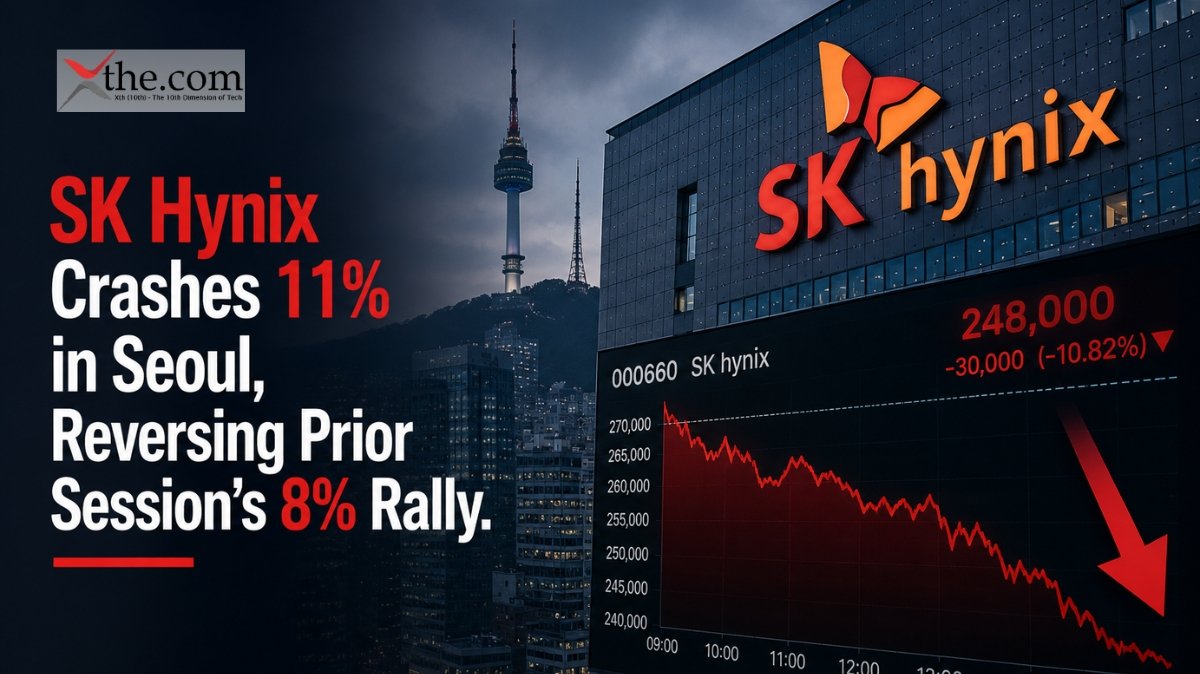
About eleven billion dollars disappeared from SK Hynix’s market value in just one trading session in Seoul on Thursday, July 16, 2026. This happened less than a week after the company completed the largest U.S. share sale ever by a foreign company. SK Hynix crashed 11 percent; headlines do not capture the whiplash traders actually lived through a stock that rocketed nearly 13% higher on Wednesday gave almost all those gains by Thursday’s close. This sharp reversal also pulled down the rest of Asia’s chip sector.
This is not a garden-variety pullback. It is SK Hynix post-IPO swings in their rawest form, a pattern that has defined the stock since its Nasdaq debut on July 10 turned it into a magnet for leveraged single-stock exchange-traded funds and short-dated options of traders. The mechanics of that new trading ecosystem, more than any single piece of fundamental news, explain why a company at the center of the artificial intelligence memory boom can lose an eighth of its value before lunch.
Why SK Hynix Crashed 11% in Seoul
The headline number tells only part of the story. SK Hynix crashes 11 percent; Seoul reverses 8 percent Wednesday rally describes the exact mechanism at work: Wednesday’s buy-side sidecar and near-13% surge set up a Thursday session primed for profit-taking the moment sentiment cracked. Korea Exchange data show the stock closing down roughly 11.5%, with intraday losses briefly touching 12.5%, at a price near 1.84 million won.
Institutional and foreign investors led the sell-off, together selling more than a trillion won in shares. Meanwhile, retail traders tried to buy as prices fell. That imbalance triggered a sell-side sidecar just minutes after the market opened. The Korea Exchange uses this tool to pause program trading when index futures move too quickly in one direction. This was the 37th time the sidecar was activated this year, showing how volatile 2026 has been, not just for SK Hynix but for the whole market.
The Monday-Wednesday-Thursday Pattern
Anyone tracking SKHYV volatility in Seoul this month has watched a genuine three-act structure play out. The stock logged its steepest one-day decline Monday, as investors who had ridden the AI memory trade for months decided to lock in gains amid growing worried that spending on data-center hardware might be cresting. Wednesday reversed that mood entirely, with buyers piling back in and driving a nearly 13% rally in Seoul. Thursday erased almost the entire move.
Such a quick reversal over three sessions is rare, even for a fast-growing stock. This suggests the problem is as much about how the market is set up as it is about company fundamentals. The new Nasdaq American Depositary Receipts, combined with SK Hynix shares traded in Seoul, create opportunities for arbitrage and hedging that make every change in mood more extreme. In New York, SK Hynix’s ADRs dropped nearly 9%, which was less than the fall in Seoul but still erased most of the previous day’s gains.
Samsung, Seoul Semiconductor, and the Sector-Wide Selloff
Samsung drops 7 percent Thursday was the second headline of the day, and it mattered because Samsung’s decline confirmed this was a sector event, not an SK Hynix-specific accident. Samsung Electronics finished the session down between 7% and nearly 9% depending on the exact print used, closing near 255,000 won. The country’s two largest chipmakers rarely move in lockstep by coincidence; when they do, it usually signals a repricing of the entire memory cycle rather than a stock-specific stumble.
The losses spread further down the supply chain. Seoul Semiconductor and LG Innotek fall headlines followed within hours, as Seoul Semiconductor fell more than 5%, and LG Innotek dropped between 1% and 3%, depending on the final numbers. Samsung SDI, which makes batteries and materials for the Samsung group, lost over 2%. None of these companies had released new guidance or warnings that morning. Their declines were driven by broad selling across the index and a broader rethink about how much longer the AI infrastructure trade can continue in the short term.
The Overnight Trigger from Wall Street
Korea was not the source of this sell-off. It followed a sharp drop in U.S. chip stocks the day before, which carried over into Asian trading. Micron Technology fell about 8% in New York, and Dell shares dropped nearly 10% because of worries that memory prices and server demand were weakening faster than analysts expected. This overnight decline made Seoul traders keen to sell quickly without waiting for more information.
Japan also saw similar losses. Advantest, which makes chip-testing equipment and is closely linked to Nvidia’s supply chain, fell by more than 6%. SoftBank Group, which is heavily invested in AI infrastructure, dropped nearly 7%. Tokyo Electron lost over 5%, and Renesas Electronics fell about 4%. The fact that three national markets fell together in a single session shows how closely connected the global semiconductor industry is and how quickly news from the United States can affect markets in Seoul, Tokyo, and beyond.
What the Selloff Signals About the AI Memory Cycle
Analysts are divided about what will happen next. Barclays started covering SK Hynix with an Overweight rating and a price target of 330,000 won, saying that high-bandwidth memory supply will remain tight well into 2027 despite short-term swings. Morgan Stanley disagrees, downgrading the stock and warning that the memory market is starting to weaken as the sector moves past its peak. Earlier in July, Citigroup and Goldman Sachs both raised their price targets, expecting demand for HBM chips used in Nvidia’s data-center GPUs to keep growing, even if the stock stays volatile.
SK Hynix will report its second-quarter earnings on July 22, and those results will be more important than any single day’s price move. Most analysts still expect revenue to continue growing, driven by HBM shipments to Nvidia and other AI accelerator companies. However, the past week has shown that, with leveraged ETFs, new ADR flows, and retail traders adjusting to the stock’s new liquidity, SK Hynix’s share price now responds as much to market mechanics as to actual chip demand.
Gazing Forward
The next big moment comes soon. Until the July 22 earnings report, expect more ups and downs as options expire; ADR arbitrage happens, and news from Washington and Beijing moves the stock in different directions. Investors who bought into the AI memory story for extended growth will need to handle bigger single-day drops than before. It will become clearer whether Thursday’s sell-off signals a real turning point in the memory cycle or just another round of volatility once SK Hynix releases its results next week.
The artificial intelligence boom is changing the semiconductor industry at a pace few companies predicted a year ago. Equipment suppliers frequently act as the earliest indicator of where chipmakers are placing their biggest bets, and the latest numbers from ASML leave little doubt. The Dutch lithography leader has once again lifted its expectations, strengthening the view that investments in AI infrastructure remain strong despite wider economic uncertainty. ASML raises guidance for 2026, ASML €45 billion sales, and ASML AI chip demand has become a defining theme for investors tracking the global semiconductor market.
ASML Raises Guidance 2026 as AI Investments Accelerate
ASML Holding NV increased its full-year guidance for 2026 for the second time, showing strong confidence in demand from major semiconductor makers. The company currently expects annual revenue between €43 billion and €45 billion, up from its previous forecast of €36 billion to €40 billion.
The latest projection means ASML raises guidance for 2026, which has become one of the year’s most significant developments in the semiconductor machinery sector. It also reinforces expectations that spending on advanced chip manufacturing will remain strong as technology companies expand AI infrastructure and cloud computing capacity.
Executives say customers are still investing heavily in the latest manufacturing technology because demand for AI processors continues to grow faster than expected. These investments depend on advanced lithography systems, which are necessary for making next-generation chips.
AI Chip Demand Continues to Drive Equipment Orders
The primary force behind ASML AI chip demand is the extraordinary expansion of artificial intelligence computing. Tech companies are spending billions of euros on new data centers with advanced graphics processors and AI accelerators.
Each new generation of AI processors needs more advanced manufacturing methods. ASML’s Extreme Ultraviolet (EUV) lithography systems help chipmakers create smaller, more efficient transistors, making these systems essential for leading chip production.
Leading chipmakers are increasing their production capacity to fill orders for AI hardware. Whether they make processors for cloud services, business AI, or consumer products, they need more lithography equipment to boost output.
That investment cycle has translated directly into stronger bookings for ASML and explains why ASML’s €45 billion sales now appear achievable before the year ends.
Q2 Performance Exceeds Market Expectations
Second-quarter results showed that demand is even stronger than analysts expected.
The company’s ASML Q2 net sales of €9.3B exceeded the LSEG consensus estimate of €8.8 billion. This result shows strong shipments of advanced lithography systems and related services.
Net profit was also higher than expected. ASML reported €2.9 billion in earnings for the quarter, compared to analyst forecasts of about €2.6 billion. This strong profitability comes from good pricing, effective operations, and reliable demand for high-end chip manufacturing equipment.
Investors pay close attention to ASML’s quarterly results because its order pipeline can vary significantly with customer spending cycles. The latest quarter showed that customers are still receiving high-value systems, despite ongoing global supply chain uncertainty.
ASML €45 Billion Sales Signals Strong Industry Confidence
Revenue guidance between €43 billion and ASML €45 billion sales represents one of the strongest outlook revisions the company has delivered in recent years.
A number of factors explain the improvement.
Large semiconductor manufacturers continue expanding fabrication capacity dedicated to AI processors.
Cloud service providers continue to engage in aggressive infrastructure spending.
Governments across North America, Europe, and Asia continue backing domestic semiconductor production through industrial policy initiatives.
These trends have led to steady demand for advanced lithography equipment, rather than the short buying cycles that were once common in the semiconductor industry.
For institutional investors, the higher revenue guidance indicates that customers are confident enough to invest billions of euros in long-term manufacturing growth, despite concerns about inflation, trade restrictions, and interest rates.
Gross Margins Reflect Pricing Strength
Revenue is only part of the picture.
The company’s amended outlook also includes an ASML gross margin of 54-56%, indicating that management expects profits to remain very strong.
Maintaining ASML gross margin at 54-56% while increasing production emphasizes several of ASML’s competitive strengths.
ASML operates with limited direct competition in advanced EUV lithography.
ASML’s products can be sold at premium prices because customers have few other options.
Service contracts and software upgrades also bring in steady, high-margin revenue.
The new margin guidance indicates that higher production volumes are not hurting profitability, which is important for long-term shareholders focused on earnings quality.
ASML Second Guidance Raise 2026 Highlights Exceptional Momentum
Companies usually raise their guidance only when management is confident that business conditions have really improved.
The announcement signifies ASML’s second guidance raise in 2026, reinforcing management’s conviction that AI-related investments remain durable rather than temporary.
Many tech companies have gained excitement around AI, but few have raised their annual forecasts twice in one year.
This is important because spending on chipmaking machinery usually comes months before actual chip production. When customers buy more equipment, it shows they are confident about future demand, not just current sales.
Consequently, ASML’s second guidance raise for 2026 serves as an indirect indicator that semiconductor manufacturers expect strong AI processor demand to last well into future production cycles.
Why AI Infrastructure Spending Shows Few Signs of Slowing
Artificial intelligence applications continue expanding across multiple industries.
Financial institutions deploy AI for fraud detection and customer service.
Healthcare organizations use machine-learning models to accelerate medical research and diagnostic support.
Manufacturing companies integrate AI into automation systems to improve productivity.
All these uses need more powerful computing hardware.
Major cloud providers are still investing heavily in GPU arrays to support large language models, enterprise AI, and generative AI services. These investments lead to more semiconductor manufacturing orders, boosting ASML’s AI chip demand throughout the supply chain.
Unlike past semiconductor cycles, which were mostly driven by smartphones or PCs, AI infrastructure spending comes from enterprise customers making long-term investments.
Investors Concentrate on Long-Term Competitive Advantages
ASML holds a unique place in the semiconductor industry.
Its cutting-edge lithography systems remain essential for producing leading-edge processors manufactured by companies including TSMC, Samsung, and Intel.
Replacing ASML’s systems would require major technological advances that competitors haven’t yet achieved.
As the need for more powerful AI processors grows, manufacturers must keep investing in ASML’s equipment.
This firm market position gives investors better insight into ASML’s future earnings than is typical for companies in cyclical tech markets.
The updated guidance gives investors more confidence that ASML’s leadership in advanced lithography is still turning into solid financial outcomes.
Market Implications Beyond ASML
This guidance increase is about more than just one company’s quarterly results.
Equipment suppliers often give early signs of where semiconductor production is headed. Strong demand at ASML suggests chipmakers are still expanding capacity rather than holding back on investments.
This optimistic perspective could also help suppliers of semiconductor materials, manufacturing automation, precision parts, and advanced packaging technologies.
Financial markets often view strong equipment orders as evidence that tech spending remains healthy. Consequently, ASML raises guidance 2026 may shape investor sentiment across many semiconductor-related industries, not just for ASML.
Gazing Forward
The latest outlook shows how artificial intelligence is changing global semiconductor investment priorities. With ASML raising guidance 2026, projected ASML €45 billion sales, stronger ASML AI chip demand, the impressive ASML Q2 net sales €9.3B beat, projected ASML gross margin of 54-56%, and the milestone ASML second guidance raise 2026, the company has secured its position at the heart of the AI hardware market. The phrase “ASML raises 2026 guidance second time €45 billion AI chips” sums up more than just an earnings upgrade—it signals lasting confidence that advanced semiconductor manufacturing will continue to power growth in the tech industry through 2026 and beyond.
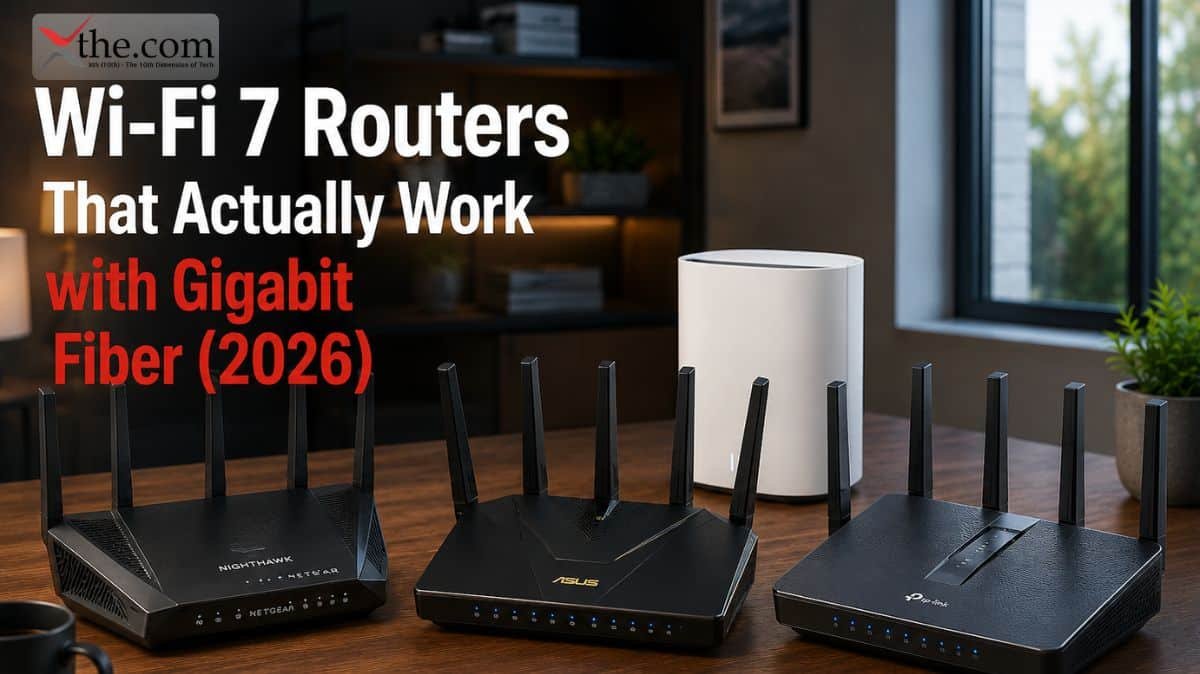
Gigabit fiber is now available in most major US cities, and the router your ISP shipped you is almost certainly holding you back from using it. The gateway that Xfinity, AT&T Fiber, or Verizon Fios drops at your door is built to minimum spec — enough to handle support calls, not enough to push every megabit you are paying for through a real home with real walls and real devices.
A Wi-Fi 7 router fixes that. Multi-Link Operation connects your devices across multiple bands simultaneously. Wider 320 MHz channels move more data per transmission. Smarter traffic management keeps 40 devices from stepping on each other during peak hours. If your plan delivers 1 Gbps or more to your home, the right router is the last piece that makes that speed show up on every device in every room.
Here is what actually works — matched to real ISP plans, real home sizes, and situations you will actually recognize.
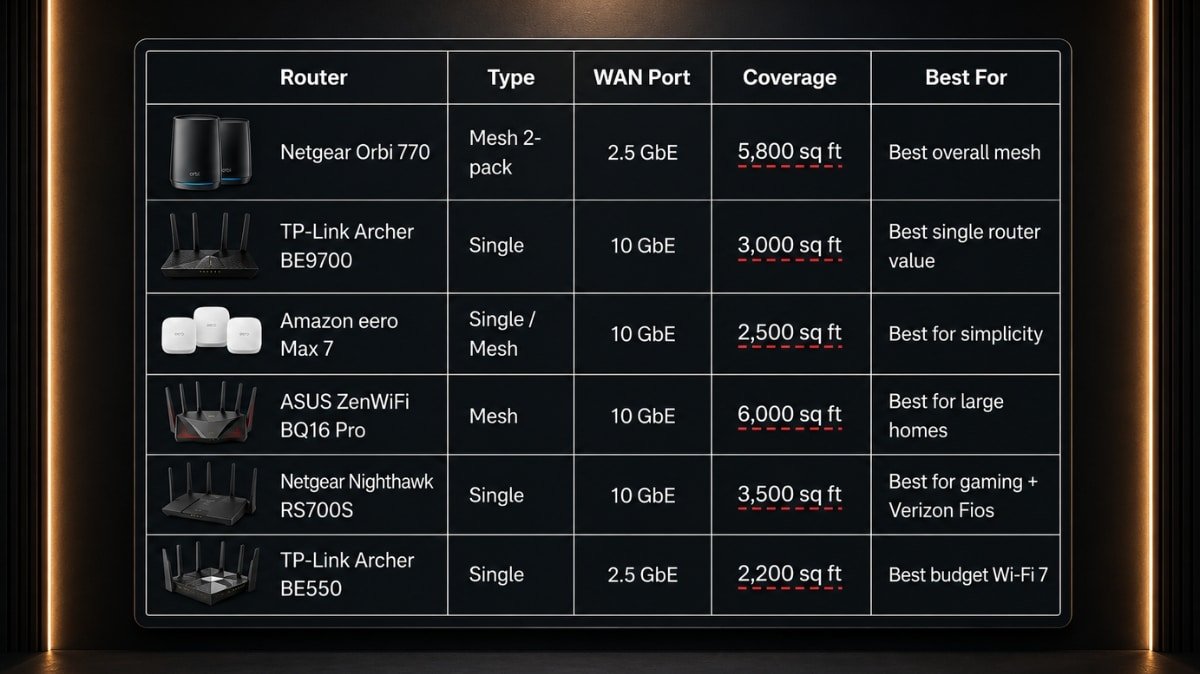
Quick Picks
Router
Type
WAN Port
Coverage
Best For
Netgear Orbi 770
Mesh 2-pack
2.5 GbE
5,800 sq ft
Best overall mesh
TP-Link Archer BE9700
Single
10 GbE
3,000 sq ft
Best single router value
Amazon eero Max 7
Single / Mesh
10 GbE
2,500 sq ft
Best for simplicity
ASUS ZenWiFi BQ16 Pro
Mesh
10 GbE
6,000 sq ft
Best for large homes
Netgear Nighthawk RS700S
Single
10 GbE
3,500 sq ft
Best for gaming + Verizon Fios
TP-Link Archer BE550
Single
2.5 GbE
2,200 sq ft
Best budget Wi-Fi 7
What Wi-Fi 7 Actually Does — and What It Does Not
Wi-Fi 6 and 6E were fast enough for a single device sitting near the router. The problem was everything else: multiple users streaming simultaneously, smart home devices piling onto the 2.4 GHz band, signal dropping through two walls to a bedroom, latency spiking during peak evening hours. Those are not speed problems — they are congestion and management problems.
Wi-Fi 7 solves three specific improvements.
Multi-Link Operation (MLO) lets your phone or laptop maintain active connections across 5 GHz and 6 GHz at the same time. The router routes each data packet over whichever path is fastest at that moment. Latency drops significantly. Speed stays consistent even when the network is busy.
320 MHz channels on the 6 GHz band double the channel width compared to Wi-Fi 6E. More width means more data per transmission. A compatible device in the same room as the router can realistically move 2 to 3 Gbps over Wi-Fi — numbers that were previously only possible with a wired connection.
Multi-RU allocation lets the router communicate with multiple devices within a single transmission window instead of taking turns. On a home network with 30 or 40 connected devices, this is what eliminates the slowdowns that hit every evening when everyone is home.
What Wi-Fi 7 does not do: it does not increase the speed your ISP delivers to your home. If AT&T Fiber gives you 1 Gbps, you get 1 Gbps. The router determines how well that 1 Gbps reaches your devices — which is exactly where most homes are losing speed right now.
Which Router Should I Get for My Specific ISP and Plan
This is the question most buying guides bury in fine print. Here it is answered directly.
I have Xfinity and my plan is 1 Gbps or under. The TP-Link Archer BE550 at $150 handles this without any waste. The 2.5 GbE WAN port has headroom above 1 Gbps and covers apartments and smaller homes cleanly. If your home is over 2,500 square feet, move up to the Netgear Orbi 770 mesh system instead.
I have Xfinity and my plan is 2 Gbps. You need a 10 GbE WAN port. The TP-Link Archer BE9700 at $190 is the right call for a single-router setup. For larger homes, the Netgear Orbi 770 2-pack covers the space — its 2.5 GbE WAN port handles 2 Gbps with a narrow margin.
I have AT&T Fiber on any plan. Every router on this list works with AT&T Fiber, but you must put the AT&T BGW gateway into IP Passthrough mode first. Without that step, your own router sits behind AT&T’s gateway doing double NAT, which throttles performance and breaks VPN connections. The five-minute setup is worth doing before you assume a router is underperforming. For AT&T Fiber 2 Gbps plans, use a router with a 10 GbE WAN port — the Archer BE9700, eero Max 7, or ZenWiFi BQ16 Pro.
I have Verizon Fios. Connect via Ethernet directly from the ONT box — this is simpler than the coax MoCA method and works with every router here. For Fios 1 Gbps, the Orbi 770 or Archer BE9700 both work well. For Fios 2 Gbps, use a router with a 10 GbE WAN port. Gamers on Fios should look specifically at the Netgear Nighthawk RS700S, which pairs well with Fios’s already low-latency fiber infrastructure.
The Best Wi-Fi 7 Routers in 2026
1. Netgear Orbi 770 — Best Overall Wi-Fi 7 Mesh System
Price: ~$300 (2-pack) | Type: Tri-band mesh | WAN Port: 2.5 GbE | Coverage: 5,800 sq ft | Speed: Up to 10 Gbps
The Orbi 770 came out ahead after testing against six competing mesh systems in a two-story brick home on a 2 Gbps fiber connection. It delivered the most stable speeds, cleanest roaming between nodes, and zero disconnections over two weeks of continuous testing. Early firmware versions had issues — those are resolved, and current firmware translates the hardware’s advantage into a daily-use experience that competing systems have not matched at this price.
For Xfinity gigabit and AT&T Fiber 1 Gbps users, the 2-pack covers up to 5,800 square feet with a dedicated 6 GHz backhaul band keeping node-to-node communication separate from client traffic. Adding a satellite does not shrink the bandwidth available to your devices — a problem that plagues cheaper mesh systems.
The one honest limitation: The 2.5 GbE WAN port is a ceiling. Users on AT&T Fiber 2 Gbps or Verizon Fios 2 Gbps plans will extract the full plan speed in wired connections but may see that WAN port becomes a bottleneck under peak wireless load. If you are on a multi-gig plan and need full headroom, the ASUS ZenWiFi BQ16 Pro is the right move instead.
This is the router for: Families in medium to large homes, 2,000 to 5,000 square feet, on Xfinity or AT&T Fiber gigabit plans who want mesh coverage without spending $1,000.
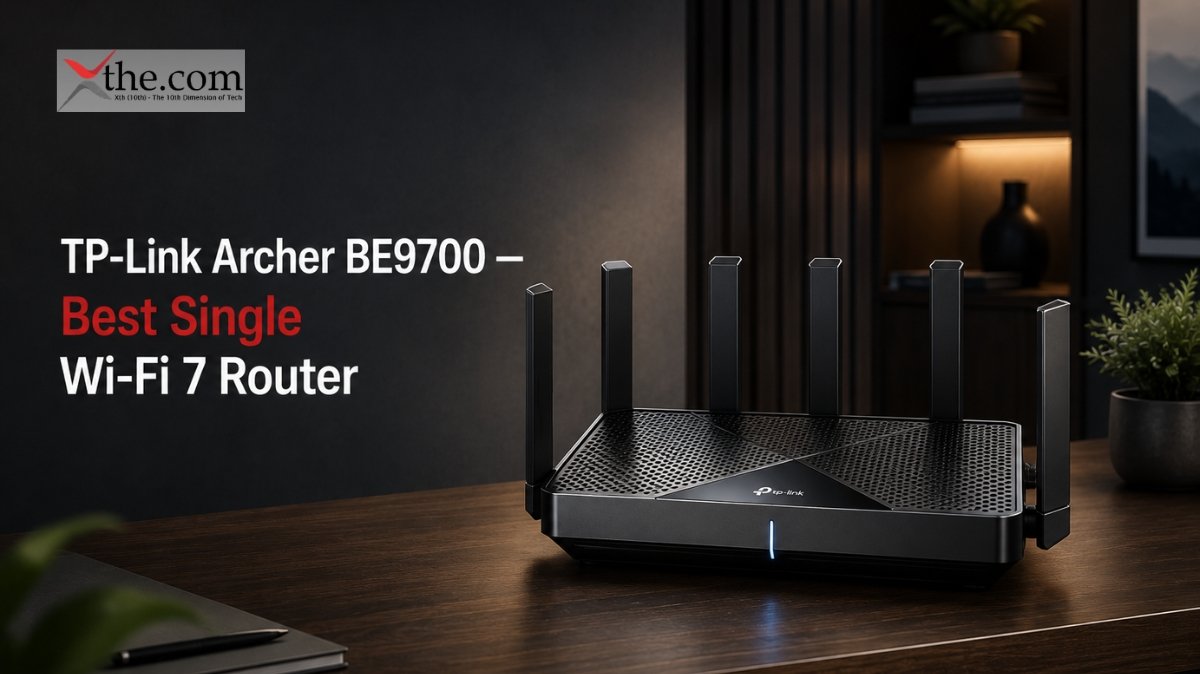
2. TP-Link Archer BE9700 — Best Single Wi-Fi 7 Router
Price: ~$190 | Type: Tri-band single | WAN Port: 10 GbE | Coverage: 3,000 sq ft | Speed: Up to 9.7 Gbps
Under $200 with a 10 GbE WAN port and genuine tri-band Wi-Fi 7 performance. That combination does not exist at this price point from any other manufacturer in 2026. The Archer BE9700 is the answer for apartments, condos, and homes under 3,000 square feet where a single router covers the space and budget matters.
Behind it: one 10 GbE LAN port and four 2.5 GbE ports — enough for a NAS, a wired gaming rig, and two smart TVs without needing a separate switch. There is also a USB 3.0 port for network storage, and Mac users get Time Machine support built in without any configuration.
Real-world 6 GHz performance outpaces most Wi-Fi 6E routers at the same distance. The 5 GHz band holds up through standard interior walls better than comparable budget hardware. TP-Link’s Tether app manages setup, QoS, and guest network controls without requiring a web interface.
The one honest limitation: No native mesh support beyond adding TP-Link EasyMesh extenders. If your home needs mesh coverage, start with the Orbi 770 instead. Some users also prefer to keep TP-Link hardware off their network given the company’s Chinese ownership — a valid security posture that is worth knowing before purchasing.
This is the router for: Anyone in a smaller home or apartment on AT&T Fiber, Xfinity, or Verizon Fios up to 2 Gbps who wants genuine Wi-Fi 7 performance at a price that does not require justification.
3. Amazon eero Max 7 — Best Wi-Fi 7 Router for People Who Are Done Troubleshooting
Price: ~$450 | Type: Tri-band single / expandable mesh | WAN Port: 10 GbE | Coverage: 2,500 sq ft | Speed: Up to 11 Gbps
The eero Max 7 is for people who have spent too many evenings restarting their router and just want it to work. Setup is five minutes through the eero app. Updates run silently in the background. The compact cylinder does not look like networking hardware. You plug it in, connect to your phone, and your network is running — including automatic band steering, automatic firmware updates, and automatic security scanning.
Frontier Fiber ships the eero Max 7 with its 2 Gbps and 5 Gbps plans. That tells you it performs at multi-gig speeds. Dual 10 GbE ports — one WAN, one LAN — confirm it. For Verizon Fios users connecting via Ethernet from the ONT, the eero Max 7 is the simplest high-performance option available.
The eero ecosystem scales without configuration. Add a second or third node, and the system builds a mesh automatically. Every node is the same hardware, so there is no separate “satellite” SKU to track down.
The one honest limitation: No web interface. No advanced QoS controls. No VLAN configuration. No traffic logs. The eero works entirely through the Amazon app and requires an Amazon account. Users who want full visibility and control over their network will find the eero frustrating. At $450 for a single unit, it is also the most expensive standalone router on this list — the TP-Link BE9700 delivers comparable raw performance for $260 less.
This is the router for: Remote workers and busy households who value a stable, maintenance-free network over advanced configuration options. Especially strong for Verizon Fios and Frontier Fiber customers.
4. ASUS ZenWiFi BQ16 Pro — Best Wi-Fi 7 Mesh for Large Homes and Thick Walls
Price: ~$1,100 (2-pack) | Type: Quad-band mesh | WAN Port: 10 GbE | Coverage: 6,000 sq ft | Speed: Up to 19 Gbps
Most mesh systems make a quiet compromise: the 6 GHz band handles both the wireless backhaul between nodes and the connections from your devices — splitting that bandwidth into two. At close range you may not notice. At a distance, when the backhaul, link is already working hard, your device connections slow down.
The ZenWiFi BQ16 Pro does not make that compromise. Each unit has two separate 6 GHz radios. One handle backhaul exclusively. The other serves client devices exclusively. The result is that the speed you measure next to a satellite node is close to the speed you measure next to the main router — which is not true of most mesh systems, even expensive ones.
For homes over 4,000 square feet, multi-level construction, or concrete and brick walls that kill Wi-Fi range, this is the hardware that actually solves the problem. The 10 GbE WAN port on each unit handles any current fiber plan, including AT&T Fiber 5 Gbps and Verizon Fios 2 Gbps. A USB port on each node connects to a phone hotspot for automatic internet backup during outages — useful in-home offices where a dropped connection costs real money.
ASUS firmware is the most complete on this list: traffic analyzer, AiProtection security via Trend Micro, VPN server, AiMesh controller, and granular QoS. Power users who want to see everything happening on their network get more from ASUS than any other brand here.
The one honest limitation: $1,100 for a two-pack is a serious investment. The units are large and require adequate ventilation — the internal cooling fan cycles audibly every few minutes under load. ASUS’s app is functional but noticeably less polished than Netgear’s or eero’s.
This is the router for: Homeowners with large, multi-story, or concrete-construction homes on multi-gig fiber plans who want the highest-performance mesh system available without going to enterprise hardware.
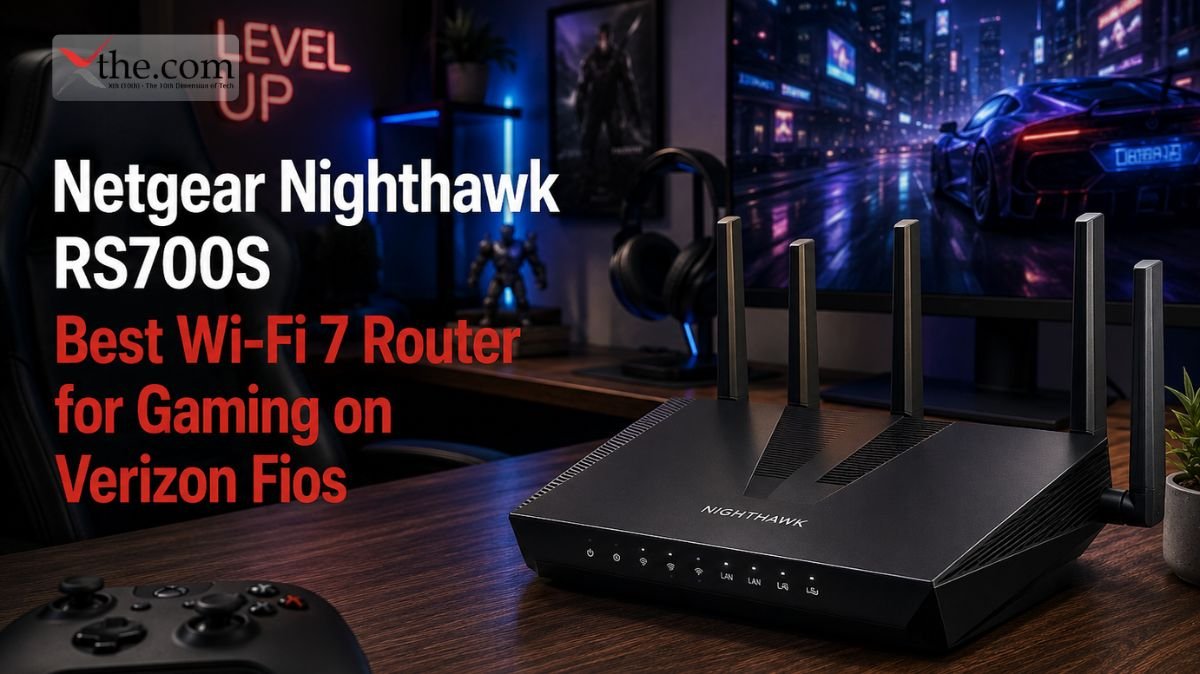
5. Netgear Nighthawk RS700S — Best Wi-Fi 7 Router for Gaming on Verizon Fios
Price: ~$450 | Type: Tri-band single | WAN Port: 10 GbE | Coverage: 3,500 sq ft | Speed: Up to 10 Gbps
Verizon Fios already delivers lower baseline latency than cable or DSL — that is a structural advantage of fiber. The Nighthawk RS700S is built to preserve and extend that advantage through the router and into your gaming sessions.
Hardware-level QoS lets you dedicate bandwidth and low-latency treatment to a specific device — your gaming PC or console — while the rest of the household streams and downloads without interrupting your connection. This is not a software toggle that slows down when the router is busy. It is handled at the chipset level, which means it works under load when you actually need it.
On the back: one 10 GbE WAN, one 10 GbE LAN, four 1 GbE LAN ports. If your gaming PC is wired in, the 10 GbE LAN means that connection is never the weak link — regardless of plan speed. And at 3,500 square feet of coverage, it handles most single-family homes without needing a satellite node.
The one honest limitation: Netgear’s gaming features require a Netgear account and app dependency for some controls. Mesh expansion works but is not as seamless as the Orbi ecosystem. At $450 it sits at the same price as the eero Max 7, which has stronger multi-gig performance if gaming is not your priority.
This is the router for: Gamers on Verizon Fios or AT&T Fiber who play competitively and need guaranteed low latency even when multiple household members are using the network simultaneously.
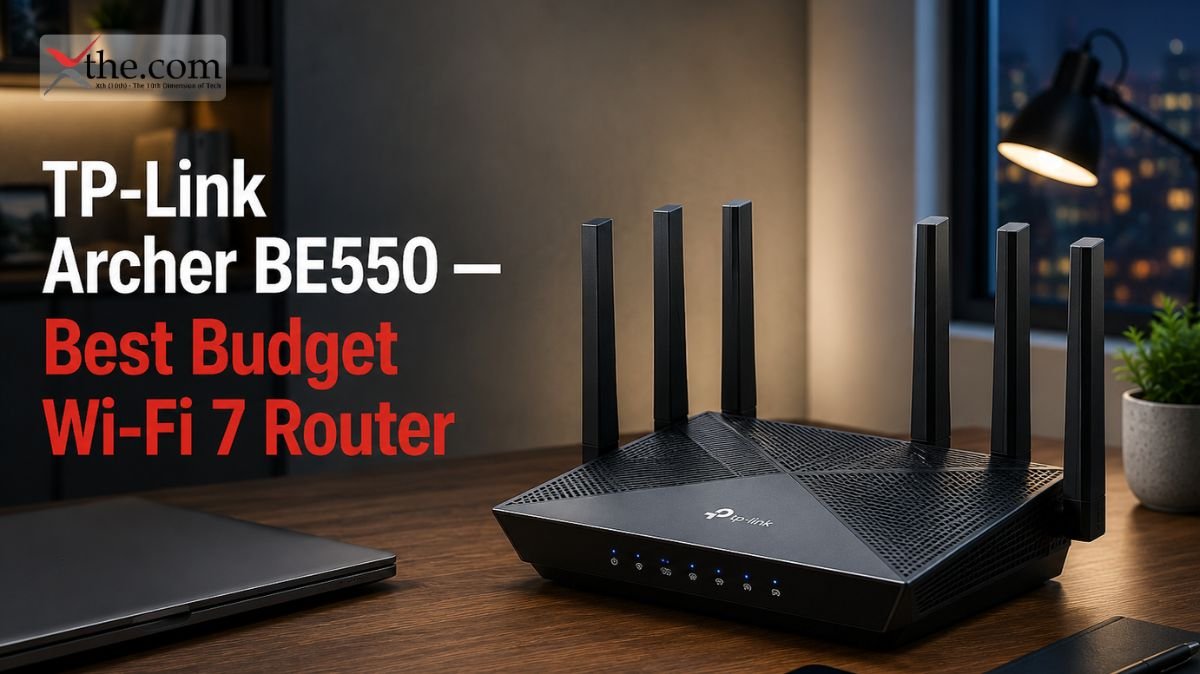
6. TP-Link Archer BE550 — Best Budget Wi-Fi 7 Router
Price: ~$150 | Type: Dual-band single | WAN Port: 2.5 GbE | Coverage: 2,200 sq ft | Speed: Up to 3.6 Gbps
The Archer BE550 makes Wi-Fi 7 core improvements accessible at a premium price. For Xfinity customers on standard gigabit plans, Spectrum users, or anyone whose plan tops out at 1 Gbps, the BE550 delivers MLO, wider channels, and better multi-device handling at a price that is genuinely difficult to argue with.
The 2.5 GbE WAN port is the honest ceiling. It handles gigabit plans cleanly. Users on 2 Gbps or faster plans will hit that ceiling — in which case the Archer BE9700 at $190 is the right step up. If your current plan is 1 Gbps or under, this limitation never affects you.
Real-world 5 GHz performance is strong for the price. The 2.4 GHz band covers smart home devices at a range. Setup through the TP-Link Tether app takes under ten minutes.
The one honest limitation: No 6 GHz band means it misses the widest Wi-Fi 7 channels. Coverage is limited to smaller homes. Users who expect to upgrade to a multi-gig plan in the near future should buy the Archer BE9700 now rather than upgrading again in twelve months.
This is the router for: Renters, apartment dwellers, and budget-conscious homeowners on Xfinity, Spectrum, Cox, or Optimum gigabit plans who want a meaningful Wi-Fi upgrade without spending over $150.
Orbi 770 vs eero Max 7 — Which One to Actually Buy
These two come up as the most common comparison because they are priced close to each other for single-unit configurations and both target mainstream households.
Buy the Orbi 770 if: Your home is over 2,500 square feet and you need mesh coverage. You want more network controls than the eero provides. You are on Xfinity or AT&T Fiber gigabit and need whole-home coverage.
Buy the eero Max 7 if: Your home is under 2,500 square feet, or you can place a single router centrally. You want the simplest possible setup and maintenance experience. You are on Verizon Fios or Frontier Fiber and prioritize reliability over advanced features.
The performance difference in real-world use is smaller than the spec gap suggests. Both deliver strong Wi-Fi 7 speeds in the rooms directly served by hardware. The Orbi 770 covers more square footage per dollar with the 2-pack. The eero Max 7 requires less ongoing attention. Those differences matter more than the speed of benchmarks for most households.
When You Should NOT Buy a Wi-Fi 7 Router Yet
Not every household needs to upgrade right now. Here is when waiting makes more sense than spending.
Your internet plan is under 500 Mbps, and you have no immediate plans to upgrade. At that speed, a Wi-Fi 6 router is sufficient and costs significantly less. Wi-Fi 7’s advantages compound at higher plan speeds and higher device counts.
Every device in your home is over three years old. Wi-Fi 7’s MLO feature requires a Wi-Fi 7 capable device to activate — older phones, laptops, and tablets fall back to Wi-Fi 6 or 6E behavior. You still benefit from better network management, but the headline speed improvements do not appear until you have Wi-Fi 7 client devices.
Your current router is working fine, and your home is under 1,500 square feet. A functioning Wi-Fi 6 router in a small space does not leave meaningful performance on the table that Wi-Fi 7 would recover. Wait until your router fails, or your plan speed increases.
Matching Your Router to Your Fiber Plan — The Quick Reference
Your router’s WAN port is the hard ceiling for internet speed. A bottleneck here loses throughput before the Wi-Fi signal even leaves the antenna.
Up to 1 Gbps — 2.5 GbE WAN is sufficient. BE550 or Orbi 770 handle this cleanly.
1 to 2.5 Gbps — 2.5 GbE WAN covers this range with narrow overhead. Orbi 770 works; Archer BE9700 gives more headroom.
2.5 Gbps and above — 10 GbE WAN required. Archer BE9700, eero Max 7, ZenWiFi BQ16 Pro, and Nighthawk RS700S all qualify.
For AT&T Fiber specifically: configure IP Passthrough on the BGW gateway before connecting to your router. Without it, double NAT reduces performance and breaks gaming and VPN connections.
Mesh or Single Router — The Actual Decision
A single router works for homes under 2,000 square feet with standard drywall and wood-stud construction, with the router placed reasonably centrally.
You need a mesh system when any of these are true: your home exceeds 2,500 square feet, you have multiple floors with no central placement option, or your walls are concrete, brick, or older plaster construction that blocks Wi-Fi signal aggressively.
The Netgear Orbi 770 handles the first two situations. The ASUS ZenWiFi BQ16 Pro handles all three including the worst-case construction — at a price that reflects it.
Placement matters as much as hardware. The best router underperforms when installed in a corner, in a cabinet, or far from where most devices actually live. Place the main router as centrally as your ISP’s entry point allows.
Frequently Asked Questions
1. I just upgraded to AT&T Fiber 2 Gbps. Do I need a new router?
Yes, if your current router has a 1 GbE WAN port. You are capping your speed at 1 Gbps at the hardware level before it reaches any device. A router with a 10 GbE WAN port — the Archer BE9700 or eero Max 7 — removes that ceiling.
2. My Wi-Fi is slow only in my bedroom. Do I need a whole new router or just an extender?
If the bedroom is through two or more walls and more than 40 feet from your current router, a mesh node is the right fix. An extender amplifies a weak signal and adds latency in the process. A mesh node like the Orbi 770 satellite maintains a dedicated backhaul connection that does not sacrifice speed the way extenders do.
3. Does Wi-Fi 7 help if I only have five or six devices?
Yes, but less dramatically than in larger households. With few devices, the congestion management improvements matter less. The main benefit for small households is MLO — lower latency and more consistent speeds for each connected device.
4. Can I use the Netgear Orbi 770 with Verizon Fios?
Yes. Connect via Ethernet from the Fios ONT box. The Orbi 770 handles Fios gigabit plans with the 2.5 GbE WAN port. For Fios 2 Gbps, the WAN port provides enough headroom for most use cases, though heavy simultaneous wired and wireless use may approach the ceiling.
5. Is Wi-Fi 7 worth working from home?
For remote workers with video conferencing running on one device, file syncing on another, and smart home devices in the background, yes. Wi-Fi 7’s MLO keeps latency low during video calls even when background traffic is competing for bandwidth — the main frustration with Wi-Fi 6 in work-from-home setups.
Final Verdict
For most American households on a gigabit fiber plan, the Netgear Orbi 770 is the right purchase. It covers large homes, works out of the box with Xfinity, AT&T Fiber, and Verizon Fios, and delivers consistent real-world performance at a price that does not need a lengthy justification.
Users in smaller homes or apartments who do not need to mesh: the TP-Link Archer BE9700 at $190 is the most compelling value on this list. A 10 GbE WAN port and genuine Wi-Fi 7 tri-band performance under $200 is the deal in this category right now.
Verizon Fios gamers: the Netgear Nighthawk RS700S is the specific hardware for your situation. The hardware-level latency prioritization makes a measurable difference in competitive play.
Done troubleshooting and want it to just work: eero Max 7. No caveats.
Wi-Fi 7 is a real generational improvement — not just a spec number on a box. On a fiber plan delivering genuine gigabit speeds to your home, the right router is the last upgrade that makes that investment visible on every device in every room.
The Magnificent Seven index has gained just 1.1% in 2026. The Nasdaq 100 is up almost 18%. That gap is not a rounding error. It is the clearest signal yet that Coinbase, Lyft, Axon, and AI trade 2026 has become a story investors can no longer afford to ignore, even as Nvidia and its mega-cap peers sit on the sidelines of their own rally.
For three years, “AI stock” meant one of seven names. That definition is breaking down in real time. Coinbase COIN, Lyft LYFT, and Axon AXON rallies beyond Mag7 dynamics now show up in earnings calls, federal contract notices, and product launches that have nothing to do with chips or cloud capital expenditure. A crypto exchange, a ride-hailing app and a Taser manufacturer are proving that beyond Magnificent Seven stocks, the artificial intelligence trade has moved from a thematic bet on seven balance sheets to something embedded across sectors that rarely share a headline.
The Breadth Behind the Boom
Wall Street used to have a simple rule for AI investing: buy the Magnificent Seven and wait for their value to grow. That no longer fits the market. Microsoft just had its worst month since 2000, and Meta’s CEO reportedly told staff that progress on AI agents has been slower than hoped. Investors are still interested in AI, but they no longer believe only seven companies can benefit from it.
Investors pulled hundreds of millions of dollars from Magnificent Seven-focused funds in June while channeling billions into semiconductor and memory-chip vehicles, according to Bloomberg data. That rotation tells only part of the story: market breadth AI 2026 now extends past chipmakers into consumer platforms, transport systems and public-safety technology, sectors that were never supposed to carry AI multiples at all. Anyone still charting the market beyond the Magnificent 7’s breadth by watching a handful of chip tickers is already missing where the next leg of this trade is showing up.
Coinbase Turns Regulatory Clarity into Product Velocity
For much of early 2026, Coinbase traded as if it was waiting for approval. That changed in just five days. The stock jumped about 19% to close near $165 on July 2, briefly reaching $173 during the day. This jump followed the company’s second ‘System Update’ event, which introduced tokenized stock access for non-US users, options trading on the platform, and an AI-powered, SEC-registered Coinbase Advisor.
Timing is important. The GENIUS Act, a federal stable coin law passed a year ago, requires final regulations by mid-July 2026. This deadline came just as Coinbase took action. CEO Brian Armstrong told Yahoo Finance that agentic infrastructure is now central to Coinbase’s future. The company now lets users connect tools like Claude to their accounts to rebalance portfolios in plain English. Coinbase also joined over 140 firms, including Visa and Mastercard, to launch a new dollar-pegged stablecoin called Open USD, expanding its role in on-chain payments as regulations become clearer. After the event, Bernstein kept its high $330 price target on the stock.
A Five-Day Sprint Worth Watching
None of this happened because Bitcoin suddenly rallied. It happened because Coinbase shipped products faster than the market expected a crypto exchange could. That is a different kind of catalyst than the one driving Nvidia, and it is precisely why the Yahoo Finance Coinbase Lyft Axon rally deserves focus from investors who have tuned out anything that isn’t a GPU maker.
Lyft’s Bet on Bezos-Style Reinvention
Lyft has not yet released its second-quarter results, which are due August 5. What has driven the stock higher by mid-July is different: a strong move into self-driving cars and a concentration on operational discipline, which CEO David Risher credits lessons from Jeff Bezos. The stock rose from about $13.71 in mid-April to over $16 by mid-July, helped by a $1 billion share of buyback, a growing partnership with Waymo in Nashville, and the purchase of FreeNow to speed up Lyft’s expansion into Europe.
Risher told Yahoo Finance’s Power Players podcast that Lyft made “a big decision last year to go global,” highlighting acquisitions that diversify the business and support its self-driving plans. The company also hired Senthil Padmanabhan, a former eBay engineering leader, as chief technology officer starting July 20. This hire is intended to accelerate Lyft’s AI and automation efforts. These changes aren’t only about Q2 earnings—they show Lyft is restructuring for a future with both human drivers and robotaxis, and investors are already reacting to this shift.
Axon’s Non-Lethal Pivot Meets Federal Tailwinds
Axon Enterprise provides the clearest illustration of how far this AI trade-expanding-stocks-2026 story can travel from Silicon Valley. The Taser maker, started in a Tucson garage in 1993, saw its shares jump about 34% in one week after federal filings showed President Trump bought between $1 million and $5 millions of Axon stock. Two weeks later, Immigration and Customs Enforcement announced it was seeking a five-year, $220 million Taser contract. Procurement experts told CNBC that the requirements seem to fit only Axon’s latest device.
Behind the headlines, Axon has a real software business. Its AI-powered products, like the Draft One report-writing tool and the Axon Assistant platform now used by law enforcement agencies across the country, saw revenue growth by more than 700% year over year last quarter. CEO Rick Smith told Yahoo Finance that Axon is also working on a new cartridge to replace bullets, adding a hardware story to its software growth. Piper Sandler and Needham both raised their price targets on the stock to $724 and $750, respectively, following these developments.
What Market Breadth Beyond Mag7 Means for Investors
Market breadth expanding beyond Mag7 what Coinbase, Lyft, and Axon surge means investors ask most frequently boils down to a single question: is this rotation durable, or a temporary release valve for a market tired of watching seven stocks decide everything? The honest answer sits somewhere between the two. Coinbase’s rally rests on real regulatory milestones and product launches, not speculation. Axon’s federal contract prospect is real in scale but unconfirmed in timing, since the ICE award has not been finalized. Lyft’s story is the least AI-native of the three, built more on autonomous-vehicle positioning and capital discipline than on any large language model.
Coinbase, Lyft, and Axon prove AI trades wider than Magnificent Seven stocks in July 2026 because each company found a way to attach genuine AI infrastructure — agentic trading tools, automated report generation, machine-assisted evidence review — to a business that already had customers and revenue. That is a fundamentally different risk profile than paying a premium multiple for future capital expenditure returns.
Investors now have the chance to gain exposure to AI without owning chipmakers or big tech giants. The risk is confusing a short-term contract rumor or a quick product launch for a lasting change in value. Coinbase still needs to show that its agentic tools can generate steady revenue, not merely headlines. Axon must turn its stock boost into a real contract before its current ICE deal ends in August. Lyft needs to prove its autonomous vehicle strategy works before Waymo’s app makes Lyft’s fleet management less important.
None of this takes away from what has already happened. Three very different companies, connected only by their use of artificial intelligence, have outperformed the stocks that were expected to lead to this trend. If this continues through earnings season, the Magnificent Seven might need a new name, or investors may stop relying on just seven companies to drive a rally that has already moved beyond them.
A stronger dollar rarely arrives without consequences. This time, investors face a more complicated equation. The US dollar surge in July 2026 has unfolded alongside rising Treasury yields, higher oil prices, and renewed geopolitical tension after Iran declared the Strait of Hormuz closed. The result is a market environment where cash flows into the world’s reserve currency while government bonds lose ground. The DXY dollar’s rally on July 16 reflects investors’ pursuit of safety, yet the same forces driving the dollar higher are also increasing inflation expectations and pushing borrowing costs higher. That unusual combination defines the dollar good, bonds bad Iran narrative currently dominating global markets.
US dollar surge July 2026 Signals a Flight to Safety.
Currency markets reacted quickly as traders reconsidered geopolitical risks. The US Dollar Index jumped, pushing the DX-Y higher. NYB dollar surges one of the day’s top market indicators. Investors often turn to the dollar during periods of instability because it is the primary global reserve currency and the standard for international trade and finance.
Meanwhile, oil markets reacted to possible supply disruptions from the Strait of Hormuz, a key route for global energy shipments. Higher crude prices brought back worries that inflation could speed up after a period of calm. This has created a market divide that many portfolio managers have not seen in years.
The DXY dollar rally on July 16 shows more than just risk aversion. It signals a move toward cash as worries about inflation make long-term bonds much less appealing.
Why the Dollar Is Good, and Bonds Are Bad: Iran Has Become the Market’s Defining Theme
Usually, when geopolitical uncertainty is high, both the US dollar and Treasury bonds benefit as investors seek safe assets. This time is different because rising oil prices are changing the situation.
Higher energy prices raise costs for transportation, manufacturing, and consumers worldwide. Investors quickly started to expect that the Federal Reserve can keep interest rates high for longer than they thought before.
When interest rate expectations rise, bond prices fall.
That explains why traders describe today’s environment as a dollar-good, Iran-bad environment for bonds. Investors see the dollar as a safe place, but they are concerned that ongoing inflation will reduce the value of bonds.
The key 10-year Treasury yield is now close to 4.65%, making it one of the most watched numbers in global markets. For every 10-basis point rise in Treasury yields, the federal government’s yearly borrowing costs go up by about $100 billion, adding more financial pressure even before any new spending.
DXY dollar rally July 16 and the Oil Connection
Energy markets remain central to the current currency story.
The Strait of Hormuz handles roughly one-fifth of global oil shipments. Even the possibility of prolonged disruption forces traders to reexamine future inflation, corporate earnings, and monetary policy.
The relationship follows a straightforward sequence.
Iran-related tensions push oil prices higher.
Higher oil prices lift inflation expectations.
Higher inflation expectations drive Treasury yields upward because investors demand more compensation for holding bonds.
Higher yields strengthen the US dollar as global investors pursue higher returns and increased security.
This chain reaction explains why traders’ dollar bonds Iran Hormuz Bloomberg has become one of the most discussed market themes among professional investors. Bloomberg’s market analysis, later reflected across financial reporting including Yahoo Finance, highlighted precisely this unusual divergence between currency strength and bond weakness.
The Impact on Global Companies
A stronger dollar produces winners and losers.
Big American multinational companies earn a lot of money overseas. When they bring those earnings back to the US, the amount shrinks if the dollar is strong. Tech firms, drug makers, industrial exporters, and consumer brands frequently see their profits squeezed when the dollar remains high for an extended period.
On the other hand, investors with cash or short-term investments in dollars benefit from stronger buying power and better yields.
This creates a further layer of complexity within the dollar rally bonds to sell DXY July 2026 environment. Equity investors must distinguish between businesses that benefit from domestic strength and those exposed to international currency headwinds.
Export-heavy companies may experience reduced competitiveness as American goods become more expensive abroad.
Domestic-focused businesses face fewer currency-related challenges.
Bond Investors Face New Challenges
Fixed-income investors rarely welcome rapid increases in Treasury yields.
Long-term bonds drop in value when yields go up because their interest payments are lower than what new bonds offer.
Portfolio managers now prefer shorter-term bonds, which let them reinvest their money sooner if interest rates keep rising.
The dollar good environment Iran bad bonds backdrop reinforces that strategy. Investors remain cautious about locking up money in long-term bonds while inflation remains unclear.
Corporate bonds are also under more scrutiny, since credit spreads could widen if the economy weakens, and energy costs stay high.
Understanding Traders grapple dollar surges bonds fall Iran Hormuz escalation July 2026
The phrase ‘Trader’s grapple dollar surges bonds fall Iran Hormuz escalation July 2026′ sums up the unusual mindset now shaping investment choices.
Markets usually reward defensive positioning during geopolitical crises.
Today, investors have to juggle several competing factors at once.
The dollar offers safety.
Oil threatens inflation.
Treasury yields continue rising.
Corporate earnings face currency pressure.
Government borrowing becomes increasingly expensive.
These mixed signals mean investors need to look past the usual strategies for recessions or growth.
Institutional investors are now focusing more on flexibility instead of taking big risks with long-term bonds.
Portfolio Strategy in a Good Dollar, Bad Bond Environment
The phrase “Good for dollar bad for bonds what Iran escalation means portfolio July 2026” summarizes the investment question confronting wealth managers and institutional investors.
Right now, some types of investments look more attractive than long-term government bonds.
Short-duration Treasury bills provide attractive yields while limiting interest-rate risk.
Energy producers benefit directly from higher commodity prices if supply constraints continue.
Dollar-denominated real assets retain purchasing power during times of inflation.
Companies with primarily domestic revenue streams often experience fewer foreign exchange headwinds than multinational exporters.
At the same time, investors are careful with sectors that rely on falling interest rates or strong international earnings growth.
Managing risk is now more important than simply being invested in the whole market.
Spreading investments across various asset classes remains key, since global events can change quickly.
Reading the DX-Y.NYB dollar surge Beyond Headlines
The DX-Y.NYB dollar surge is about more than just foreign exchange shifts.
It shows how expectations are shifting about inflation, Federal Reserve policy, global trade, energy markets, and government finances.
Professional investors are now looking at currency markets and bond yields together rather than as separate signals.
This combined approach gives a better view of where markets might be headed.
If oil prices settle down and tensions ease, Treasury yields might fall, and the dollar could stop rising as quickly.
But if energy problems continue, investors could stay stuck in this ‘good dollar, bad bonds’ situation for a while.
Market Outlook
The US dollar surge in July 2026 shows how fast global markets can change when geopolitics shift. The fact that both the DXY dollar rally on July 16 and Treasury yields are rising suggests that inflation worries are now more important than the usual demand for safe bonds. As long as there is uncertainty around the Strait of Hormuz, the story of a strong dollar, weak bonds, and concerns about Iran will likely stay in focus. Portfolio managers are now working to stay flexible, manage interest rate risk, and allocate capital where higher rates and a strong dollar present opportunities rather than risks.
Three seats became available at the International Space Station this week, and three new crew members arrived within hours to fill them. This quick exchange is the essence of a Soyuz handover, and it happened again on Tuesday. The Soyuz crew’s ISS 2026 rotation brought a new team to the station just as their predecessors prepared to return home after eight months in space.
The new ISS crew arrives in July 2026 with NASA astronaut Anil Menon and Roscosmos cosmonauts Pyotr Dubrov and Anna Kikina. They launched aboard Soyuz MS-29 from the Baikonur Cosmodrome in Kazakhstan at 10:47 a.m. EDT. The spacecraft docked with the station’s Prichal module about three hours later, at 1:52 p.m. EDT, after a two-orbit journey. Dubrov is the mission commander, making his second spaceflight, as is Kikina, while Menon is on his first trip to space. The three will spend about eight months on the station, with plans to return to Earth in April 2027.
A Crew Handover Built on Overlap, Not Urgency
Spaceflight almost never allows for gaps, and NASA and Roscosmos have spent decades perfecting the process to avoid them. Menon, Dubrov, and Kikina will work alongside the outgoing Soyuz MS-28 crew for about twelve days. This coincidence gives them time to share important knowledge that manuals can’t fully explain, like which valve is tricky, which experiment needs extra care, or which module sounds different than before.
The outgoing crew is the other half of this story, and the reason the 240-day space station crew returns narrative matters as much as the arrival itself. Roscosmos cosmonauts Sergey Kud-Sverchkov and Sergey Mikayev, along with NASA astronaut Chris Williams, launched on November 27, 2025, and are set to undock from the station’s Rassvet module on July 26. Their stay will be about 241 days, close enough to the round figure to earn the label. This is the new Soyuz crew replaces 240-day ISS station dynamic in practice: one crew’s arrival is timed almost precisely to another’s departure, a rhythm the two space organizations have maintained with few interruptions since the station’s early days.
What Eight Months in Orbit Does to a Body
The physical effects of long-term spaceflight are tough, even if they don’t make headlines. Bones lose about 1% to 1.5% of their density each month in microgravity unless astronauts work hard to prevent it. Muscles weaken, and the sense of balance, adjusted to months without gravity, has to adapt again. After landing in Kazakhstan, Kud-Sverchkov, Mikayev, and Williams will begin a rehabilitation program lasting several weeks. This includes working with physical therapists, retraining their balance, and slowly getting used to standing up again. It may not be as dramatic as a launch but helping the body adjust back to life on Earth is a key part of spaceflight.
The Station Itself Is on Borrowed Time
This International Space Station crew rotation in July 2026 arrives against a background that gives every mission now a quiet undertone of conclusiveness. NASA has committed to operating the ISS through 2030, after which a special U.S. Deorbit Vehicle will guide the 450-ton station into a controlled descent over a remote part of the Pacific Ocean. According to NASA’s schedule, that leaves about four more years of crewed missions. This timeline affects everything, from which research gets priority to the push for commercial replacement programs by companies like Axiom Space, Blue Origin, and Vast.
Even with these changes ahead, Menon, Dubrov, and Kikina have a busy mission. They will conduct many scientific experiments, perform spacewalks, and handle routine maintenance on systems that have run nonstop for 25 years. Menon will focus on research into making semiconductor crystals in space, which could lead to better computer and medical device parts. It’s a unique connection between science in orbit and the technology industry back on Earth.
The crew’s research also shows a bigger change happening on the station: there is more use of automated and AI tools to spot problems in medical and system checks before people need to step in. NASA has tested this kind of decision-support software over several missions, believing that with only a few years left, it’s better to catch faults early than to add more crew to fix them later. This is just one part of a larger shift, the same one pushing companies like Axiom Space, Blue Origin, and Vast to develop their own crewed stations. These small changes frequently become more important in hindsight than they seem at first.
The Commercial Crew Backdrop
The Soyuz system is still one of the two vehicles that keep the ISS staffed. SpaceX’s Dragon capsule takes turns with Soyuz for crew transport under a barter agreement between NASA and Roscosmos, which has been extended through at least 2027. This deal makes sure astronauts from both countries fly on each other’s spacecraft, providing a backup in case one vehicle is grounded. This ISS NASA Russian crew return July 2026 cycle is a sign that, geopolitical tension aside, the operational partnership between the two agencies has proven durable in ways few other U.S.-Russia collaborations possess.
The Soyuz crew’s return to Earth on July 26 will follow a familiar routine: undocking from Rassvet, a brief free flight, and a parachute landing on the Kazakh steppe about three and a half hours later. This process is so well-practiced that it rarely makes the news—except when, as usual, everything goes smoothly.
What Comes Next
The New Soyuz crew arrives at the ISS; replaces three cosmonauts; 240-day stay; July 2026 milestone is one entry in a rotation calendar that will repeat roughly twice a year until the station’s final crew closes the hatch for good. The International Space Station crew rotation for the July 2026 240-day mission ends the cycle now underway and is unremarkable in the way that well-run infrastructure is unremarkable — which is, in its own way, the achievement worth noting. Twenty-five years of continuous human presence in orbit did not happen by accident. It happened because crews like this one keep showing up, keep handing off the work, and keep coming home in one piece. The station may now have a retirement date. The handoffs that have kept it alive for this long do not appear to be slowing down before it arrives.
Electricity bills could soon become one of the most visible costs of the artificial intelligence boom. Utility companies across the United States have requested a record-breaking $9.2 billion in utility rate hikes for 2026, with regulators now reviewing proposals that could affect more than 56 million Americans. A new PowerLines report, confirmed by CBS News, says this is the largest quarterly wave of utility rate requests ever. Utilities are expanding electrical networks to meet the massive energy needs of AI data centers while keeping up with demand from homes and businesses. The resulting power companies’ rate increases for 56 million customers have become a national economic and political issue, especially as electricity rates in Q2 2026 continue to climb in many states.
In the second quarter of 2026, it produced an unprecedented milestone for the U.S. utility industry. Utilities collectively filed requests totaling utility rate hike $9.2 billion 2026, according to the latest PowerLines $9.2 billion utility rate Q2 2026 report.
These filings affect electricity providers serving over 56 million Americans utility rate increase customers across multiple states. If regulators approve every request, residential customers could see their monthly bills go up by about $15 to $40, depending on where they live and how much electricity they use.
Unlike in past years, these requests are not mainly due to fuel costs or storm recovery. The main reason is the rapid growth of AI computing, which requires a large and stable supply of electricity.
Why AI Data Centers Are Driving Electricity Costs
The fast pace of building AI data centers has changed electricity demand forecasts nationwide. Big tech companies are committing billions in massive computing facilities that use as much power as small cities.
This growing AI data center power demand and utility rate challenge has forced utilities to accelerate investments in new transmission lines, substations, transformers, and power generation. These projects cost billions, and utilities usually recover these expenses through customer rates.
Former Michigan utility commissioner Tremaine Phillips told CBS News that many of the current rate requests are due to new, large customers joining utility systems. AI companies need reliable electricity right away, so utilities are expanding infrastructure much sooner than they had planned.
It is becoming harder to ignore the link between AI growth and higher utility bills for consumers.
Power Companies Rate Increase: 56 million Customers Could Feel
The proposed power company rate increases for 56 million customers may vary by state and utility company, but analysts expect many households will see noticeable jumps in their bills.
If a family now pays about $150 a month for electricity, a $20 increase would mean $240 more each year. In the highest estimates, some households could pay almost $500 more per year if all proposals are approved.
Small businesses have similar worries. Restaurants, shops, manufacturers, and offices already encountering higher costs may have to cover these extra utility expenses or raise prices for customers.
The effects go beyond family budgets. Higher utility costs can drive inflation, affect business investment, and change overall spending.
Understanding Electricity Rates Q2 2026
The latest filings illustrate how rapidly electricity rates Q2 2026 have become a major economic topic.
Unlike fuel prices, which can change quickly, utility rates usually last for years because they pay for long-term projects. Once approved, these rates help utilities cover construction costs over time.
Multiple factors contributed to higher electricity rates in Q2 2026, including expanding transmission networks, modernizing aging electrical grids, combining renewable energy resources, improving grid robustness, and accommodating unprecedented industrial electricity demand from AI facilities.
All these factors have led to one of the biggest waves of utility investment requests in recent years.
The Findings Behind the PowerLines $9.2 Billion Utility Rate Q2 2026Report
The PowerLines $9.2 billion utility rate Q2 2026 report shows how quickly utility planning has changed in just two years.
In the past, electricity demand remained fairly steady in many areas due to improved energy efficiency. But AI computing has changed those expectations almost overnight.
PowerLines found that utilities are now often citing AI-related industrial customers as the reason for accelerating infrastructure investments. Instead of planning slow growth over decades, utilities are dealing with immediate shortages in some fast-growing areas.
This change explains why investment proposals have hit record highs in just one quarter.
The projected 56 million Americans utility rate increase goes beyond household finances.
Higher electricity prices impact manufacturing, commercial real estate costs, healthcare, schools, and public infrastructure. While data centers bring economic growth and tech jobs, they also put a lot of strain on local power systems.
Some consumer advocates say that regular customers should not have to bear most of the costs of new infrastructure driven by corporate AI growth. Others believe that technology investments help local economies and will bring wider benefits that make utility upgrades worthwhile.
State regulators have to balance these different interests while ensuring reliable electricity services.
Regulatory Approval Will Determine Final Costs
Utility companies cannot just raise customer bills as soon as they file rate requests.
Each proposal is carefully reviewed by state public utility commissions. Regulators consider financial data, projected costs, future electricity needs, and how customers will be affected before deciding whether the increases are justified.
Consumer groups, business organizations, industrial customers, and environmental groups often take part in these reviews by providing evidence and professional opinions.
Often, regulators approve only part of the requested increases instead of the full amount.
The review process can take several months, so some approved increases may appear on customer bills later in 2026 or early 2027.
The Growing Debate Over Utility Rate Increase Report 2026
The latest utility rate-increase report for 2026 has sparked further debate over who should pay for America’s AI-driven energy growth.
Supporters say utilities need to build bigger electrical systems before shortages threaten the grid. They think investing in infrastructure now can avoid future outages and sustain economic growth fueled by AI.
Critics claim that large tech companies that use large amounts of electricity should pay more directly for new infrastructure, rather than spreading the costs to millions of regular customers.
This debate will likely continue as AI investment grows across the country.
The phrase “Utility companies request $9.2 billion rate hikes 56 million Americans Q2 2026” is more than merely a big number. It constitutes a turning point in how new technologies affect everyday household costs.
Artificial intelligence is no longer just about software—it now influences physical infrastructure. Each new data center needs more power generation, stronger transmission lines, bigger substations, and better distribution systems.
Even people who never use AI platforms directly may see higher monthly electricity bills because of these investments.
Why Electricity Rates Rising $9.2 Billion AI Data Centers Utility Demand
The question “Why are electricity rates rising $9.2 billion AI data centers utility demand” is now more important than ever for consumers, businesses, and policymakers.
The answer is that modern AI computing needs a huge amount of electricity. Utilities have to build infrastructure that can handle nonstop, high-capacity use while still providing reliable service to homes and businesses.
These investments cost a lot, and current rules usually let utilities recover approved expenses by raising customer rates over time.
It remains unclear whether future policies will require tech companies to pay a larger share of these costs.
Gazing Forward
America’s AI growth is changing much more than just the tech industry. It is affecting utility policies, state regulations, family budgets, and national infrastructure plans. The record $9.2 billion in utility rate-hike requests for 2026 show how quickly digital innovation can have real economic effects. As regulators review these proposals in the coming months, millions of people will be watching closely, since the results could affect electricity bills for years to come.