




Google Cloud regularly works with customers, partners, and registrars to deliver technology that meets their needs. We have been helping customers with digital sovereignty solutions for almost ten years.  

With this longstanding commitment, we are excited to share technical and commercial updates to our sovereign cloud solutions, enabling customers to gain greater control, choice, and security in the cloud without sacrificing functionality.  

Building on the first sovereign solutions we introduced years ago, we’ve massively scaled our global infrastructure footprint, now comprising more than:  

  • 42 cloud regions  
  • 127 zones  
  • to work at the network edge locations  
  • 33 subsea cable investments  

We have built important partnerships across Asia, Europe, the Middle East, and the United States. Our partners include:  

  • Schwarz Group and T-Systems in Germany  
  • S3NS in France  
  • Minsait in Spain  
  • Telecom Italia in Italy  
  • Clarence in Belgium and Luxembourg  
  • CNTXT in Saudi Arabia  
  • KDDI in Japan  
  • Worldwide Technology in the United States  

Our Pledge To Customer Choice 

Digital sovereignty means more than just managing encryption keys. It supports giving customers the flexibility their global businesses need. It also allows them to use multiple clouds and secure their data with advanced technologies.  

We have always supported customers in choosing providers and solutions that work for them. Because cloud sovereignty varies by customer, we offer a range of solutions to address different needs and risk levels.  

We back our strong customer commitments with reliable sovereign controls and solutions, all available now. Our updated Sovereign Cloud solution portfolio includes:  

  • Google Cloud Data Boundary lets customers decide where content is stored or processed, and allows them to manage encryption keys (which lock and unlock data) outside Google’s infrastructure. This helps them meet specific data control needs in any market.  

Google Cloud Data Boundary customers can access a broad range of Google Cloud products, including AI services. They benefit from features such as confidential computing and external key management with key access justifications, which let them control and deny access to their data as needed. With data boundaries, sovereign controls, customers can limit data processing to the United States or the EU, select countries for local data storage, and use client-side encryption to prevent unauthorized access, even by Google, to their most critical content.  

We are also introducing User Data Shield, which uses Mandiant services (security experts) to check the security of customer applications built on the Google Cloud data boundary. User Data Shield performs regular security testing of these customer applications to help confirm that sovereignty rules are being followed.  

  • Google Cloud Dedicated delivers a solution created to meet local sovereignty requirements, enabled by independent local and regional partners. For example, Google Cloud has partnered with Thales since 2021 to build a first-of-its-kind, S3NS-trusted cloud for Europe.  

This offering with Thales is intended to provide a rich set of Google Cloud services with GPUs to support AI workloads. It is operated by S3NS, a standalone French entity currently in preview. S3NS solution is designed to satisfy the rigorous security and functional resilience requirements of France’s SecNumCloud standards. We are expanding our Google Cloud dedicated footprint globally and will include Launch Next in Germany.  

For France to truly embrace digital sovereignty, it is essential to have a cloud solution that unites the greater power of hyperscale technology with the strictest local security and administrative controls. S3NS is committed to providing French organizations with access to advanced cloud services, including critical AI capabilities, all operated within France by a European operator to meet and exceed the rigorous SecNumCloud standards, said Christophe Solomon, EVP Information Systems and Secured Communications at Thales.  

  • Google Cloud air-gapped is a standalone solution designed to operate without any direct or indirect connection to external networks; ie, an air-gapped system. It is intended for customers in fields such as intelligence and defense that require high-level data security and data residency controls, meaning strict oversight of where data is stored. Google, the customer, or a Google partner can take responsibility for deploying and managing this solution.  

This solution uses open-source components and includes selected AI, database, and infrastructure services. Relying on open-source technology helps ensure business continuity and resilience during service disruptions. In 2024, Google Cloud Air Gapped was approved to host the US government’s top secret and secret-level data.  

Working with Google Cloud to introduce sovereign offerings can give our joint clients greater control, choice, and security in the cloud without jeopardizing the functionality of their underlying cloud architectures, said Scott Alfieri, Senior Managing Director and Google Business Group Lead at Accenture. Google Cloud’s extensive global infrastructure, coupled with Accenture’s transformation and industry expertise, helps organizations build an agile and scalable foundation, unlocking chances for growth and continuous innovation.  

Local Control Global Security 

Security and sovereignty go hand-in-hand. When customers control their data and operations locally, they can feel more confident about security; however, true security sovereignty is not possible if outdated infrastructure exposes data to loss or theft.  

According to the Google Threat Intelligence Group and Google Cloud’s Office of the CISO (Chief Information Security Officer), cyber attacks globally are becoming more advanced. Attackers are now leveraging Artificial Intelligence (AI) tools and techniques to exploit weaknesses in older software platforms and outdated systems.  

With Google Cloud, customers receive sovereign solutions along with top security features. These include Secure by Design technology and the expertise of the Google Threat Intelligence Group and Mandiant Consulting, which work at the front lines of cyber defense and partner with over 80 governments globally.  

Google Cloud CyberSheild uses AI and intelligence-driven tools to help governments defend against large-scale threats. Mandiant managed defense services also let customers around the world strengthen their security teams with our experts.  

Google’s Sovereign Cloud Solutions let customers leverage Google Cloud’s secure foundation and access state-of-the-art security features, including:  

  • Confidential Computing  
  • Zero Trust  
  • Post Quantum Cryptography  
  • AI-Driven Defenses  

These features can be delivered faster and at a lower cost than building them in-house.  

Sovereign Solutions For Any Organization 

We are committed to building trust, giving our customers control, and helping organizations confidently handle digital sovereignty. We continue to work with customers, partners, and regulators to improve and deliver the sovereign cloud solutions needed.  

Learn more about our digital sovereignty support on our website or by contacting your account manager.

Source: Advancing sovereignty, choice, and security in the cloud for our customers May 21, 2025 

Samsung SDI announced it will present advanced battery solutions and new technologies for the AI era at InterBattery 2026, held March 11-13 at COEX in Seoul.  

At this year’s exhibition, the company will unveil a pouch-type all-solid-state battery sample under development for physical AI applications such as humanoid robots. This product aims to provide greater safety and longer operational time, emphasizing Samsung SDI’s global leadership in all-solid-state battery technology.  

Samsung SDI will also present battery solutions that boost reliability for energy storage systems (ESS) and provide more stable, high-power batteries for uninterruptible power supplies (UPS) and battery backup units (BBU). These solutions strengthen essential AI infrastructure by ensuring continuous operation and rapid response during power fluctuations.  

United by the slogan “AI thinks battery enables,” Samsung SDI will have the largest booth, featuring innovative technologies and products.  

Our goal is to show how Samsung SDI’s battery technology brings the complete potential of the AI era to life. A company official said, “With decades of expertise, we will present premium battery solutions designed for the changing needs of AI-powered industries.”  

First Public Display of Pouch-Type All-Solid-State Battery for Physical AI 

Samsung SDI will introduce its All-Solid State Battery technology at InterBattery2026. This technology, still in development, targets mass production in the second half of next year.  

The company will show a pouch-type or solid-state battery sample for the first time, designed for new physical AI applications.  

Robots have limited space for batteries and require small, lightweight cells with high energy density for long run times. They also need high power output during motion, so batteries must deliver it without overheating.  

Samsung SDI is developing all-solid-state batteries that offer superior safety and high-power output for physical AI applications, using a pouch designed to reduce weight. After focusing on prismatic batteries for electric vehicles, the company now plans to offer a wider range of battery shapes for different applications, including humanoids, robots, aviation, and next-generation wearables.  

To align with these technological advancements, this year’s exhibition theme is Inside AI, giving visitors an up-close look at how batteries are used in industries and everyday life.  

The main booth will resemble a real IT data center, allowing visitors to feel like they are inside a working facility.  

At the center of the booth, a US UPS mock-up will feature Samsung HDI’s U8A1 battery for UPS uses.  

The U8A1 combines a unique prismatic shape and LMO chemistry for high power and safety. Designed for data centers, it offers greater energy density and volume efficiency for stable, rapid power delivery.  

Unlike regular UPS batteries that only power during outages, the U8A1 also helps keep power steady during sudden spikes in AI power consumption. This feature enables continuous operation and prevents downtime, making it better suited to changing customer needs.  

Behind the UPS area, Samsung SDI will debut its high-power BBU battery, installed in data center servers to provide instant backup during outages and prevent data loss.  

The BBU uses high-nickel NCA cathodes (which store more energy) and SCN anodes (which allow faster charging) in a cylindrical battery. Annually, at the bottom, it helps release heat, reduces internal temperature, and extends battery life, enhancing overall safety.  

By connecting high-power, high-capacity cells directly to servers, the system gives instant support during power peaks and can increase data storage time by over 50% during outages, enhancing operational continuity and protecting critical information.  

Pop Art Collaboration With Um Jaewon And Exhibition Highlights 

To begin, visitors can check out power tools that use Samsung’s HDI cylindrical batteries. This gives everyone a chance to see the company’s high-power cylindrical technology up close.  

Samsung SDI’s cylindrical batteries use tapped technology, increasing power output and charging speed. For example, a circular saw with these batterie’s cuts wood faster and recharges in 15 minutes.  

In addition to the technology displays, Samsung HDI is presenting five artworks created in collaboration with Korean artist Um Jaewon, inspired by the theme Fun-tastic Power: Energy that powers joy in everyday life. These pieces contribute a creative element to the exhibition. In his work, Um Jaewon portrays ESS as a quiet hero safeguarding sustainable energy in the AI era, and he represents Samsung HDI’s high-power batteries as small cells with significant potential, symbolizing how innovation can empower and enhance daily life.

SourceSAMSUNG SDI Unveils All-Solid-State Battery for Physical AI 

At its Vision 2025 conference, Intel announced the start of risk production for its 18A process node. This marks the beginning of low-volume test manufacturing for the node.  

Intel’s Kevin O’Buckley, the senior vice president of Foundry Services, made this announcement as Intel approaches the completion of its goal to deliver five new process nodes in a four-year period a program starting in 2021 under ex-CEO Pat Gelsinger. This Vision 2025 conference is also the first to feature Intel’s new CEO, Lip-Bu Tan, on stage.  

Intel announced its four-year development plan in June 2021. Within this plan, Intel canceled high-volume manufacturing of the 20A node to reduce costs and shifted its focus to preparing it for production. The 18A node is nearing completion, and the 5N4Y plan emphasizes having nodes ready within the four-year window rather than immediately launching high-volume manufacturing for each.  

Risk production is a key step toward launching a new node. It shows Intel believes the node is close to high-volume manufacturing. The company has already built many 18A test chips, sometimes with several designs per wafer.  

During the risk production stage, Intel manufactures wafers with a single-chip design in low volumes to refine the manufacturing process and test the node and its process design kit. Following earlier research, design, and prototyping phases, Intel expects to ramp up production later in 2024.  

Risk production entails low yields and performance as Intel refines manufacturing. Customers use this stage for qualification or engineering samples without the strict yield guarantees of fully qualified manufacturing nodes.  

Some customers accept these risks to evaluate the node early and gain a head start on competitors.  

Intel has not said whether the 18A risk production is for its Panther Lake processors, due later this year, or for outside customers. Panther Lake, the first 18A processors, will enter mass production later this year. Thus, Panther Lake likely leads the risk production, matching Intel’s usual timeline from risk production to high-volume manufacturing.  

Although Intel pioneered several new technologies on its cancelled 20A node, the 18A chips will be the first productized chips to feature both backside power delivery and ribbon-FET gate-all-around (GAA) transistors. Power via provides refined power routing to improve performance and transfer transistor density, while ribbon-FET offers higher density and faster switching in a smaller area.  

Intel is also working on its broader foundry map, including the upcoming 18A node, its first to use high NA EUV lithography. Additional node extensions will help Intel Foundry Services serve more applications.  

These changes are occurring as Intel Foundry faces challenges amid shifting economic conditions. For example, Intel has delayed building its Ohio site until 2030. Still, the news about 18A risk production matches reports that Intel is already making its first 18A wafers in Arizona.  

Additional details about Intel’s timeline and future production stages will likely be provided at the Foundry Direct Connect event scheduled for late April 2024.  

Risk production, while it sounds scary, is actually an industry-standard terminology. The importance of risk production is that we have reached a point where we can freeze it. Buckle O’Buckley explained: “Our customers have validated that 18A is good enough for any product, and we now have to do the risk part, which is to scale from making hundreds of units per day to thousands, tens of thousands, and then hundreds of thousands. Risk production is scaling manufacturing up and making sure that we can meet not just the capabilities of the technology but the capabilities at scale.”

Source: Intel CEO embraces its 18A node for external customers as 18A-P gets ‘inbound interest’ — company cites increasing yields 

AI agents are evolving from simple tools to virtual team mates that help us work more efficiently. As teams adopt these agents, tracking them can be challenging. Their ability to handle complex tasks independently makes it critical to manage their identities, permissions, life cycles, and resource access securely.  

Our goal is simple, we want to give AI agents, the new digital teammates, the same protections and controls you already use for your workforce identities. The main benefit is that you can manage the security and life cycle of all AI agents from a single central location, just as you do with your human users. Today, I’m happy to tell you about the public preview of Microsoft Entra Agent ID, announced at Microsoft Build. In this first release, we’ve created a single directory for all agent identities in Microsoft Copilot Studio and Azure AI Foundry. This means that whether an agent is built by a developer or an information worker, you can see and manage the agent securely in the Microsoft Entra admin center.  

In the next six months, we’ll add more features for access management, security, and identity governance to Microsoft Entra Agent ID. We’ll also add support for agents from Security Copilot, Microsoft 365 Copilot, and other third-party solutions.  

How To Get Started 

As organizations increasingly adopt AI solutions, it’s important to know which agents have access to their environments. Starting today, you will see a new application type in the Microsoft Entra admin center that allows these agent identities. The agent ID application type lets you quickly view and track agent identities in your directory.  

To get started, sign in to the Microsoft Entra Admin Center and go to Enterprise Applications. At the top of the list, use the filter bar, set the application type dropdown to Agent ID (preview), and review the AI agents created with Copilot Studio or Azure AI Foundry in your tenant. Begin by selecting an agent, exploring its permissions and lifecycle settings, and making any required security updates. This will ensure you are actively managing your agents securely from today.  

What’s Next for Microsoft Entra Agent ID 

The features we offer today are just the beginning of our work to help you secure and manage AI Agent Identities. We understand you need more than visibility, so we are developing new tools to give you greater control over AI Agents and their access to resources.  

For example, we plan to make Microsoft Entra Agent ID work not just with agents built on Microsoft AI platforms. It will also support agents created using many other AI development tools.  

Over the next few months, Microsoft Entra Agent ID will add new features. These updates will help you strengthen your Zero Trust security and save time for both developers and identity teams.  

For Developers 

  • Built-in security controls: Agent identities in Microsoft Entra will use a least-privilege approach. They will request just-in-time, limited tokens for the resources the agent needs, such as a specific file or Teams channel.  
  • Instant Enterprise Boarding: agent identities will be full of identities in Microsoft Entra, so identity teams can find, approve, and audit your organization’s agents with the same tools they use for apps and users. There is no need for extra security reviews or custom co-auth flows once your agent has an identity in other Microsoft Entra tenants, each with its own policies, while you maintain a single codebase and telemetry stream.  

For Identity Practitioners 

  • Richer access controls: You can set detailed conditional access policies and permissions. This ensures AI agents access only the resources they need, using real-time signals and context.  
  • Enhanced lifecycle management: You will be able to automate least-privileged access from the beginning and manage AI agent identities as carefully as you do for users and services, from creation to removal.  
  • Expanded auditing and monitoring: You will gain access to detailed logs and visibility into agent activities for compliance and security. You can track what each agent does.  

Better Together: We Are Working With The Industry, Our Partners, And You  

We’ve always believed security is a team sport, and this will be especially true in protecting AI agents and their identities. That’s why I am so energized by the progress we are making together as an industry. Two weeks ago, Microsoft announced our support for the agent-to-agent (A2A) protocol, and we are actively partnering with the industry to design enterprise-grade identity support for both the A2A and the popular MCP protocols.  

Here is a demo of A2A in action. Our team used Azure AI Foundry and Microsoft Entra Agent ID to create a Teams agent that finds Entra and meeting room agents in the Entra registry, then uses them to book a meeting room and invite team members.   

Today, I am also excited to announce that we are partnering with ServiceNow and Workday. As part of this, we will integrate Microsoft Entra Agent ID with the ServiceNow AI platform and the Workday agent system on record. This will enable automated provisioning of agent identities that can perform duties alongside human employees in parallel. We are working to integrate ServiceNow and Workday agent-enabled applications with Microsoft Entra ID so that every agent created in ServiceNow or Workday has its own identity.  

As the next step, try out the new Microsoft Entra Agent ID features by managing a few AI agents in your environment. Provide feedback or questions in the comments below to help us improve. We are excited about what’s next for Microsoft Entra Agent ID and look forward to hearing how you use these features.  

Ensure every identity human or agent is managed and secured together.

Source: Announcing Microsoft Entra Agent ID: Secure and manage your AI agents 

NVIDIA’s new Blackwell Ultra architecture introduces program-dependent launch, enabling preemptive scheduling of subsequent GPU kernels while the current kernel executes. This advancement in the GB300 NVL72 system enhances GPU utilization and throughput for complex AI workloads, such as agent-based AI and advanced reasoning models.  

Highlights Of Programmatic Launch And Blackwell Ultra 

  • The new launch feature cuts GPU idle time between kernels and maximizes throughput for high-performance AI workloads.  
  • The GB300 delivers a 1.5x boost in NVF throughput and doubles the attention task speed compared to standard Blackwell.  
  • The platform targets extended context inference and test-time scalability, supporting agentic systems that require deep reasoning.  
  • Blackwell Ultra supports 800 GB/s networking (Spectrum-X Quantum-X800) and works with NVIDIA Dynamo for large-scale multi-node tasks.  
  • These enhancements are expected to become available through partners in the second half of 2025.  

Blackwell Ultra includes a RAS engine to detect faults and cut downtime, adding reliability and efficiency.  

AI has advanced for years by scaling pre-training with larger models, more data, and greater computing power to achieve new capabilities. Over the past five years, this approach has increased compute needs by 50 million times, but now making smarter systems is about more than just bigger models. The focus is shifting to refining models and enabling them to think.  

Refining AI models with post-training scaling boosts performance and conversational ability. Tuning with domain-specific and synthetic data enables nuanced tech understanding and better inputs. Synthetic data production has no upper limit, increasing demand for post-training compute.  

A new approach called test-time scaling has now emerged to boost AI intelligence.  

Also known as long-thinking test time, scaling dynamically increases compute during AI inference to enable deeper reasoning. AI reasoning models don’t just generate responses in a single pass; they actively think, weigh multiple possibilities, and refine their answers in real time.  

This is moving us closer to true agentic intelligence: AI that can think and act independently to tackle more sophisticated tasks and provide more useful answers.  

Switching to post-training and test-time scaling greatly increases the need for computational resources. For example, the post-training process may require up to 30 times as much computational power as the original pre-training phase when creating custom AI models. Likewise, the long thinking involved in test-time scaling can demand up to 100 times as much computation as a single inference would for solving especially complex tasks.  

Blackwell Ultra NVIDIA GB300 NVL72 

To address these needs, NVIDIA launched Blackwell Ultra, a high-speed computing platform made for advanced AI reasoning. It supports training-time, post-training, and test-time scaling. Blackwell Ultra is built for large-scale AI inference, offering smarter, faster, and more efficient AI while keeping costs down.  

Blackwell Ultra powers the NVIDIA GB300 NVL72 systems. These liquid-cooled rack-scale setups connect 36 NVIDIA Grace CPUs and 72 Blackwell Ultra GPUs, all working together as one large GPU. The system offers an NVLink bandwidth of 130 TB/s.  

Blackwell Ultra delivers even greater AI inference performance for real-time multi-agent systems and long-term context reasoning. Its new Tensor cores provide 1.5 times more AI compute FLOPS than Blackwell GPUs. The GB300 NVL72 offers 70 times more AI FLOPS than the HGX H100. Blackwell Ultra also supports several FP4 formats to improve memory efficiency for advanced AI. Coherent memory per GB300 NVL72 rack opens the door to breakthroughs in AI, research, real-time analytics, and more. It provides the large-scale memory needed to run many large AI models simultaneously, having a high volume of complex tasks from many concurrent users, improving performance and reducing latency.  

Blackwell Ultra Tensor Cores accelerate attention layers twice as fast as the previous Blackwell system. This enables efficient processing of long context lengths, which is vital for real-time AI handling millions of input tokens at once.  

Optimized Large Scale Multi-Node Inference 

Efficiently inquiring AI inference requests across many GPUs is key to keeping costs low and increasing revenue in AI factories.  

Blackwell Ultra uses PCIe Gen 6 and ConnectX-8 800G Super NIC to raise network bandwidth to 800 GB/s.  

With more network bandwidth, NVIDIA Dynamo an open-source inference framework scales AI model services across nodes. It allocates GPU workers dynamically to reduce traffic bottlenecks.  

Dynamo also offers disaggregated serving. This means it separates the context (pre-fill) and generation (decode) steps for large-language-model inference across GPUs. This setup improves performance, making scaling easier and lowering costs.  

GB300 NVL72 supports 800 GB/s per GPU and integrates Quantum-X800 and Spectrum-X networking. It efficiently scales model size, data, and reasoning for AI factories and data centers.  

  • data  
  • reasoning capability  

Summary 

Blackwell Ultra accelerates AI reasoning, enabling real-time insights, smarter chatbots, better analytics, and productive AI agents in finance, healthcare, and e-commerce. Organizations can run larger models and more demanding AI workloads faster and more efficiently, making advanced AI practical in real life.  

Blackwell Ultra products will be available from partners in the second half of 2025, with all major cloud providers and server makers supporting them. See below for more details.

Source: NVIDIA Blackwell Ultra for the Era of AI Reasoning 

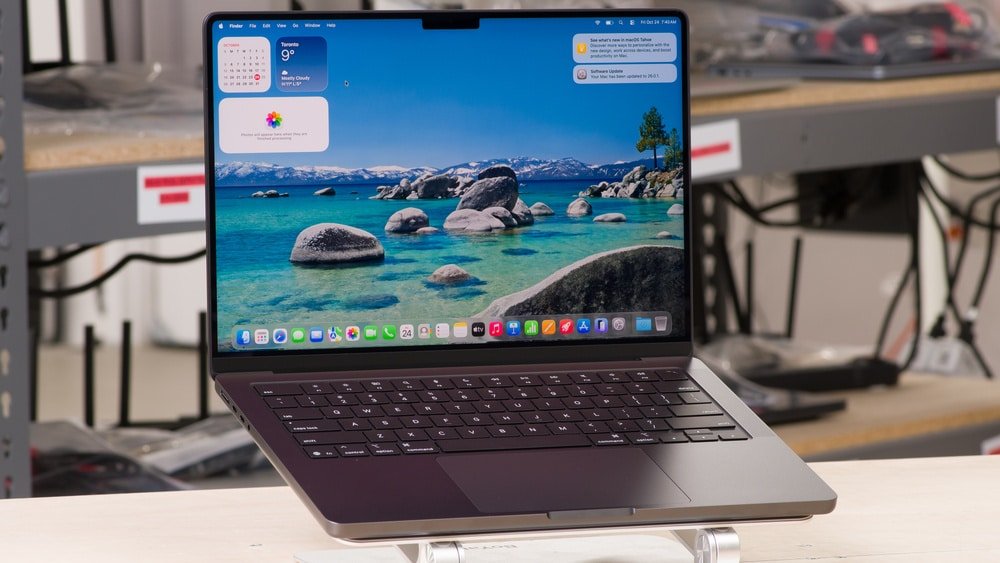
Apple has launched the new 14-inch and 16-inch MacBook Pro models with M5 Pro and M5 Max chips. These laptops deliver enhanced performance and advanced AI capabilities. The new CPU features what Apple describes as the world’s fastest CPU core. The GPU now integrates a Neura core l Accelerator in each, along with increased Unified Memory Bandwidth. This delivers up to 4x the AI performance of the previous generation and up to 8x for ML models. These enhancements enable developers, researchers, business professionals, and creatives to leverage AI-driven workflows directly on the MacBook Pro.  
 
The laptops now have SSDs that are up to twice as fast and start with:  

  • 1 TB of storage for the M5 Pro  
  • 2 TB of storage for the M5 Max  

The new MacBook Pro also features the N1 wireless chip, which supports WiFi 7 and Bluetooth 6 for better wireless performance and reliability. Other highlights include:  

  • up to 24 hours of battery life  
  • a Liquid Retina display with Nano Texture option  
  • a range of connectivity options, including Thunderbolt 5  
  • a 12MP Center Stage camera  
  • studio-quality microphones  
  • a 6-speaker sound system  
  • Apple’s intelligence features and macOS Tahoe  

The MacBook Pro is available in Space Black and Silver, with pre-orders starting March 4 and availability beginning March 11.  

MacBook Pro with M5 Pro and M5 Max sets a new standard for Pro Laptops, now up to four times faster than the previous generation, said John Ternus, Apple’s senior vice president of hardware engineering. With Neural accelerators in the GPU, the new MacBook Pro lets professionals run advanced LLMs on the device and unlock features that other laptops can’t match, all while keeping great battery life with faster unified memory and storage. Users can do even more with their work, opening new possibilities and expanding what’s possible.  

Outstanding Performance With M5 Pro And M5 Max 

The M5 Pro and M5 Max chips use Apple’s new Fusion architecture, designed specifically for AI. This approach combines two dies into a single system-on-a-chip, yielding significant performance gains. Both chips have a new CPU with up to 18 cores, including six super-cores featuring the world’s fastest CPU core and 12 new performance cores. This setup is optimized for power-efficient multi-threaded professional tasks and delivers up to 30% faster performance. The M5 Pro is ideal for users with complex workflows, such as coders working on algorithms or photographers managing large image libraries. The M5 Max is built for those who need maximum power, such as engineers running demanding simulations.  

The M5 Pro and M5 Max scale up performance from M5 and use the same advanced GPU design. Each core has a Neural Accelerator. LLM prompt execution is up to four times faster than on M4 Pro and M4 Max. This lets researchers and developers train custom models locally. Creative professionals can use AI-powered tools for editing, music, and design. Both chips also bring up to 50% more graphics performance than M4 Pro and M4 Max. Motion designers can work with complex 3D scenes in real-time. VFX artists can preview effects instantly. The neural engine is now faster and more efficient. Unified memory bandwidth is also higher, enabling advanced workflows such as intensive AI model training and massive video projects. M5 Pro supports up to 64 GB of unified memory and up to 307 GB/s bandwidth. M5 Max supports up to 128 GB of memory and up to 614 GB/s bandwidth.  

The 14 and 16-inch MacBook Pro models with M5 offer:  

  • AI image generation is up to 7.8 times faster than on a MacBook Pro with M1 Pro and up to 3.7 times faster than on a MacBook Pro with M14 Pro.  
  • LLM prompt execution is up to 6.9 times faster than on a MacBook Pro with M1 Pro and up to 3.9 times faster than on a MacBook Pro with M4 Pro.  
  • 3D rendering in Maxon Redshift is up to 5.2 times faster on a MacBook Pro with M1 Pro and up to 1.4 times faster on a MacBook Pro with M4 Pro.  
  • Gaming performance with Ray Tracing in titles like Cyberpunk 2077 Ultimate Edition is up to 1.6 times faster than on a MacBook Pro with M4 Pro.  

The 14 and 16-inch MacBook Pro models with M5 Max offer:  

  • AI image generation is up to 8x faster on the MacBook Pro with M1 Max and up to 3.8x faster on the MacBook Pro with M5 Pro Max.  
  • LLM prompt execution is up to 6.7 times faster than on a MacBook Pro with M1 Max and up to 4 times faster than on a MacBook Pro with M4 Max.  
  • Video effects rendering in Blackmagic DaVinci Resolve Studio is up to 5.4 times faster than on a MacBook Pro with M1 Max and up to 3 times faster than a MacBook Pro with M5 Max.  
  • AI video enhancement in Topaz Video is up to 3.5x faster than on a MacBook Pro with M4 Max.  

Improved Storage Speed and Longer Standard Storage 

The new MacBook Pro achieves up to double the read and write speeds of the previous generation, reaching up to 14.5 GB/s in storage benchmarks. This speed assists professionals handling 4K and 8K video content and large data sets. The M5 Pro includes 1 TB of storage, the M5 Max offers 2 TB, and the 14-inch M5 starts at 1 TB.  

More Reasons To Upgrade 

Upgrade now to the new 14 and 16-inch MacBook Pro with M5 Pro or M5 Max for a serious performance boost over older MacBook Pro models, whether you have Apple Silicon or Intel.  

  • With neural accelerators in the GPU, users upgrading from M1 models will see up to eight times faster AI performance in benchmark workloads.  
  • Exceptional Battery Life: The new MacBook Pro delivers up to 24 hours of battery life, giving Intel-based upgraders up to 13 additional hours and users coming from M1 models up to 3 more hours, so they can get more done on a single charge. Unlike many PC laptops, the MacBook Pro delivers the same incredible performance whether plugged in or running on battery power. Users will be able to fast-charge up to 50% in just 30 minutes with a USB-C power adapter rated at 96 W or higher.  
  • Upgraders will enjoy the Liquid Retina Pro Display, which offers 1600 nits of peak HDR brightness, up to 1000 nits for HDR content, and a Nano Texture option. The new MacBook Pro offers a range of connectivity options, including: three Thunderbolt 5 ports for fast data transfer, HDMI with support for up to 8K resolution, an SDXC card slot for quick media input, MagSafe 3 for fast charging with M5 Pro, You can connect up to two high-resolution external displays, each with M5, up to 4, giving you the flexibility to set up a larger workspace.  
  • Thanks to the Apple M1 chip, Wi-Fi 7, and Bluetooth 6, you get better performance and more reliable wireless connections.  
  • The new MacBook Pro features a 12MP Center Stage camera with desk-view support and studio-quality microphones, so you’ll look and sound your best on calls. You’ll also enjoy an immersive six-speaker sound system with special audio support.  

An Outstanding Experience With macOS Tahoe 

MacOS Tahoe brings new features to MacBook Pro that boost productivity :   

  • Spotlight now makes it easier to find apps and files and take action right from the search bar.  
  • Apple’s intelligence is more powerful and better protects your privacy.  
  • Shortcuts are smarter, letting you use Apple intelligence models directly.  
  • Live translation built into messages, FaceTime, and the phone app helps you communicate across languages by translating text and audio.  
  • Developers can add Apple intelligence features to their apps or use the core models framework for on-device intelligence tasks.  
  • Continuity features include the phone app on Mac, which lets you relay calls from your phone and live activities from your iPhone so you can keep up with live updates.  
  • macOS Tahoe also introduces a new design with Liquid Retina and more ways to personalize your Mac, including an updated Control Center with new color options for folders, app icons, and widgets.  

MacBook Pro And The Environment 

The MacBook Pro was designed with the environment in mind and helps Apple move closer to its goal of being carbon-neutral by 2030. It uses 45% recycled materials, including 100% recycled aluminum for the enclosure and 100% recycled cobalt for the battery. Half of the electricity used in its manufacturing comes from renewable sources, including wind and solar.  

The new MacBook Pro is built to last, is easier to repair, and offers strong software support, all while meeting Apple’s standard energy efficiency and safer materials. Its packaging is made entirely from fiber and is easily recyclable.

Source: Apple introduces MacBook Pro with all‑new M5 Pro and M5 Max, delivering breakthrough pro performance and next-level on-device AI

We are acquiring Promptfoo, an AI security platform enabling businesses to identify and address vulnerabilities in their AI systems during development.  

As companies start using AI co-workers in daily work, evaluation, security, and compliance are essential. Businesses need reliable ways to test agent behavior, spot risks before launch, and help clear records for supervision and accountability.  

Led by Ian Webster and Michael DeAngelo, the Promptfoo team has built strong tools. More than 25% of Fortune 500 companies use them. The company also offers a popular open source CLI and library for testing LLM applications. We will continue investing in and supporting the open-source project. Ongoing updates and community involvement will continue. We will also partner to improve enterprise features in Frontier.  

Promptfoo brings engineering to the evaluation, security, and testing of AI systems at scale. Their work helps businesses deploy secure and reliable AI applications. We look forward to integrating these capabilities into Frontier.  

Srinivas Narayan, CTO of B2B Applications, OpenAI  

We plan to expand multiple key features for businesses building agents on Frontier.  

  • Security and safety testing will be built into Frontier. Automated checks will look for risks like prompt injections, jailbreaks, data leaks, tool misuse, and policy violations.  
  • Security and evaluation will be part of the development process. Frontier will work with workflows to quickly spot, investigate, and fix agent risks. Security will be a key part of building and running enterprise AI systems.  
  • Frontier will include built-in reporting and traceability for documentation monitoring and compliance.  

Promptfoo was created to provide developers with practical advice on securing AI systems. This is important as agents connect to real data and systems. Ensuring their security and validation is more important than ever. By joining OpenAI, we aim to accelerate this mission. We plan to bring advanced security, safety, and governance features to teams building AI systems.  

Ian Webster, Co-Founder and CEO, Promptfoo  

We are excited to become the Promptfoo team. We will keep building the secure, reliable AI tools businesses need.

Source: OpenAI to acquire Promptfoo 

HP has released a high-priority security notice for enterprise administrators and IT managers regarding CVE-2025-31648, a firmware vulnerability affecting many Intel-based workstations. This issue is found in the Intel processor microcode and could allow attackers to gain higher access rights in certain situations.  

As of March 2026, HP launched the final and urgent remediation phase for business-class workstation fleets, including the Zed by HP and Elite series. This alert stresses the need for prompt action and outlines fleet-wide remediation procedures.  

Technical Summary: CVE-2025-31648 

The vulnerability results from improper handling of values in processor microcode during critical system operations. It manifests when the system startup code interfaces with System Management Mode (SMM), a privileged hardware-controlled environment.  

Intel rates the base severity as low due to the attack’s complexity; nonetheless, the risk is grave for secure environments. Failing to act promptly may leave systems exposed: an attacker with privileged local access and deep knowledge of microcode could bypass normal security limits because this is a firmware-level vulnerability. Standard OS-based endpoint detection and response tools cannot detect it.  

Affected HP Workstation Platforms 

HP’s Security Advisory confirms that the vulnerability impacts several generations of Intel-based hardware currently deployed in enterprise fleets:  

  • Z by HP Workstations: Models Spanning the G8, G9, and the Latest G11generations, (including Z2, Z4, Z6, and Z8 Towers).  
  • Elite book and elite desktop series Conover business class systems utilizing 12th through 14th gen Intel Core processors  
  • HPE SimpliVity and ProLiant nodes: certain workstation adjacent server nodes used in Edge compute environments  

The Resolution: Firmware And Microcode Updates 

HPE is fixing CVE-2025-3164A by releasing BIOS and UEFI firmware updates that will include the latest Intel Platform Update (IPU/2026.1) microcode.  

Fleet administrators must follow these steps to resolve the issues:  

Utilize HP Client Management Script Library (CMSL) or Microsoft Endpoint Configuration Manager to audit BIOS versions across the fleet.  

  1. Acquire SoftPaqs: HP has released specific SoftPaq bundles for each affected model. These are available via the HPE Support Site or HPE Image Assistant Tool.  
  1. Validate the Microcode revision after updating. Verify that the Microcode version meets the requirements outlined in Intel Advisory Intel SA-01399.6.  

Strategic Mitigation for Fleets 

In addition to applying immediate patches, HPE strongly urges reinforcing workstation security by enabling these hardware-based features without delay.  

  • Enable HP Sure Start: Ensure the self-healing BIOS feature is enabled to protect against unauthorized firmware changes during updates.  
  • Strict Local Privilege: Because the attack requires a privileged user, enforce a strict least-privileged model at the operating system level to help prevent such attacks.  
  • Implement Secure Boot: Check that UEFI Secure Boot is enabled to keep the system secure from start-up through operating system launch.  

Conclusion:  

Although CVE-2025-31648 is difficult to exploit, it represents a serious breach of hardware trust. Organizations with large workstation fleets must act without delay and update to the February or March 2026 firmware versions. Immediate updates are essential to maintaining long-term system security. 

Source: Intel Processor Firmware February 2026 Security Update 

Intel Xeon 6 processors, formerly known as Sapphire Rapids, are architected with enhanced security as a primary design objective. Each single-socket (1S) processor features 136 PCIe 5.0 lanes, surpassing the typical 128 lanes available in competing solutions. The 6700P and 6500P series, introduced in early 2025, target compute-intensive workloads, AI operations, and high-performance computing environments in U.S. research laboratories and enterprise data centers.  

Main Security and Performance Features 

  • Security against firmware and update processes: the platforms integrate seamless firmware update (SFU), enabling updates without system reboots and minimizing operational disruption. Security capabilities include Intel Trusted Domain Extensions (TDX) for Confidential Computing and Software Guard Extensions (SGX).  
  • Optimized High Speed I/O: with 136 PCIe 5.0 lanes on single-socket designs, these processors develop a 6% increase in I/O capacity relative to competing products, supporting enhanced connectivity for NVMe storage, network interfaces, and hardware accelerators.  
  • Integrated AI acceleration: Intel Advanced Matrix Extensions (AMX) support up to 2048 FLOPS for INT8 precision and 1024 FLOPS for BF16/FP16 workloads. This integration optimizes the process of our AI-driven security network analytics and anomaly detection workloads.  
  • Performance and memory bandwidth: The processors support DDR5 at 6400 MT/s and multiplexed rank (MCR) DDR5, offering over 37% higher memory bandwidth than standard RDIMMs.  
  • Self-boot capabilities: Intel Xeon 6 processors can boot independently without a platform controller hub (PCH), enabling an autonomous CPU boot process.  

In research environments, these enhancements deliver significant gains in AI storage performance and in high-throughput, low-latency workloads, utilizing up to 128 cores per socket.  

Telsium 6 processors feature a flexible dual-architecture design with P-cores for chaining tasks and E-cores for scalable, high-density workloads on the same platform. Choose up to 288 E-cores for strong performance per Watt in cloud-native applications, or high core count, high-frequency P-cores for AI and high-performance computing. This architecture separates tasks to optimize both performance and efficiency, delivering up to two to three times better results.  

Intel Xeon 6 P-cores (Performance-cores) 

Intel Xeon 6 processors with P-cores deliver strong performance per core, with more cores, double memory bandwidth, and AI acceleration in every core, offering twice the performance for AI and HPC tasks. These processors outperform general-purpose CPUs on compute-intensive workloads such as AI inference and ML. They are also well-suited for public cloud workloads, with better performance per vCPU for floating-point operations, transactional databases, and HPC with AI inferencing. Intel Xeon remains a top choice for data processing on leading AI accelerator platforms.  

  • AI acceleration is built into every core. Intel AMX boosts inferencing for several model types, letting each core handle up to 2048 floating-point operations per cycle for INT8 and 1024 for BF16 or FP16.  
  • You can increase memory throughput with MRDIMM, which delivers over 37% more bandwidth than RDIMM and reaches up to 8,800 MT/s. Both core types also support DDR5-6400 high-speed memory.  
  • You can use up to 128 cores per socket and up to 504 MB L3 cache with low latency. Intel AVX-512 is available with P-cores to accelerate vector math for HPC and AI workloads.  

Intel Xeon 6 E-Core (Efficient-Cores) 

Intel Xeon 6 processors with Efficient cores are designed for high core density and strong performance per watt. They are especially useful for cloud-scale workloads that need high task-parallel throughput, compared to the second-generation Intel Xeon Scalable processors, which are common in today’s data centers and are good candidates for performance-per-watt upgrades. Intel Xeon 6 processors with e-cores can deliver over 2.6 times better performance per watt. Their efficiency also makes them a good fit for settings with limited power, space, or cooling. Intel Xeon 6 processors with E-Cores can:  

  • Replace 4 servers based on second-gen Intel Xeon scalable processors with just one server while keeping similar performance.  
  • Combine three racks of systems with second-gen Intel Xeon Scalable processors into a single rack.  
  • Support AI inferencing (making predictions using trained AI models) and vector operations using Intel Advanced Vector Extensions (Intel AVX-512), as well as new features like Vector Neural Network Instructions (VNNI, which help optimize AI tasks) and fast convert functionality for lower precision number formats BF16 and FP16.  
  • Provide up to 288 cores per socket, up to 216 MB of L3 cache, and very low latency even with large L3 access sizes.  

Shared Architecture Features 

Compatibility: Both types use the same platform and socket, enabling flexible infrastructure.  

AI acceleration: both have built-in acceleration using Intel Advanced Vector Extensions instructions that improve data processing for AI and Intel Advanced Matrix Extensions/Vector Neural Network instructions (AMX/VNNI, which optimize complex AI computations).  

Security: Both offer advanced security features, such as Intel TDX, for confidentiality. Intel Xeon 6 processors with p-cores and e-cores are efficient because they deliver scalable performance per workload as server workloads increase, with almost linear power and performance across a wide range of workloads. For intensive workloads, this means power is used efficiently to finish tasks faster in cloud or shared computing environments. This efficiency level means servers use only the power they need when busy, helping lower costs when they are not fully used. These processors also support sustainability through system-wide power management and telemetry, which help improve performance per watt in each application and reduce overall energy consumption.  

Source: Intel® Xeon® 6 Architecture – Performance and Efficiency Cores

AMD’s latest ROCm update adds support for new Ryzen APUs and enhances local AI features.  

This consistent progress in ROCm improvements demonstrates how local AI deployment is rapidly gaining power.  

These software advances stem from AMD’s focused efforts over recent years to improve the ROCm stack, particularly for Edge AI. At CES2026, for example, AMD introduced ROCm 7.2.7, which supports the new Ryzen AI 400 Gorgon Point APUs. Building on this, the company has also improved local model performance, which we’ll cover soon.  

In addition to these hardware advances, AMD has prioritized seamless ROCm integration with tools like Comfy UI, an image generation tool that delivers a 5-fold performance increase in ROCm 7. The company has also expanded ROCm support for consumer products, effectively doubling Ryzen and Radeon compatibility over the past year. Together, these moves illustrate how AMD’s software strategy aligns with its consumer objectives.  

Reflecting this increased user base, AMD has introduced smooth integration with the ONNX path for inference and training, targeting Windows AI users and OEMs. Additionally, ROCm is now compatible with PyTorch on Windows, and the Rock software package, an open-source platform from HIP and ROCm. Through these steps, Windows is becoming a key platform for ROCm as AMD drives local AI adoption into the mainstream.  

These technical and strategic improvements now enable local AI inference on consumer hardware to nearly match the quality of cloud-based models. For instance, AMD compared open-source models like GPT running on Ryzen AI Max Plus APUs against cloud-based counterparts. According to AMD, results show that for benchmarks similar to GPQA Diamond and MMLU, local and cloud performances are largely comparable, highlighting how much edge AI has improved through ROCm and new hardware capabilities.  

Source: AMD ROCm 7.2.2 Adds Support for Ryzen AI 400 CPUs & Unlocks Faster Local Inference Performance